ExpatAdminHubEuropean expat guide
FR
Menu▾
HomePrivacyCookiesAboutContact
All guidesPreparationHousingFinanceHealthcareWorkFamily
ExpatAdminHubEuropean expat guide
HomePrivacyCookiesAboutContact
Categories
All guidesPreparation (checklists, visas, moving)Housing (rentals, utilities, neighborhoods)Finance (banking, taxes, budgeting)Healthcare (insurance, doctors, pharmacies)Work (jobs, contracts, work permits)Family (schools, childcare, family life)Culture (language, customs, integration)
FR

ExpatAdminHub

Practical guides for European expats navigating admin, housing, healthcare, and everyday life abroad.

Navigation

HomeAboutContactPrivacyTermsSitemap

Stay Updated

1 tip per week, no spam.

© 2026 ExpatAdminHub · European expat guide.
FR

Housing

rentals, utilities, neighborhoods

Short-Term Rental in France 2026: Meublé de Tourisme Obligations for Hosts
Housing · 27 June 2026

Short-Term Rental in France 2026: Meublé de Tourisme Obligations for Hosts

Letting a furnished place on Airbnb, Booking or directly as a meublé de tourisme in France is no longer a grey-area side hustle — since the loi Le Meur (law no. 2024-1039 of 19 November 2024) it sits inside a tightening compliance frame: a registration number, a night cap on your primary residence, an energy-performance floor, a SIRET, the right micro-BIC bracket, and the taxe de séjour. Get one of those wrong and you risk a fine, a delisting, or a requalified tax position. This guide lays out, in plain English, exactly which obligations apply to a short-term host in 2026, where the rules changed, and how to check your own situation before your next booking. It is written for the individual host — an expat renting a second flat, a primary-residence owner letting a spare room or the whole place while away — not for professional operators or hotels. It is general information, not legal or tax advice.

Read the article
Tenant Rights in France: Deposit, Repairs & the Written Proof That Wins Disputes
Housing · 08 Jun 2026

Tenant Rights in France: Deposit, Repairs & the Written Proof That Wins Disputes

If you rent in France, three searches probably brought you here: "landlord won't return deposit France", "how to force my landlord to do repairs", or "my landlord is ignoring my move-out notice." These are the most common — and most stressful — tenancy disputes, and they all share one quiet truth: the tenant who has a dated, written, provable record almost always wins. French rental law (the Loi n°89-462 du 6 juillet 1989) is genuinely protective of tenants, but the law only helps you if you can prove what happened and when. As a non-French-speaking expat, that paper trail matters even more — a clear, traceable record of every request closes the door on "I never received that" and "you never asked." This guide walks through getting your dépôt de garantie back, forcing repairs your landlord is dodging, giving notice correctly, and using the état des lieux as evidence — and shows the simplest way to keep all of it in one provable place.

Read the article
Rent by AdminLanding: Big 2026 Update for French Landlords
Housing · 08 Jun 2026

Rent by AdminLanding: Big 2026 Update for French Landlords

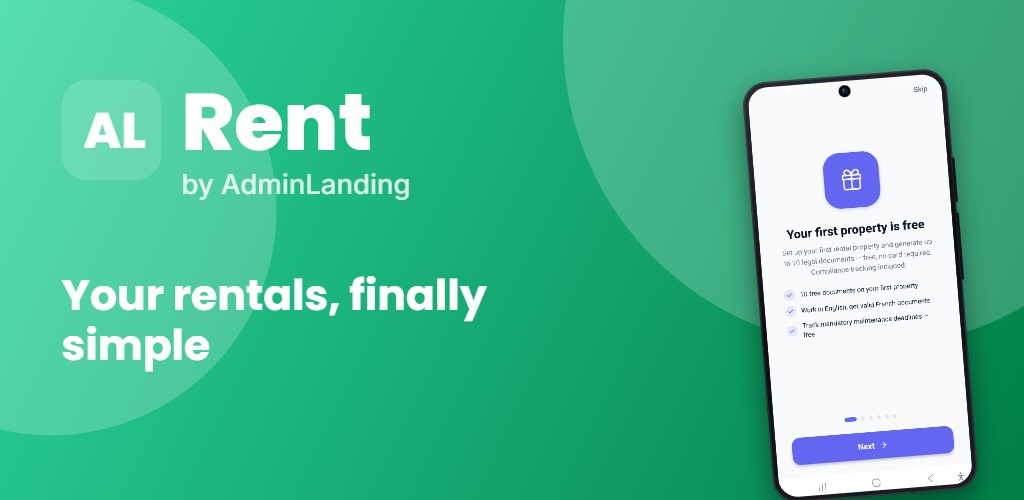
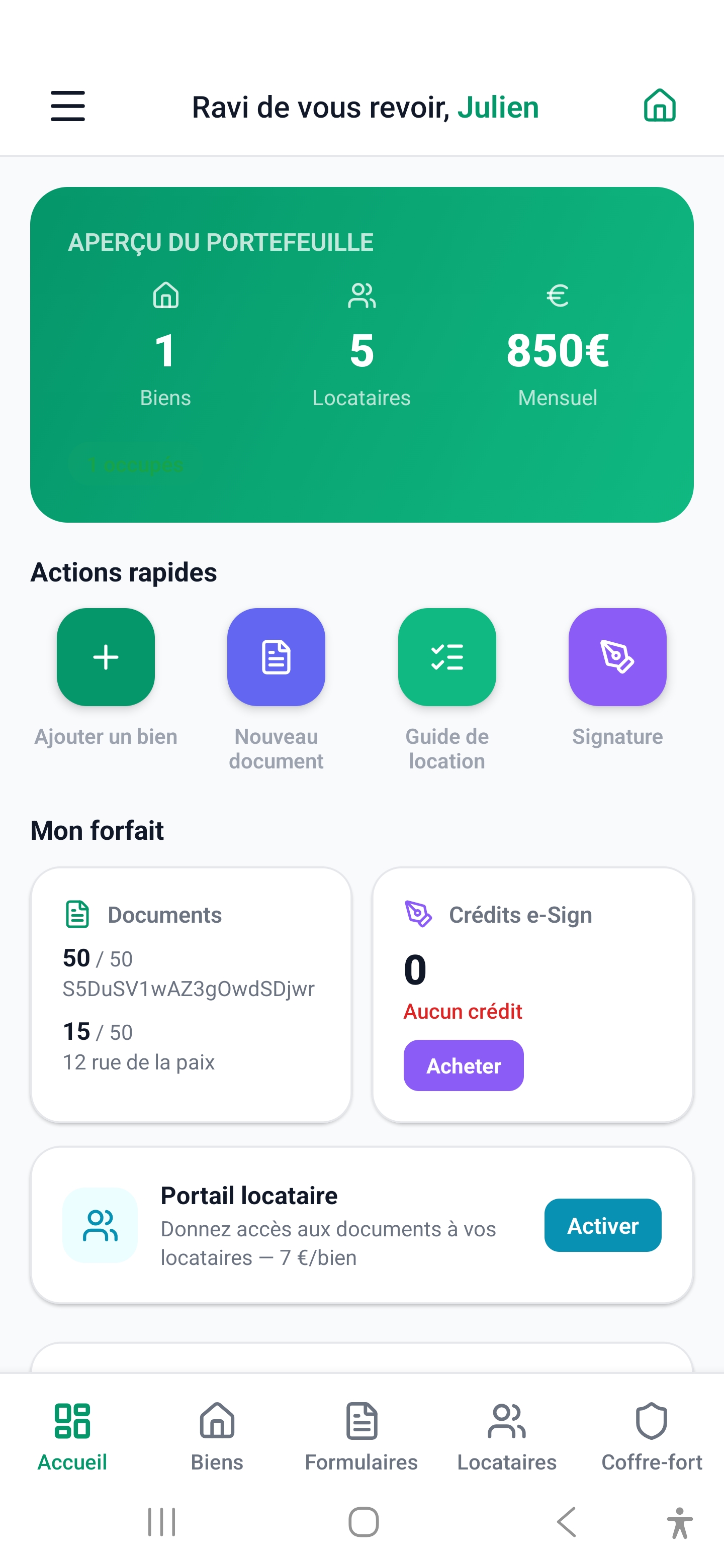
If you own a flat or house in France and you do the paperwork yourself — often from another country — you already know the real work isn't the rent, it's the bail, the monthly quittance de loyer, the état des lieux, the deposit, and the slow drip of compliance deadlines nobody reminds you about. Rent by AdminLanding (store name Rent — Lease & Short-Term in English, Rent — Bail & Courte Durée in French) just shipped its biggest update yet across both its mobile apps (iPhone + Android) and its web back-office at adminlanding.com — and the headline for non-resident and expat landlords is simple: you can now run a French rental end-to-end — long-term lease or short-term / Airbnb (meublé de tourisme) — in English or French, from a phone in London or a laptop in New York, without paying an agency 6–10% to do it for you. The two standout additions: a per-property compliance check that scores every legal obligation (DPE letting-ban, diagnostics, SIRET, short-term registration, taxe de séjour) at a glance, and a "which document do I need?" finder that maps your situation to the right one of 23 templates. This is a what's-new guide: what the update added, what each surface now does, and what it costs (the first property is free).

Read the article
Non-Resident Landlord French Rental Tax: The 2026 Declaration Guide (2044 / 2042)
Housing · 15 May 2026

Non-Resident Landlord French Rental Tax: The 2026 Declaration Guide (2044 / 2042)

If you live abroad and rent out a property in France, France taxes that rental income — wherever you are tax-resident. The rules that trip up non-resident landlords are specific: which form to file, the 20% minimum rate, the social-levy rate that depends on your health-insurance country, and the tax treaty that stops you being taxed twice. This guide walks through the 2026 declaration end to end, for unfurnished rentals taxed as revenus fonciers. (Furnished rentals follow the separate [LMNP/BIC rules](/en/blog/2026-05-13-lmnp-furnished-rental-tax-micro-bic-vs-reel-guide).)

Read the article
LMNP Furnished Rental Tax 2026: Micro-BIC vs Régime Réel Explained
Housing · 13 May 2026

LMNP Furnished Rental Tax 2026: Micro-BIC vs Régime Réel Explained

Rent out a furnished property in France and your income is not revenus fonciers — it is BIC (industrial and commercial profit), under the LMNP regime. That single difference changes everything: the allowances, the ability to deduct depreciation, and even how your eventual sale is taxed after the 2025 reform. Here is how LMNP works in 2026, the micro-BIC vs régime réel choice that decides your tax bill, and the recent rule changes every furnished landlord should know.

Read the article
Best Rental Management Apps for French Landlords in 2026
Housing · 11 May 2026

Best Rental Management Apps for French Landlords in 2026

If you rent out property in France in 2026, the choice of rental-management software is no longer between spreadsheet and agency. Six SaaS products now hold the bulk of the French independent-landlord market — Rentila (≈50,000 landlords), BailFacile, GérerSeul, Hestia Software, Smartloc and Smovin — alongside Rent — Lease & Short-Term, which is native on both Android and iOS, bilingual FR/EN, and — new in 2026 — covers both long-term leases and short-term / meublé de tourisme letting, with a per-property compliance check built in. They differ on what they treat as the unit of work (the property, the lease, the document, the calendar). They differ on language (most are French-only). They differ on what they ship for the tenant side (Rentila, BailFacile and Hestia offer a web tenant portal; others rely on email PDFs). This guide compares the seven that matter, applied to the situation that defines this audience: an expat or non-resident landlord with one to five properties who needs ALUR-compliant paperwork done at distance without paying 6–10% to a mandataire de gestion.

Read the article
Furnished or Unfurnished? The Tax & Lease Decision for Foreign French Property Owners (2026)
Housing · 04 May 2026

Furnished or Unfurnished? The Tax & Lease Decision for Foreign French Property Owners (2026)

Most foreign owners of French rental property face the furnished-versus-unfurnished question once and resolve it from intuition: furnished feels easier ("I can keep my own things in there"), unfurnished feels more committed. The tax and lease consequences of that intuition are larger than most owners realise, and they cut in opposite directions. Furnished sits under the BIC regime (Bénéfices Industriels et Commerciaux) with the LMNP statute — a commercial-income tax frame that allows building amortissement large enough to drive taxable rental income close to zero in the early years. Unfurnished sits under revenus fonciers with simpler accounting but no amortissement, and a 3-year lease with a more stable tenant. The choice is irreversible only in one direction (opting out of micro-foncier into régime réel binds you for 3 years; the reverse is automatic). This guide walks through the tax math, the lease-duration trade-off and the operational footprint each path produces, framed for foreign owners specifically — where the choice is made remotely, often without a French accountant, and where the wrong default can cost meaningful tax efficiency every year for the life of the lease.

Read the article
Managing a French Rental Property from Abroad: Mandataire vs DIY in 2026
Housing · 03 May 2026

Managing a French Rental Property from Abroad: Mandataire vs DIY in 2026

If you own a French rental property and don't live in France, every operational decision splits two ways: hire a mandataire de gestion (a regulated French property manager) and pay a percentage of every month's rent for the rest of the lease, or run the property yourself from another country and design around the time-zone, language and signature constraints that come with it. Both work in 2026 — French law has become materially friendlier to the at-distance landlord since the eIDAS regulation (EU 910/2014) made qualified electronic signatures legally equivalent to wet ink, since the lettre recommandée électronique (Décret n° 2018-347 of 9 May 2018) replaced the post-office trip for most legal notices, and since the digital lease and digital état des lieux became routine practice. This guide compares the two paths, walks through the legal infrastructure that makes DIY feasible, and shows where the work actually happens day-to-day for non-resident landlords.

Read the article
Becoming a French Landlord as a Non-Resident: First-Year Tax & Admin Setup (2026)
Housing · 02 May 2026

Becoming a French Landlord as a Non-Resident: First-Year Tax & Admin Setup (2026)

Owning a rental property in France while living outside it puts you in the most-misunderstood corner of the [French tax system](/en/blog/2026-04-19-declaration-revenus-france-expats-guide-2026). The rental income is French-source, which means France taxes it regardless of where you live (Article 164 B of the Code Général des Impôts). But you are a non-résident fiscal — and that single status changes which tax office you write to, which forms you file, the minimum rate applied to your French income, whether 17.2% in social contributions also apply, and whether you need a fiscal representative. This guide walks foreign-national French property owners through the first-year setup: who you are in the eyes of the FISC, where to register, what you'll file every May, and the specific traps that trip up first-time non-resident landlords. Sources at every step are official: legifrance, impots.gouv.fr, the Bulletin Officiel des Finances Publiques (BOFiP), and ANIL.

Read the article
CAF Registration in France: Complete Guide to Housing Aid (APL, ALF, ALS) for Expats (2026)
Housing · 26 Apr 2026

CAF Registration in France: Complete Guide to Housing Aid (APL, ALF, ALS) for Expats (2026)

The Caisse d'Allocations Familiales (CAF) administers three housing-aid schemes — APL (aide personnalisée au logement), ALF (allocation de logement familiale), and ALS (allocation de logement sociale) — covering roughly 6 million households in France, with eligibility now based on income calculated on a rolling 12-month window since the 2021 reform (revenus contemporains). For an expat just arrived, the picture rarely starts that clean. Which of the three aids applies depends on whether your dwelling is conventionné with the State, on your family composition, and on whether anyone else in the household qualifies for family benefits. Eligibility also requires a stable and regular residence in France, a valid titre de séjour for non-EU nationals, a décent dwelling that meets minimum surface and energy criteria, and an online dossier on caf.fr. The first payment lands roughly 6 to 8 weeks after the application is validated — and only after a one-month carence during which no aid is paid. This guide walks through which aid applies to your situation, what documents CAF actually asks for, how the espace allocataire works, and the mistakes that delay or kill applications. Read this before signing the lease whenever possible.

Read the article
État des Lieux in France: Complete Guide to Move-In and Move-Out Property Inspections (2026)
Housing · 19 Apr 2026

État des Lieux in France: Complete Guide to Move-In and Move-Out Property Inspections (2026)

The état des lieux is the single most important — and most frequently skipped — document in a French tenancy. Far from a formality, it is a legally mandatory inventory under the Loi ALUR (Loi n°2014-366 du 24 mars 2014) and Article 3-2 of the Loi n°89-462 du 6 juillet 1989. Skipped, rushed, or badly drafted, it is the single clearest predictor of a dispute at the end of the lease: tenants lose their dépôt de garantie because they cannot prove the property's initial condition; landlords lose their right to any deduction because they cannot prove deterioration. Two inspections are required — an état des lieux d'entrée at move-in and an état des lieux de sortie at move-out — and both must be signed by both parties, or carried out by a huissier de justice if either refuses. This guide walks through the legal framework, the mandatory contents, how to conduct each inspection properly, and what to do when things go wrong.

Read the article
Quittance de Loyer: Free Template & Legal Requirements in France (2026)
Housing · 11 Apr 2026

Quittance de Loyer: Free Template & Legal Requirements in France (2026)

The quittance de loyer (rent receipt) is one of the most important recurring documents in a French tenancy. Far from a mere courtesy, it is a legal obligation for landlords under Article 21 of the Loi n°89-462 du 6 juillet 1989. For tenants — especially expats — it serves as the primary justificatif de domicile (proof of address) for virtually every administrative procedure in France: opening a bank account, applying for a titre de séjour, registering with the [CAF](/en/blog/2026-04-26-caf-registration-housing-aid-france-expats), or enrolling children in school. This guide covers everything landlords and tenants need to know about quittances in 2026, including legal requirements, required content, electronic delivery rules, and common pitfalls.

Read the article
French Bail (Lease Contract): Complete Legal Guide for Tenants and Landlords
Housing · 01 Apr 2026

French Bail (Lease Contract): Complete Legal Guide for Tenants and Landlords

The bail de location is the cornerstone of every rental relationship in France. Governed primarily by the Loi n°89-462 du 6 juillet 1989 (for unfurnished) and the Loi ALUR of 2014, it defines the rights and obligations of both landlord and tenant for the entire duration of the tenancy. Whether you are renting your first apartment in France or letting a property, this guide covers every clause that matters.

Read the article
Quittance de Loyer: Landlord Obligations and How to Generate Rent Receipts in France
Housing · 29 Mar 2026

Quittance de Loyer: Landlord Obligations and How to Generate Rent Receipts in France

In France, landlords are legally required to provide a [quittance de loyer](/en/blog/2026-04-11-quittance-de-loyer-free-template-legal-guide) (rent receipt) to any tenant who requests one. Whether you are a landlord managing a property or an expat tenant who needs proof of rent payment, understanding this obligation is essential — non-compliance can have legal consequences.

Read the article
Renovate Now or Wait? The Energy Renovation Timing Trap Facing European Households
Housing · 28 Dec 2025

Renovate Now or Wait? The Energy Renovation Timing Trap Facing European Households

Across Europe, millions of households are asking the same question: should we renovate now — or wait for better subsidies, clearer rules, or lower prices? This hesitation feels rational. In reality, it often leads to higher costs, missed incentives, and rushed decisions later. This article explains the hidden timing trap behind energy renovation.

Read the article
European Housing 2025: Rent Caps, New Tenant Rights & Digital Contracts — The Essential Expat Guide
Housing · 07 Dec 2025

European Housing 2025: Rent Caps, New Tenant Rights & Digital Contracts — The Essential Expat Guide

Europe’s rental market is hitting a historic turning point. With soaring rents, massive post-COVID relocations, remote work shifting demand, and housing shortages in several countries, the EU and national governments have accelerated reforms. The result: 2025 is a decisive year for expats. New rent caps are spreading, tenant rights are expanding, governments are inspecting quality more aggressively, and a silent revolution is underway: the digitalisation of rental contracts. This long-form guide—written for expats navigating unfamiliar systems—explains what’s changing, how to prepare, and how to avoid the administrative traps of renting in a country you’re still learning to decode.

Read the article
The 2025–2026 Expat Housing Shock: Why Rents Are Surging in Europe — and How to Protect Yourself
Housing · 26 Nov 2025

The 2025–2026 Expat Housing Shock: Why Rents Are Surging in Europe — and How to Protect Yourself

Berlin, Madrid, Lisbon, Paris, Amsterdam… everyone is saying it: rents are out of control. For expats, pressure is even higher with international competition and stricter paperwork. This 2025–2026 guide explains the housing shock — and how to protect yourself instead of being pushed out.

Read the article
Finding English-Speaking Real-Estate Agents in France (2025): Navigating the Market Like a Pro
Housing · 15 Nov 2025

Finding English-Speaking Real-Estate Agents in France (2025): Navigating the Market Like a Pro

You land in Paris, Lyon, or Nice with one dream: a bright, affordable apartment — and someone who speaks English to guide you. Quickly, you discover the maze: incomplete listings, agencies asking for French guarantors, contracts you can't decode. But there's a method — the one seasoned expats use. In 2025, finding a reliable English-speaking agent has never been easier… if you know where to look and how to negotiate.

Read the article
Renting your first home in Europe: dossier, viewing rules, utilities and real scam shields
Housing · 08 Oct 2025

Renting your first home in Europe: dossier, viewing rules, utilities and real scam shields

Most rental mistakes happen before the viewing. Build your dossier, know the red flags, and secure utilities from day one.

Read the article