ExpatAdminHubEuropean expat guide
FR
Menu▾
HomePrivacyCookiesAboutContact
All guidesPreparationHousingFinanceHealthcareWorkFamily
ExpatAdminHubEuropean expat guide
HomePrivacyCookiesAboutContact
Categories
All guidesPreparation (checklists, visas, moving)Housing (rentals, utilities, neighborhoods)Finance (banking, taxes, budgeting)Healthcare (insurance, doctors, pharmacies)Work (jobs, contracts, work permits)Family (schools, childcare, family life)Culture (language, customs, integration)
FR

ExpatAdminHub

Practical guides for European expats navigating admin, housing, healthcare, and everyday life abroad.

Navigation

HomeAboutContactPrivacyTermsSitemap

Stay Updated

1 tip per week, no spam.

© 2026 ExpatAdminHub · European expat guide.
FR
  1. Home
  2. Blog
  3. Housing
  4. État des Lieux in France: Complete Guide to Move-In and Move-Out Property Inspections (2026)
État des Lieux in France: Complete Guide to Move-In and Move-Out Property Inspections (2026)
This article is also available in French.
Lire en français →

French rental law series

  • Non-resident landlord rental tax (2044)
  • LMNP furnished tax: micro-BIC vs réel
  • French bail lease: full guide
  • Landlord obligations: rent receipts
  • Free quittance template (legal guide)

État des Lieux in France: Complete Guide to Move-In and Move-Out Property Inspections (2026)

Published April 19, 2026·Updated April 26, 2026

The état des lieux is the single most important — and most frequently skipped — document in a French tenancy. Far from a formality, it is a legally mandatory inventory under the Loi ALUR (Loi n°2014-366 du 24 mars 2014) and Article 3-2 of the Loi n°89-462 du 6 juillet 1989. Skipped, rushed, or badly drafted, it is the single clearest predictor of a dispute at the end of the lease: tenants lose their dépôt de garantie because they cannot prove the property's initial condition; landlords lose their right to any deduction because they cannot prove deterioration. Two inspections are required — an état des lieux d'entrée at move-in and an état des lieux de sortie at move-out — and both must be signed by both parties, or carried out by a huissier de justice if either refuses. This guide walks through the legal framework, the mandatory contents, how to conduct each inspection properly, and what to do when things go wrong.

Key facts

  • An état des lieux is legally mandatory for all residential leases in France (Article 3-2, Loi n°89-462 du 6 juillet 1989, as modified by Loi ALUR 2014).
  • Two inspections: état des lieux d'entrée (move-in) and de sortie (move-out). Both must be signed by landlord and tenant — or performed by a huissier if either party refuses.
  • Without an état des lieux d'entrée, the tenant is presumed to have received the property in good condition (Article 1731, Code Civil) — very disadvantageous for the tenant.
  • Deposit return deadline: 1 month if no deductions, 2 months if deductions are made (Loi ALUR). Beyond that, the landlord owes 10% of monthly rent per month of delay.
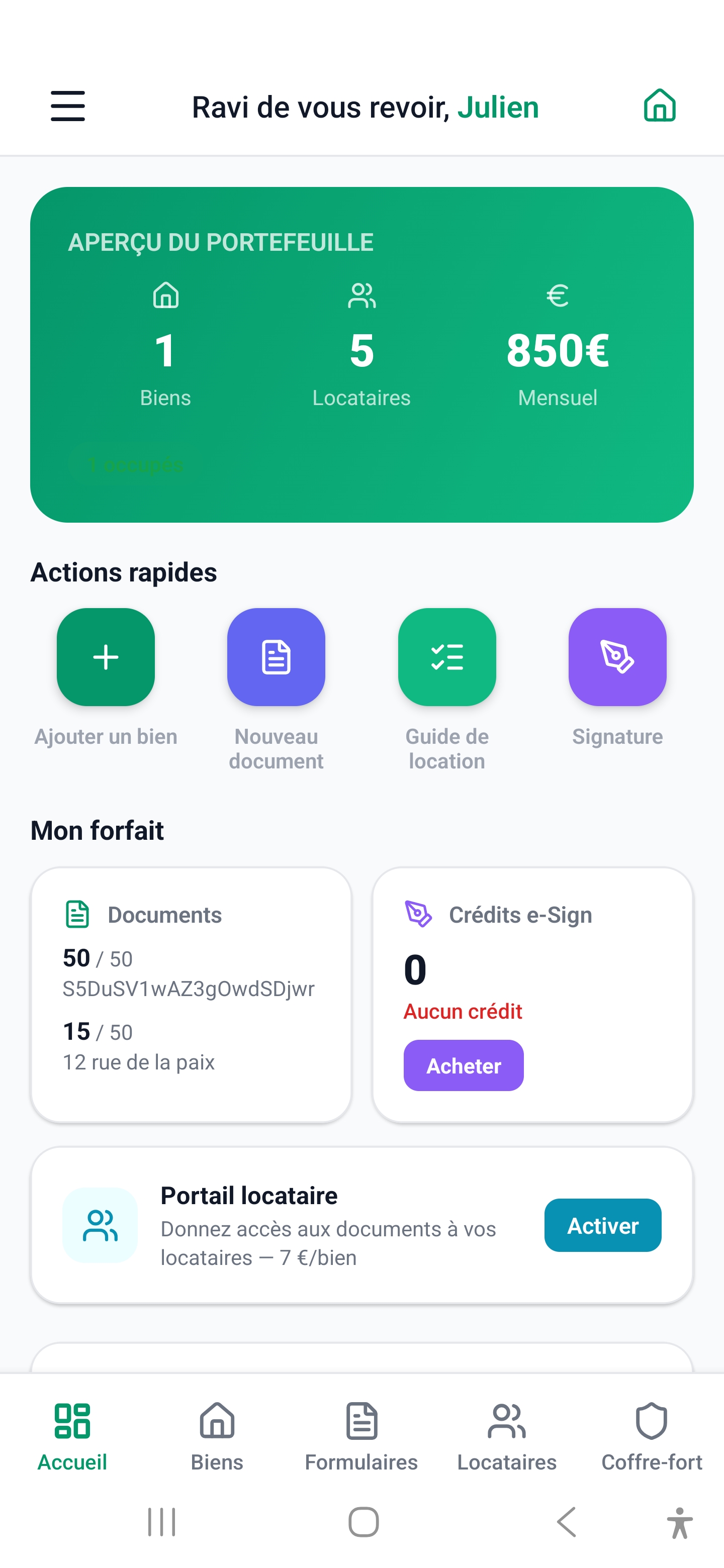
  • Digital états des lieux have full legal value since 2014. AdminLanding generates ALUR-compliant versions, and Rent — Bail, Quittance, Loyer on Google Play lets landlords complete them from their phone.

What is an état des lieux (legal definition)

An état des lieux is a written inventory describing the exact condition of a rented property at two key moments: when the tenant receives the keys (entrée) and when they hand them back (sortie). It is not a formality or a courtesy — it is a legally mandatory document under Article 3-2 of the Loi n°89-462 du 6 juillet 1989, as modified by the Loi ALUR (Loi n°2014-366 du 24 mars 2014). Since ALUR, a single standardised format applies to all residential leases, detailed by Décret n°2016-382 du 30 mars 2016.

The obligation applies to:

• Unfurnished rentals (location nue) — the main residential lease

• Furnished rentals (location meublée) — including bail mobilité and student leases

• Colocation — each co-tenant must be party to the inspection

• HLM and institutional landlords — no exemption

How it must be done:

• Contradictoire — performed together by both parties (landlord or their mandated agent, and tenant), or their appointed representatives. This is the standard method and carries the strongest evidentiary value.

• By a huissier de justice — a court-appointed bailiff establishes the inventory if one party refuses to attend or to sign, or if the parties cannot agree. The cost is split 50/50 regardless of who is at fault, with a regulated tariff (around €130–€230 depending on property size).

Two copies must be produced — one for the landlord, one for the tenant — and both copies must be annexed to the bail (rental contract). A missing or incomplete état des lieux is one of the most common reasons why deposit disputes end up before the juge des contentieux de la protection.

Entrée vs sortie — two inspections, one comparison

The entire legal mechanism of the état des lieux rests on a comparison. The état des lieux d'entrée establishes the baseline — the exact condition of every room, surface, appliance and fixture on the day the tenant receives the keys. The état des lieux de sortie records the condition on the day the keys are returned. Any difference between the two, other than what qualifies as usure normale (normal wear and tear, or vétusté), may be deducted from the tenant's dépôt de garantie.

État des lieux d'entrée:

• Performed the day the tenant takes possession (remise des clés)

• Must be attached to the bail as an annex

• The tenant has 10 days after signature to request corrections or additions (Décret 2016-382)

• For heating installations specifically, the tenant has the first month of the heating period (premier mois de chauffe) to ask for additions relating to radiators, boiler, thermostats, etc.

État des lieux de sortie:

• Performed the day the tenant hands back the keys (restitution des clés)

• Meter readings taken again — electricity, gas, water — to establish final consumption

• The landlord compares room-by-room with the entrée version

• Any deductions must be justified with invoices (devis or factures) from a professional

For reference on the underlying lease contract and deposit mechanics, see our guide to the French bail (lease contract). If you're drafting the lease itself, AdminLanding's bail generator produces a compliant contract with every Loi 1989 clause — including the état des lieux annex reference — pre-populated from your property and tenant data.

Key principle: anything visible and present at entrée that is not recorded is presumed to have been in good condition. Anything recorded at entrée as already damaged cannot later be charged to the tenant at sortie.

What must be included — mandatory mentions

The Décret n°2016-382 du 30 mars 2016 prescribes the precise content required for an état des lieux to be legally valid. Missing any of the mandatory items exposes the document to legal challenge.

Administrative header:

• Type of état des lieux — entrée or sortie (explicit mention)

• Date — the day the inspection is carried out

• Address of the property — complete address, including building, staircase, floor, and door number

• Identity and contact details of the parties — landlord (or mandated agent) and tenant (or co-tenants for colocation)

• Reference to the bail — date of signature of the rental contract

Technical readings (compteurs):

• Electricity meter — reading (index) and meter number

• Gas meter — reading and meter number, if applicable

• Water meter(s) — cold and/or hot water, with reading and meter number

• For individual sub-meters in collective buildings, each index must be recorded

Room-by-room description:

For every room (salon, cuisine, salle de bains, chambres, WC, entrée, couloir, balcon/terrasse, cave, parking) a detailed description of:

• Walls (murs) — paint, wallpaper, tiles: colour and condition

• Floors (sols) — parquet, tiles, carpet, laminate: condition, marks, scratches

• Ceilings (plafonds) — condition, stains, cracks

• Windows and shutters (fenêtres, volets) — glazing, frames, handles, blinds

• Doors and locks (portes, serrures) — condition, alignment, functioning

• Electrical fittings (prises, interrupteurs, luminaires) — working order, visible wear

• Plumbing fixtures (robinetterie, sanitaires) — condition, drip, scale

• Appliances if any (électroménager) — model, serial number, working order

• Furniture for meublés — itemised list with condition of each piece

Keys and accessories:

• Number and type of keys delivered — main door, mailbox, cave, garage, badge d'immeuble, clé de cave

• Any remote controls, garage openers, access cards

Signatures:

• Both parties must sign every page (paraphes) and the final page (signatures)

• For digital états des lieux, electronic signature has full legal value since 2014
Get the next rental guide before your neighbours do

We send one practical landlord/tenant tip per week — bail, ALUR, DPE, quittance. No spam, unsubscribe anytime.

Room-by-room walkthrough — how to do it properly

The quality of an état des lieux is determined almost entirely by how carefully the inspection is carried out. A rushed five-minute walkthrough is worse than no état des lieux at all, because it creates a binding document that misrepresents reality.

Before starting:

• Allow at least 30 minutes for a studio, 1 hour for a 2-room, 1h30+ for a family flat

• Bring a charged phone with good camera quality — photographs are decisive evidence

• Bring a torch — to inspect wardrobes, cupboards, behind appliances

• Bring a measuring tape — useful for disputed marks and holes

Use precise vocabulary. The Décret 2016-382 and case law use standard terms — and so should you. Vague words like « état correct » create ambiguity. Preferred terms:

• Bon état — in good condition

• État d'usage — acceptable for the age of the property

• Usure normale / vétuste — normal wear for the expected lifespan

• Taché — stained (specify where and how)

• Fissuré / fendu — cracked or split

• Rayé — scratched

• Dégradé — damaged

• Absent / manquant — missing (e.g. a handle, a shelf, a socket cover)

• Hors service — not working (for appliances or fixtures)

Photograph everything, systematically:

• Wide shot of each room

• Close-up of every defect — always with something for scale

• All meters (electricity, gas, water) with the index clearly visible

• The full set of keys laid out

• Timestamp matters: your phone's EXIF data provides legal-grade evidence of date and time

Test everything that can be tested:

• Every tap, hot and cold, checking flow and temperature

• Every electrical socket (bring a charger or a socket tester)

• Every light switch

• Every window and shutter — open, close, lock

• Every door and key

• Toilet flush, shower drainage, kitchen extractor, boiler ignition

• Heating — if the inspection is outside the heating period, note this explicitly and use your right to amend during the first heating month

Check for humidity and ventilation:

• Sniff behind wardrobes and in corners of bathrooms

• Look for condensation marks on windows

• Verify the VMC (mechanical ventilation) is running — a tissue held in front of the vent should be sucked in

Usure normale vs dégradation — who pays

This is the single most disputed issue at move-out. The principle, now codified by Décret n°2016-382 du 30 mars 2016, is simple: the tenant is not responsible for normal wear and tear (usure normale, or vétusté). They are responsible only for deterioration (dégradation) caused by negligence, misuse, or lack of routine maintenance.

What counts as usure normale:

• Paint that has faded after several years

• Small scuff marks behind furniture

• Minor fading of parquet in high-traffic zones

• Natural yellowing of joints

• Worn carpet in entry areas

What is typically chargeable to the tenant:

• Holes in the wall from shelves or TV mounts (beyond small picture nails)

• Stains from pets or cigarettes

• Broken tiles, cracked sinks, shattered glass

• Appliances broken through misuse

• Damage from unreported water leaks

• Excessive dirt requiring professional cleaning

The grille de vétusté (depreciation grid):

The Décret 2016-382 allows landlord and tenant to annex a grille de vétusté to the bail, setting out the expected lifespan of each element. Typical figures found in published grids:

• Paint on walls: 7 years

• Wallpaper: 7–10 years

• Moquette (carpet): 7–10 years

• Parquet: 15–20 years

• Kitchen appliances: 10–12 years

• Boiler: 15–20 years

Practical example: A tenant leaves after 5 years. The paint needs redoing. With a 7-year lifespan, vétusté has consumed 5/7 of the paint's value. The landlord can only charge the tenant for 2/7 of the cost — not the full repainting. Without a grille de vétusté, the same logic applies through case law, but disputes are much harder to resolve without a written reference.

Case law principle (Cass. Civ. 3e, 3 November 2011): The landlord cannot charge the tenant for work that amounts to normal renovation of an aged property.

Digital état des lieux — full legal value since ALUR

Since the Loi ALUR, a digital état des lieux has the same legal weight as a paper one — and in many ways offers superior evidentiary quality. Article 1366 of the Code Civil (formerly Article 1316-1) expressly recognises electronic writings as equivalent to paper, provided the author can be identified and the integrity of the document is preserved.

Requirements for a legally valid digital état des lieux:

• Both parties must sign electronically — either via a qualified electronic signature (eIDAS) or, for non-qualified e-signatures, with sufficient authentication to link the signature to the signer

• Both parties must receive a copy — ideally by email with the signed PDF attached, or through a platform that provides downloadable archives

• The document must contain all the mandatory items set out by Décret 2016-382 — no shortcut is acceptable

• Photographs must be embedded in the PDF or clearly referenced, with date/time stamps

• Meter readings must be numerical (not approximate), and ideally supported by a photo of the meter

Advantages of the digital format:

• Timestamps are tamper-evident — EXIF data on photos, audit trails on platforms

• Instant delivery — both parties have the document immediately, no postal delay

• Automatic archiving — no risk of losing the paper copy before the end of the lease

• Easy to amend — the tenant's 10-day right to add observations, and the first-heating-month right, are easier to exercise when the baseline document is electronic

Where to generate a compliant digital état des lieux:

AdminLanding's état des lieux generator produces ALUR-compliant entrée and sortie documents with photographs attached, a built-in grille de vétusté, and signature électronique conforme eIDAS — the same tool used by professional agencies. For landlords who want to conduct the inspection on-site from a phone, Rent — Bail, Quittance, Loyer on Google Play (Android) or on the Apple App Store (iOS) provides the same functionality on mobile, with photographs taken directly inside the app.

What happens if there's no état des lieux

The absence of an état des lieux has asymmetric consequences — depending on which one is missing, the disadvantaged party changes.

If there is no état des lieux d'entrée:

Article 1731 of the Code Civil applies: the tenant is presumed to have received the property in good condition and must hand it back in the same state. This presumption is extremely disadvantageous — in practice, it means the landlord can claim deductions for any visible defect at sortie, and the tenant has no way to prove the defect pre-existed.

Exception: If the absence is due to the landlord's refusal (and the tenant has evidence — e.g. a recommandé AR demanding an inspection), the presumption can be rebutted. In this case the burden of proof shifts back to the landlord to demonstrate that the tenant caused the deterioration.

If there is no état des lieux de sortie:

The reverse: the landlord loses the right to invoke Article 1731 and, more importantly, cannot justify any deduction from the dépôt de garantie. The deposit must be returned in full within 1 month (Loi ALUR). Case law consistently holds that the burden of proving deterioration lies with the landlord, and without an état des lieux de sortie, they have no baseline.

Practical advice — always insist on both:

  1. At entrée: if the landlord tries to hand over keys without an inspection, refuse to accept the keys until the inspection is done. If they refuse, send a recommandé avec accusé de réception citing Article 3-2 of the Loi 1989, and engage a huissier.
  2. At sortie: if the landlord doesn't show up, engage a huissier and attend yourself. The cost is shared, but the protection is essential.
  3. Never sign an état des lieux you haven't read or that you disagree with. Once signed, contesting it is very difficult — you have only 10 days to amend, and contradicting it later requires strong evidence.

Disputes — mediation before litigation

Disagreements over an état des lieux — typically at sortie, when the landlord withholds some or all of the dépôt de garantie — are among the most common rental disputes in France. Fortunately, there is a well-established escalation path that most disputes never need to fully exhaust.

Step 1 — Direct negotiation and recommandé AR. Start by writing to the landlord (or managing agent) by recommandé avec accusé de réception, itemising the contested deductions and requesting a detailed justification with devis or factures. The landlord is legally required to provide supporting documents for any deduction. If you have a quittance de loyer trail, invoices, or photographs contradicting the deductions, include them.

Step 2 — Huissier de justice (if disagreement arose at sortie itself). Either party can request a huissier to establish the état des lieux at move-out. The cost is split 50/50 regardless of the outcome, with a regulated tariff of roughly €130–€230 depending on the property's surface area.

Step 3 — Commission départementale de conciliation (CDC). The CDC is a free mediation body available in every French département, composed of landlord and tenant representatives. It handles disputes on état des lieux, dépôt de garantie, charges récupérables, and more. Referral is free and takes about 2 months. The CDC issues a non-binding opinion that is often respected, especially when the case looks weak.

Step 4 — Tribunal judiciaire (juge des contentieux de la protection). For disputes under €10,000, the juge des contentieux de la protection has exclusive jurisdiction over residential lease disputes. No lawyer is required, but the procedure is more formal. Typical timeline: 6–12 months from filing to judgment. If the landlord is held liable for the delay in returning the deposit, they owe 10% of monthly rent per month of delay (Loi ALUR).

Typical overall timeline for a contested deposit:

• Month 1: Sortie + recommandé AR

• Months 2–3: Negotiation, CDC referral

• Months 4–6: CDC opinion, potential settlement

• Months 6–18: Court action if still unresolved

How AdminLanding helps

AdminLanding's Pack Location is built specifically for landlords and tenants navigating French tenancy law. It generates legally compliant états des lieux (both entrée and sortie) that comply with Article 3-2 of the Loi 1989 and Décret n°2016-382 du 30 mars 2016, with:

• Standardised room-by-room templates — all mandatory items pre-populated, nothing forgotten

• Photo attachments — uploaded directly into the PDF, with timestamps preserved

• Built-in grille de vétusté — annexed automatically, with standard lifespans for each element, editable if you have a custom grid

• Meter readings with photo proof

• EU eIDAS-compliant e-signature — legally qualified, with an audit trail both parties receive by email

• Instant archiving — the signed document is stored in your account, downloadable any time

For on-site use, Rent — Bail, Quittance, Loyer on Google Play (Android) or on the Apple App Store (iOS) runs the same workflow from your phone or tablet — you take the photos, complete the room descriptions, and collect signatures directly at the handover, without going back to a desk. The two accounts are linked, so what you start on mobile can be finalised on the web and vice versa.

Both platforms also generate the supporting documents you'll need through the lease — bail, quittances de loyer, régularisation des charges, congé, restitution du dépôt de garantie — keeping everything linked to the same property file. For landlords with multiple properties or tenants renewing their titre de séjour (who regularly need quittances from the last 3 months), this integrated approach removes most of the manual document work.

The état des lieux generator is part of the Pack Location (€49 for the first property, one-time) — the cost of a single huissier visit, but for documents you'll use throughout the lease.

Frequently Asked Questions

Is an état des lieux mandatory in France?

Yes. Article 3-2 of the Loi n°89-462 du 6 juillet 1989 (as modified by the Loi ALUR of 2014) makes an état des lieux mandatory for all residential leases — unfurnished, furnished, bail mobilité, student leases, and colocation. Both an état des lieux d'entrée and an état des lieux de sortie are required. If either party refuses, the other can request a huissier de justice, with the cost split 50/50.

Can I do a digital état des lieux?

Yes. Since the Loi ALUR of 2014, digital états des lieux have full legal value, provided they are signed electronically by both parties and both receive a copy. They must contain all the mandatory items required by Décret n°2016-382 du 30 mars 2016, including photographs and meter readings. The digital format often provides better evidentiary quality than paper thanks to embedded timestamps.

What counts as normal wear and tear (usure normale)?

Usure normale includes paint fading over time, small scuff marks behind furniture, minor worn spots on parquet in high-traffic zones, and natural yellowing of joints. The grille de vétusté annexed to the bail (Décret 2016-382) sets expected lifespans — typically 7 years for paint, 15–20 years for parquet, 10–12 years for kitchen appliances. Anything beyond normal wear — holes in walls, stains from pets, broken tiles, unreported leaks — is chargeable to the tenant.

How long does the landlord have to return my deposit?

1 month if the état des lieux de sortie is conforming to the entrée (no deductions), or 2 months if deductions are made (Loi ALUR). Beyond these deadlines, the landlord owes the tenant a penalty equal to 10% of the monthly rent per month of delay. The landlord must justify every deduction with devis or factures — unjustified deductions can be challenged before the juge des contentieux de la protection.

What if the landlord refuses to do an état des lieux?

Send a lettre recommandée avec accusé de réception citing Article 3-2 of the Loi 1989 and demanding an inspection. If the refusal persists, engage a huissier de justice — the cost (around €130–€230) is split 50/50. Do not accept the keys (entrée) or hand them back (sortie) without an état des lieux: you lose your main protection and Article 1731 of the Code Civil presumes you received the property in good condition.

Can I add comments after signing the état des lieux?

Yes, within a limited window. Under Décret n°2016-382 du 30 mars 2016, the tenant has 10 days after the entrée to request additions or corrections. For items related to heating (radiators, boiler, thermostats), the deadline extends to the end of the first month of the heating period (premier mois de chauffe). Requests should be made in writing, ideally by recommandé AR, and the landlord must annex them to the original état des lieux.

Who pays for the huissier if we disagree?

The cost of a huissier de justice for an état des lieux is split 50/50 between landlord and tenant, regardless of outcome or fault. The tariff is regulated (roughly €130–€230 depending on the property's surface area). This is a fixed rule — even if the court later finds one party entirely at fault, the huissier fee itself is not reassigned.

Stay updated

For more practical insights on this topic, explore our related articles:

  • Non-Resident Landlord French Rental Tax: The 2026 Declaration Guide (2044 / 2042)
  • LMNP Furnished Rental Tax 2026: Micro-BIC vs Régime Réel Explained
  • Best Rental Management Apps for French Landlords in 2026
  • Furnished or Unfurnished? The Tax & Lease Decision for Foreign French Property Owners (2026)

Tool by AdminLanding

Manage your French rental in English, from your phone

Rent — Bail, Quittance, Loyer generates ALUR-compliant leases, rent receipts, digital états des lieux and 21 rental documents — eIDAS e-signature, bilingual FR/EN. €49 starter pack, no subscription.

Get Rent — Bail, Quittance, Loyer

Conclusion: The état des lieux is the single document that decides who pays for what at the end of a French lease. No état des lieux d'entrée means the tenant has no leverage — Article 1731 of the Code Civil presumes the property was handed over in good condition, and any defect at sortie becomes chargeable. No état des lieux de sortie means the landlord has no leverage — the deposit must be returned in full. Given the stakes, a 30-minute inspection done properly, with photographs and precise vocabulary, is one of the highest-return acts in any tenancy. Use a professional tool — AdminLanding's Pack Location or Rent — Bail, Quittance, Loyer on Google Play — to generate ALUR-compliant documents, photograph everything, and keep a permanent archive. The small upfront investment pays for itself the first time there's a dispute.

Tool by AdminLanding

Manage your French rental in English, from your phone

Rent — Bail, Quittance, Loyer generates ALUR-compliant leases, rent receipts, digital états des lieux and 21 rental documents — eIDAS e-signature, bilingual FR/EN. €49 starter pack, no subscription.

Get Rent — Bail, Quittance, Loyer→

Stay Updated

1 tip per week, no spam.

About the author:

Julien Maurice is the founder of AdminLanding and writes the editorial guides on ExpatAdminHub covering European expat life, France-Switzerland cross-border work, and French administrative procedures. Contact: [email protected]

Related posts

Non-Resident Landlord French Rental Tax: The 2026 Declaration Guide (2044 / 2042)
Housing•May 15, 2026

Non-Resident Landlord French Rental Tax: The 2026 Declaration Guide (2044 / 2042)

If you live abroad and rent out a property in France, France taxes that rental income — wherever you are tax-resident. The rules that trip up non-resident landlords are specific: which form to file, the 20% minimum rate, the social-levy rate that depends on your health-insurance country, and the tax treaty that stops you being taxed twice. This guide walks through the 2026 declaration end to end, for unfurnished rentals taxed as revenus fonciers. (Furnished rentals follow the separate LMNP/BIC rules.)

Read the article
LMNP Furnished Rental Tax 2026: Micro-BIC vs Régime Réel Explained
Housing•May 13, 2026

LMNP Furnished Rental Tax 2026: Micro-BIC vs Régime Réel Explained

Rent out a furnished property in France and your income is not revenus fonciers — it is BIC (industrial and commercial profit), under the LMNP regime. That single difference changes everything: the allowances, the ability to deduct depreciation, and even how your eventual sale is taxed after the 2025 reform. Here is how LMNP works in 2026, the micro-BIC vs régime réel choice that decides your tax bill, and the recent rule changes every furnished landlord should know.

Read the article
Best Rental Management Apps for French Landlords in 2026
Housing•May 11, 2026

Best Rental Management Apps for French Landlords in 2026

If you rent out property in France in 2026, the choice of rental-management software is no longer between spreadsheet and agency. Six SaaS products now hold the bulk of the French independent-landlord market — Rentila (≈50,000 landlords), BailFacile, GérerSeul, Hestia Software, Smartloc and Smovin — alongside Rent — Bail, Quittance, Loyer, the only mobile-native option built jointly for landlords and tenants. They differ on what they treat as the unit of work (the property, the lease, the document, the calendar). They differ on language (most are French-only). They differ on what they ship for the tenant side (most ship nothing). This guide compares the seven that matter, applied to the situation that defines this audience: an expat or non-resident landlord with one to five properties who needs ALUR-compliant paperwork done at distance without paying 6–10% to a mandataire de gestion.

Read the article