ExpatAdminHubEuropean expat guide
FR
Menu▾
HomePrivacyCookiesAboutContact
All guidesPreparationHousingFinanceHealthcareWorkFamily
ExpatAdminHubEuropean expat guide
HomePrivacyCookiesAboutContact
Categories
All guidesPreparation (checklists, visas, moving)Housing (rentals, utilities, neighborhoods)Finance (banking, taxes, budgeting)Healthcare (insurance, doctors, pharmacies)Work (jobs, contracts, work permits)Family (schools, childcare, family life)Culture (language, customs, integration)
FR

ExpatAdminHub

Practical guides for European expats navigating admin, housing, healthcare, and everyday life abroad.

Navigation

HomeAboutContactPrivacyTermsSitemap

Stay Updated

1 tip per week, no spam.

© 2026 ExpatAdminHub · European expat guide.
FR
  1. Home
  2. Blog
  3. Housing
  4. French Bail (Lease Contract): Complete Legal Guide for Tenants and Landlords
French Bail (Lease Contract): Complete Legal Guide for Tenants and Landlords
This article is also available in French.
Lire en français →

French rental law series

  • Short-term rental: meublé de tourisme rules
  • Rent by AL: app + web update
  • Tenant rights: deposit, repairs, proof
  • Non-resident landlord rental tax (2044)
  • LMNP furnished tax: micro-BIC vs réel
  • Landlord obligations: rent receipts
  • Free quittance template (legal guide)

French Bail (Lease Contract): Complete Legal Guide for Tenants and Landlords

Published April 1, 2026·Updated June 27, 2026

The bail de location is the cornerstone of every rental relationship in France. Governed primarily by the Loi n°89-462 du 6 juillet 1989 (for unfurnished) and the Loi ALUR of 2014, it defines the rights and obligations of both landlord and tenant for the entire duration of the tenancy. Whether you are renting your first apartment in France or letting a property, this guide covers every clause that matters.

Key facts

  • An unfurnished lease (bail de location nue) runs for a minimum of 3 years (6 years if the landlord is a legal entity), under Articles 3–8 of the Loi n°89-462 du 6 juillet 1989.
  • A furnished lease is 1 year minimum (9 months for students), and the property must include the 11 furniture items listed in Décret n°2015-981 du 31 juillet 2015.
  • The bail mobilité, created by the Loi ELAN (2018), runs 1–10 months and is non-renewable — reserved for tenants in training, study, internship, civic service, or temporary professional transfer.
  • Mandatory clauses under Article 3 of the Loi ALUR (2014) cover party identity, property description, rent and charges, deposit, and diagnostics (DPE, état des risques).
  • AdminLanding generates fully compliant leases (nue, meublée, mobilité, étudiant, colocation) with all mandatory clauses and pre-attached diagnostics.

Types of bail in France

French law distinguishes several types of residential leases, each with different rules:

• Bail de location nue (unfurnished): 3-year minimum term (6 years if the landlord is a legal entity). Governed by Loi n°89-462 du 6 juillet 1989, Articles 3–8.

• Bail de location meublée (furnished): 1-year minimum term (9 months for students). Must meet the 11 minimum furniture items defined by Décret n°2015-981 du 31 juillet 2015.

• Bail mobilité (mobility lease): 1–10 months, non-renewable. Reserved for tenants in professional training, studies, apprenticeship, internship, voluntary service, or temporary professional transfer. Created by Loi ELAN (2018).

• Bail étudiant: 9-month furnished lease for students, non-renewable by tacit reconduction.

• Colocation (shared tenancy): Can use either a single joint lease (bail unique solidaire) or individual leases per room.

The lease type determines your notice period, renewal rules, and deposit limits.

Mandatory clauses: what every bail must contain

Under Article 3 of the Loi du 6 juillet 1989 (as amended by Loi ALUR), every bail must include:

• Identity of the parties: Full names, addresses, and contact details of landlord(s) and tenant(s)

• Property description: Address, type (apartment/house), number of rooms, living area (surface habitable in m², measured per Loi Boutin), floor level, and annexes (parking, cellar)

• Designated use: Habitation (residential) only, or mixte (residential + professional)

• Rent amount: Base rent (loyer), charges (provision pour charges), and payment terms (monthly, quarterly)

• Deposit amount: Maximum 1 month's rent excluding charges for unfurnished; 2 months for furnished. No deposit for bail mobilité.

• Duration and start date: Lease term and effective date of occupancy

• Means of payment: Bank transfer, cheque, or other accepted methods

• Encadrement des loyers: If the property is in a rent control zone (Paris, Lyon, Lille, Montpellier, Bordeaux, etc.), the lease must state the reference rent (loyer de référence), the increased reference rent (loyer de référence majoré), and any complément de loyer

Missing any mandatory clause makes the lease voidable — a court can nullify it if challenged. AdminLanding's bail generator builds every required clause in order, with the Loi 1989 references attached, so the lease is compliant at signature rather than retroactively patched.

Required annexes and diagnostics

The bail is not complete without the dossier de diagnostics techniques (DDT), which must be annexed:

• DPE (Diagnostic de Performance Énergétique): Energy class A–G. Since 1 January 2025, properties rated G are banned from new leases. F-rated properties are banned from 2028, E from 2034.

• CREP (Constat de Risque d'Exposition au Plomb): Lead exposure risk — mandatory for buildings built before 1 January 1949

• État des risques (ERNMT/ERP): Natural, mining, and technological risks for the property location

• Diagnostic électricité et gaz: If the electrical or gas installation is over 15 years old

• Surface habitable: Measured per Loi Boutin — if the actual surface is more than 5% less than stated, the tenant can request a proportional rent reduction

• État des lieux d'entrée: The move-in inspection report (must be done contradictorily between landlord and tenant at key handover)

• Notice d'information: A standardised information notice for the tenant (Arrêté du 29 mai 2015)

Failure to provide the DDT exposes the landlord to liability for hidden defects (vices cachés). Landlords should also be aware of evolving DPE energy rating requirements for rental properties in 2026.

Get the next rental guide before your neighbours do

We send one practical landlord/tenant tip per week — bail, ALUR, DPE, quittance. No spam, unsubscribe anytime.

Rent control zones: encadrement des loyers

In rent-controlled areas, the bail must comply with strict pricing rules:

How it works:

• The préfecture publishes annual reference rents (loyers de référence) per m², by neighbourhood, property type, number of rooms, construction period, and furnished/unfurnished status

• Your rent cannot exceed the loyer de référence majoré (reference rent + 20%)

• If your property has exceptional features (terrace, view, high-end fittings), the landlord may add a complément de loyer — but the tenant can challenge it within 3 months

Currently active zones (2026):

• Paris (since 2019), Lyon (since 2021), Lille (since 2020), Montpellier (since 2022), Bordeaux (since 2022), and expanding to other cities

• Check the specific reference rents on the DRIHL or ADIL website for your area

Penalties: Landlords who charge above the reference rent can be ordered to reimburse excess rent and face fines up to €5,000 (individuals) or €15,000 (legal entities).

Deposit, charges, and financial obligations

Dépôt de garantie (security deposit):

• Unfurnished: maximum 1 month of base rent (excluding charges)

• Furnished: maximum 2 months of base rent (excluding charges)

• Bail mobilité: no deposit allowed (but the landlord can request a Visale guarantee)

• Must be returned within 1 month (if état des lieux de sortie matches entry) or 2 months (if discrepancies) after departure

• Late return incurs a 10% penalty per month of delay (Article 22 Loi 1989)

Charges récupérables:

• Defined exhaustively by Décret n°87-713 du 26 août 1987

• Include: water, building maintenance, elevator, green spaces, bin collection, shared lighting

• Do NOT include: major repairs (ravalement, toiture), management fees, property tax

• Regularised annually — landlord must provide a décompte de charges

What the landlord cannot charge:

• Agency fees beyond the legal cap (€12/m² for état des lieux, €8–15/m² for other services depending on zone)

• Frais de quittance — rent receipts must be free. See our quittance de loyer guide

Notice periods and lease termination

Tenant notice (congé du locataire):

• Unfurnished: 3 months notice (reduced to 1 month in rent control zones, or for job transfer, job loss, health reasons, RSA/AAH beneficiaries, or first employment)

• Furnished: 1 month notice

• Bail mobilité: 1 month notice

• Must be sent by lettre recommandée avec accusé de réception, huissier, or hand-delivered against signature

Landlord notice (congé du bailleur):

• Unfurnished: 6 months before lease expiry, for one of 3 legal reasons only: (1) reprise pour habiter (personal or family use), (2) vente du logement (sale), (3) motif légitime et sérieux (serious breach by tenant)

• Furnished: 3 months before lease expiry

• Must include the legal reason and, if applicable, the identity of the person who will occupy

• Must be accompanied by a notice d'information about the tenant's rights

The landlord CANNOT terminate mid-lease unless for serious breach (non-payment, nuisance). Even then, it requires a court procedure.

Generating and managing lease documents with AdminLanding

Managing a French rental property involves a constant flow of documents: bail, état des lieux, quittances de loyer, avis d'échéance, lettres de relance, attestations d'assurance.

The AdminLanding Rental Pack (first property free, then €49/property, €39 each additional) handles the entire document lifecycle:

• Generate legally compliant bail contracts — unfurnished, furnished, or mobilité — pre-filled with your property and tenant data

• Produce quittances de loyer automatically each month

• Create état des lieux (entry and exit inspection reports) with a structured checklist

• Track deposits and calculate return amounts with deductions

• E-signature support for remote signing

• Bilingual documents (FR/EN) — ideal for expat tenants or landlords managing from abroad

• Short-term / meublé de tourisme — register stays, per-stay guest invoices and taxe de séjour alongside long-term leases (23 documents in all)

• Document Finder — unsure which document a situation needs (bail, avenant, congé, relance, régularisation des charges)? it walks you to the right one

• Per-property compliance check — DPE letting-ban status, mandatory diagnostics, SIRET/LMNP, short-term registration and taxe de séjour, with email reminders; also free and account-free at adminlanding.com/french-rental-compliance

Pack pricing: first property free with 10 documents included, then €49/property (50 document generations), €39 each additional, €7 per property to activate the tenant portal. No subscription.

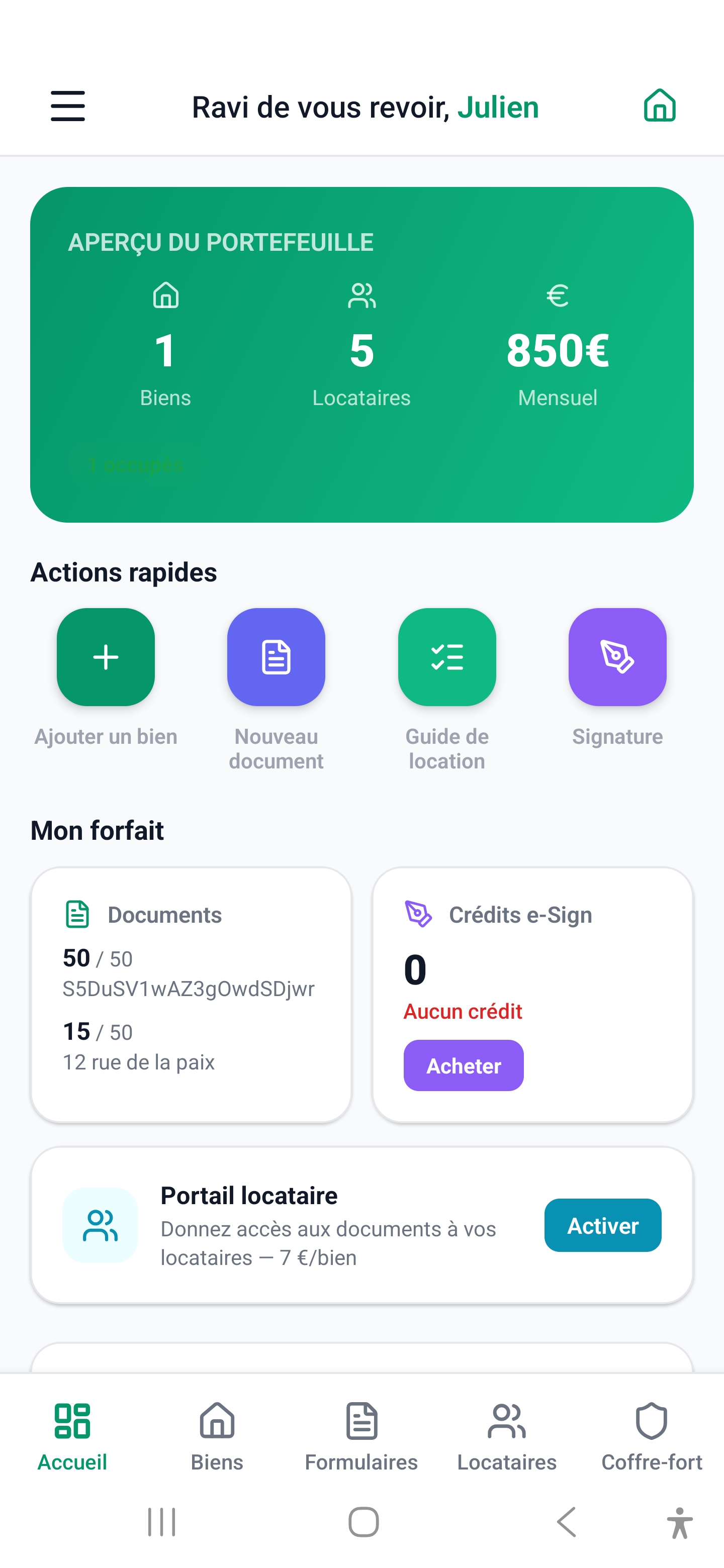
Landlords managing properties from abroad or on the go can also use Rent — Lease & Short-Term, the native mobile app that handles quittances, bail contracts, états des lieux, and deposit tracking from your phone — with a dedicated tenant portal so tenants receive documents, request repairs, and submit move-out notices directly from their own app. Available on Google Play (Android) and the Apple App Store (iOS).
Frequently Asked Questions

What is the maximum security deposit in France?

For unfurnished rentals: 1 month of base rent (excluding charges). For furnished rentals: 2 months. For bail mobilité: no deposit is allowed. The deposit must be returned within 1–2 months after departure.

Can a landlord refuse to renew my lease?

Only for 3 legal reasons: personal/family use, sale of the property, or serious breach by the tenant. The landlord must give 6 months notice (unfurnished) or 3 months (furnished) before lease expiry, with a formal letter stating the reason.

Is rent control (encadrement des loyers) mandatory everywhere?

No. It currently applies only in designated tense zones: Paris, Lyon, Lille, Montpellier, Bordeaux, and a few other cities. Check your commune's status on the DRIHL or préfecture website.

What happens if the lease does not mention the surface habitable?

For unfurnished leases, the surface habitable (Loi Boutin) is mandatory. If it is missing or understated by more than 5%, the tenant can request a proportional rent reduction through the tribunal judiciaire within 6 months of moving in.

Can a landlord refuse to accept a tenant with a guarantor outside France?

A landlord cannot refuse a guarantor based solely on their residence in the EU or EEA. However, outside the EU, landlords may require additional documentation or a different guarantee form like Visale. Refusing a French-resident guarantor on nationality grounds alone would be discriminatory.

What happens if the landlord forgets to attach a mandatory annex like the DPE?

If a mandatory annex is missing at signing, the tenant can formally request it by lettre recommandee avec accuse de reception. If the landlord fails to provide it, the tenant may seek damages or, in serious cases, request the lease be voided. Recent case law treats missing DPE as grounds for rent reduction.

Is a one-year furnished lease renewable automatically?

Yes. A furnished lease is tacitly renewed for another year unless the landlord gives 3 months notice to terminate (for a justified reason listed in article 25-8 of loi 89-462) or the tenant gives 1 month notice to leave. The renewal happens automatically without paperwork.

Stay updated

For more practical insights on this topic, explore our related articles:

  • Short-Term Rental in France 2026: Meublé de Tourisme Obligations for Hosts
  • Tenant Rights in France: Deposit, Repairs & the Written Proof That Wins Disputes
  • Rent by AdminLanding: Big 2026 Update for French Landlords
  • Non-Resident Landlord French Rental Tax: The 2026 Declaration Guide (2044 / 2042)

Tool by AdminLanding

Manage your French rental in English, from your phone

Rent — Lease & Short-Term generates ALUR-compliant leases, rent receipts, digital états des lieux and 23 rental documents — long-term AND short-term / meublé de tourisme — plus a per-property compliance check (DPE letting-ban, mandatory diagnostics, SIRET/LMNP, short-term registration, taxe de séjour) with email reminders — eIDAS e-signature, bilingual FR/EN. First property free — 10 documents included, then €49/property (50 documents), €39 each additional. No subscription.

Get Rent — Lease & Short-Term

Conclusion: The French bail is more than a formality — it is a legally dense document that determines your rights for years. Tenants should read every clause before signing. Landlords should ensure full compliance with Loi 1989, Loi ALUR, and diagnostic obligations to avoid disputes and penalties. When in doubt, use professional tools to generate documents that meet current legal standards.

Tool by AdminLanding

Manage your French rental in English, from your phone

Rent — Lease & Short-Term generates ALUR-compliant leases, rent receipts, digital états des lieux and 23 rental documents — long-term AND short-term / meublé de tourisme — plus a per-property compliance check (DPE letting-ban, mandatory diagnostics, SIRET/LMNP, short-term registration, taxe de séjour) with email reminders — eIDAS e-signature, bilingual FR/EN. First property free — 10 documents included, then €49/property (50 documents), €39 each additional. No subscription.

Get Rent — Lease & Short-Term→

Stay Updated

1 tip per week, no spam.

About the author:

Julien Maurice is the founder of AdminLanding and writes the editorial guides on ExpatAdminHub covering European expat life, France-Switzerland cross-border work, and French administrative procedures. Contact: [email protected]

Related posts

Short-Term Rental in France 2026: Meublé de Tourisme Obligations for Hosts
Housing•June 27, 2026

Short-Term Rental in France 2026: Meublé de Tourisme Obligations for Hosts

Letting a furnished place on Airbnb, Booking or directly as a meublé de tourisme in France is no longer a grey-area side hustle — since the loi Le Meur (law no. 2024-1039 of 19 November 2024) it sits inside a tightening compliance frame: a registration number, a night cap on your primary residence, an energy-performance floor, a SIRET, the right micro-BIC bracket, and the taxe de séjour. Get one of those wrong and you risk a fine, a delisting, or a requalified tax position. This guide lays out, in plain English, exactly which obligations apply to a short-term host in 2026, where the rules changed, and how to check your own situation before your next booking. It is written for the individual host — an expat renting a second flat, a primary-residence owner letting a spare room or the whole place while away — not for professional operators or hotels. It is general information, not legal or tax advice.

Read the article
Tenant Rights in France: Deposit, Repairs & the Written Proof That Wins Disputes
Housing•June 8, 2026

Tenant Rights in France: Deposit, Repairs & the Written Proof That Wins Disputes

If you rent in France, three searches probably brought you here: "landlord won't return deposit France", "how to force my landlord to do repairs", or "my landlord is ignoring my move-out notice." These are the most common — and most stressful — tenancy disputes, and they all share one quiet truth: the tenant who has a dated, written, provable record almost always wins. French rental law (the Loi n°89-462 du 6 juillet 1989) is genuinely protective of tenants, but the law only helps you if you can prove what happened and when. As a non-French-speaking expat, that paper trail matters even more — a clear, traceable record of every request closes the door on "I never received that" and "you never asked." This guide walks through getting your dépôt de garantie back, forcing repairs your landlord is dodging, giving notice correctly, and using the état des lieux as evidence — and shows the simplest way to keep all of it in one provable place.

Read the article
Rent by AdminLanding: Big 2026 Update for French Landlords
Housing•June 8, 2026

Rent by AdminLanding: Big 2026 Update for French Landlords

If you own a flat or house in France and you do the paperwork yourself — often from another country — you already know the real work isn't the rent, it's the bail, the monthly quittance de loyer, the état des lieux, the deposit, and the slow drip of compliance deadlines nobody reminds you about. Rent by AdminLanding (store name Rent — Lease & Short-Term in English, Rent — Bail & Courte Durée in French) just shipped its biggest update yet across both its mobile apps (iPhone + Android) and its web back-office at adminlanding.com — and the headline for non-resident and expat landlords is simple: you can now run a French rental end-to-end — long-term lease or short-term / Airbnb (meublé de tourisme) — in English or French, from a phone in London or a laptop in New York, without paying an agency 6–10% to do it for you. The two standout additions: a per-property compliance check that scores every legal obligation (DPE letting-ban, diagnostics, SIRET, short-term registration, taxe de séjour) at a glance, and a "which document do I need?" finder that maps your situation to the right one of 23 templates. This is a what's-new guide: what the update added, what each surface now does, and what it costs (the first property is free).

Read the article