
ExpatAdminHubEuropean expat guide
FR
Menu▾
HomePrivacyCookiesAboutContact
All guidesPreparationHousingFinanceHealthcareWorkFamily
ExpatAdminHubEuropean expat guide
HomePrivacyCookiesAboutContact
Categories
All guidesPreparation (checklists, visas, moving)Housing (rentals, utilities, neighborhoods)Finance (banking, taxes, budgeting)Healthcare (insurance, doctors, pharmacies)Work (jobs, contracts, work permits)Family (schools, childcare, family life)Culture (language, customs, integration)
FR

ExpatAdminHub

Practical guides for European expats navigating admin, housing, healthcare, and everyday life abroad.

Navigation

HomeAboutContactPrivacyTermsSitemap

Stay Updated

1 tip per week, no spam.

© 2026 ExpatAdminHub · European expat guide.
FR
  1. Home
  2. Blog
  3. Housing
  4. Quittance de Loyer: Landlord Obligations and How to Generate Rent Receipts in France
Quittance de Loyer: Landlord Obligations and How to Generate Rent Receipts in France
This article is also available in French.
Lire en français →

French rental law series

  • French bail lease: full guide
  • Free quittance template (legal guide)

Quittance de Loyer: Landlord Obligations and How to Generate Rent Receipts in France

Published March 29, 2026·Updated April 11, 2026

In France, landlords are legally required to provide a [quittance de loyer](/en/blog/2026-04-11-quittance-de-loyer-free-template-legal-guide) (rent receipt) to any tenant who requests one. Whether you are a landlord managing a property or an expat tenant who needs proof of rent payment, understanding this obligation is essential — non-compliance can have legal consequences.

Key facts

  • The quittance de loyer is governed by Article 21 of the Loi n°89-462 du 6 juillet 1989 — landlords must issue one free of charge whenever the tenant requests it.
  • A valid quittance must separate base rent (loyer nu) from charges (provision pour charges), and can only be issued after full payment — partial payments require a reçu de paiement instead.
  • Since the Loi ALUR (2014), electronic transmission is explicitly allowed if the tenant consents; refusal to issue a quittance can trigger an injonction de faire in court.
  • Tenants need a quittance to prove stable housing for CAF housing aid, prefectural residence permit files, and loan or visa applications.
  • Rent — Bail, Quittance, Loyer generates legally compliant quittances de loyer in PDF with automatic breakdown of loyer + charges and landlord signature block.

What is a quittance de loyer?

A quittance de loyer is a formal document issued by a landlord (or property manager) confirming that a tenant has paid their rent in full for a given period. It is governed by Article 21 of the Loi n°89-462 du 6 juillet 1989 (France's primary tenancy law).

The quittance must clearly separate:

• The base rent (loyer nu)

• The charges (provision pour charges or charges récupérables)

A quittance can only be issued once the full amount has been received. If the tenant has made a partial payment, the landlord must issue a reçu de paiement (payment receipt) instead — not a quittance.

Legal obligation: when must a landlord provide one?

Under Article 21 of the Loi du 6 juillet 1989:

• The landlord must provide a quittance de loyer whenever the tenant requests one

• The landlord cannot charge for issuing a quittance — it must be free of charge ("sans frais")

• The obligation applies to all residential leases governed by this law (furnished and unfurnished)

• Failure to provide a quittance upon request can be considered a fault by the landlord, and the tenant can seek a court order (injonction de faire) to compel issuance

• Since the Loi ALUR (2014), electronic transmission of the quittance is explicitly permitted if the tenant agrees

Landlords looking to upgrade their property may also want to explore green home loan options for financing eco-renovations.

What must a quittance de loyer contain?

A legally compliant quittance must include:

• Landlord identity: full name (or company name) and address

• Tenant identity: full name of the tenant(s) named on the lease

• Property address: the full address of the rented property

• Period covered: the month or period for which rent is paid (e.g., "March 2026")

• Breakdown of amounts: base rent (loyer) and charges listed separately

• Total amount paid: the sum of rent + charges

• Date of issuance

• Signature of the landlord or their authorised agent

Missing any of these elements could make the quittance legally contestable.

Get the next rental guide before your neighbours do

We send one practical landlord/tenant tip per week — bail, ALUR, DPE, quittance. No spam, unsubscribe anytime.

Why tenants need quittances (especially expats)

Quittances de loyer are not just administrative paperwork — they serve as official proof of residence and financial reliability in France. Tenants commonly need them for:

• CAF housing aid (Aide Personnalisée au Logement / APL) — the CAF requires quittances to process and maintain housing benefits

• Titre de séjour renewals — préfectures accept quittances as proof of stable housing for residence permit applications

• Bank account opening — many French banks require recent quittances as justificatif de domicile

• Future rental applications — landlords and agencies routinely ask for the last 3 quittances from previous tenancies

• Tax declarations — useful for deducting housing costs in certain cross-border tax situations

How to generate quittances efficiently

If you manage one or more rental properties, generating quittances manually each month is tedious and error-prone. Common approaches:

• Word/PDF templates: Free but requires manual data entry each month. Risk of errors and inconsistent formatting.

• Excel spreadsheets: Slightly better, but still manual and not legally formatted.

• Property management software: Automated but often expensive (€15–50/month) and designed for large portfolios.

• AdminLanding Rental Pack: The AdminLanding Quittance de Loyer tool (Rental Pack, €49) lets you generate legally compliant quittances in seconds. Enter your property and tenant details once, and produce professional, bilingual (FR/EN) rent receipts for each payment period. Ideal for expat landlords managing French properties from abroad, or French landlords with international tenants.

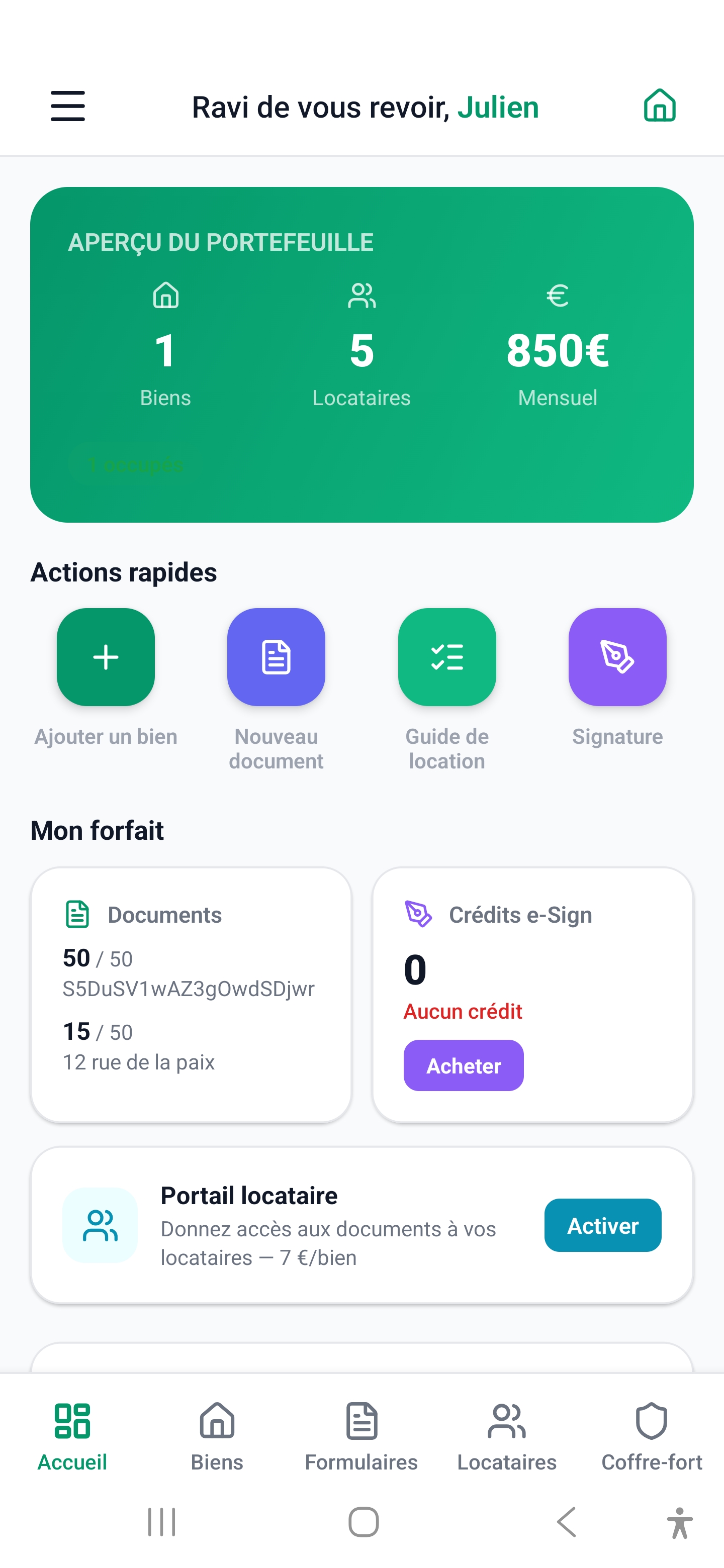
• Rent — Bail, Quittance, Loyer (mobile app): If you prefer managing from your phone, Rent — Bail, Quittance, Loyer on Google Play offers the same document coverage as the web platform — quittances, bail, état des lieux, deposit tracking — plus portfolio analytics and a dedicated tenant portal. Pack pricing (€49 first property, €39 per additional property, 50 documents each; €7 per property to activate the tenant portal). No subscription.

Quittance vs reçu de paiement: key distinction

This is a common point of confusion:

• Quittance de loyer: Issued only when the full rent + charges have been paid for the period. It serves as definitive proof of payment.

• Reçu de paiement: Issued for partial payments. It acknowledges the amount received but does not constitute full discharge of the tenant's obligation.

A landlord who issues a quittance for a partially paid rent is making a legal error — the quittance could be interpreted as acknowledgment that the full amount was received.

What if the landlord refuses to provide a quittance?

If your landlord refuses to issue a quittance after a written request:

Step 1 — Send a formal request by lettre recommandée avec accusé de réception (registered letter with acknowledgment of receipt), citing Article 21 of the Loi du 6 juillet 1989.

Step 2 — If no response within a reasonable time (typically 1 month), contact the ADIL (Agence Départementale d'Information sur le Logement) for free legal advice.

Step 3 — As a last resort, you can file a petition with the tribunal judiciaire for an injonction de faire — a court order compelling the landlord to issue the quittance.

Step 4 — Document everything. Keep copies of your bank transfers, lease, and correspondence as evidence of rent payment.

Frequently Asked Questions

Is a quittance de loyer mandatory in France?

The landlord is not required to send one automatically, but must provide one free of charge whenever the tenant requests it. This is a legal obligation under Article 21 of the Loi du 6 juillet 1989.

Can a quittance be sent by email?

Yes. Since the Loi ALUR (2014), electronic transmission is explicitly permitted, provided the tenant has agreed to receive documents electronically.

What if I only paid part of my rent?

The landlord should issue a reçu de paiement (payment receipt), not a quittance. A quittance can only be issued once the full amount for the period has been received.

Can the landlord charge me for a quittance?

No. The law explicitly states that quittances must be provided 'sans frais' (free of charge). Any clause in your lease requiring payment for quittances is void.

Can a landlord charge for issuing a rent receipt?

No. Article 4(p) of loi 89-462 explicitly prohibits any fee for providing a rent receipt. Any clause in the lease stipulating such a fee is null and void. The landlord must provide the receipt free of charge on every tenant request.

What if the tenant never asks for a quittance — is the landlord still required to issue one?

Legally, the landlord must provide a quittance on request. If the tenant never asks, the landlord is not technically in breach, but providing monthly receipts proactively is best practice and protects both parties in case of a dispute. Automated monthly sending is allowed since loi ALUR 2014.

Can I use a rent receipt as a proof of address?

Yes. A quittance de loyer is accepted as a justificatif de domicile by French administrations including CAF, CPAM, prefecture (carte de sejour), banks, and the Poste for address changes. The document must be recent (typically within 3 months) and include the full address.

Stay updated

For more practical insights on this topic, explore our related articles:

  • Best Rental Management Apps for French Landlords in 2026
  • Managing a French Rental Property from Abroad: Mandataire vs DIY in 2026
  • CAF Registration in France: Complete Guide to Housing Aid (APL, ALF, ALS) for Expats (2026)
  • État des Lieux in France: Complete Guide to Move-In and Move-Out Property Inspections (2026)

Tool by AdminLanding

Manage your French rental from your phone

Rent — Bail, Quittance, Loyer generates ALUR-compliant leases, rent receipts, digital états des lieux and 21 rental documents — eIDAS e-signature, bilingual FR/EN. €49 starter pack, no subscription.

Get Rent — Bail, Quittance, Loyer

Conclusion: The quittance de loyer is a fundamental document in French rental law — simple in concept but critical in practice. Landlords should automate the process to stay compliant and save time. Tenants, especially expats navigating French administration, should always request their quittances and keep them on file for housing aid, residence permits, and future rentals.

Tool by AdminLanding

Manage your French rental from your phone

Rent — Bail, Quittance, Loyer generates ALUR-compliant leases, rent receipts, digital états des lieux and 21 rental documents — eIDAS e-signature, bilingual FR/EN. €49 starter pack, no subscription.

Get Rent — Bail, Quittance, Loyer→

Stay Updated

1 tip per week, no spam.

About the author:

Julien Maurice is the founder of AdminLanding and writes the editorial guides on ExpatAdminHub covering European expat life, France-Switzerland cross-border work, and French administrative procedures. Contact: [email protected]

Related posts

Best Rental Management Apps for French Landlords in 2026
Housing•May 11, 2026

Best Rental Management Apps for French Landlords in 2026

If you rent out property in France in 2026, the choice of rental-management software is no longer between spreadsheet and agency. Six SaaS products now hold the bulk of the French independent-landlord market — Rentila (≈50,000 landlords), BailFacile, GérerSeul, Hestia Software, Smartloc and Smovin — alongside Rent — Bail, Quittance, Loyer, the only mobile-native option built jointly for landlords and tenants. They differ on what they treat as the unit of work (the property, the lease, the document, the calendar). They differ on language (most are French-only). They differ on what they ship for the tenant side (most ship nothing). This guide compares the seven that matter, applied to the situation that defines this audience: an expat or non-resident landlord with one to five properties who needs ALUR-compliant paperwork done at distance without paying 6–10% to a mandataire de gestion.

Read the article
Managing a French Rental Property from Abroad: Mandataire vs DIY in 2026
Housing•May 3, 2026

Managing a French Rental Property from Abroad: Mandataire vs DIY in 2026

If you own a French rental property and don't live in France, every operational decision splits two ways: hire a mandataire de gestion (a regulated French property manager) and pay a percentage of every month's rent for the rest of the lease, or run the property yourself from another country and design around the time-zone, language and signature constraints that come with it. Both work in 2026 — French law has become materially friendlier to the at-distance landlord since the eIDAS regulation (EU 910/2014) made qualified electronic signatures legally equivalent to wet ink, since the lettre recommandée électronique (Décret n° 2018-347 of 9 May 2018) replaced the post-office trip for most legal notices, and since the digital lease and digital état des lieux became routine practice. This guide compares the two paths, walks through the legal infrastructure that makes DIY feasible, and shows where the work actually happens day-to-day for non-resident landlords.

Read the article
CAF Registration in France: Complete Guide to Housing Aid (APL, ALF, ALS) for Expats (2026)
Housing•April 26, 2026

CAF Registration in France: Complete Guide to Housing Aid (APL, ALF, ALS) for Expats (2026)

The Caisse d'Allocations Familiales (CAF) administers three housing-aid schemes — APL (aide personnalisée au logement), ALF (allocation de logement familiale), and ALS (allocation de logement sociale) — covering roughly 6 million households in France, with eligibility now based on income calculated on a rolling 12-month window since the 2021 reform (revenus contemporains). For an expat just arrived, the picture rarely starts that clean. Which of the three aids applies depends on whether your dwelling is conventionné with the State, on your family composition, and on whether anyone else in the household qualifies for family benefits. Eligibility also requires a stable and regular residence in France, a valid titre de séjour for non-EU nationals, a décent dwelling that meets minimum surface and energy criteria, and an online dossier on caf.fr. The first payment lands roughly 6 to 8 weeks after the application is validated — and only after a one-month carence during which no aid is paid. This guide walks through which aid applies to your situation, what documents CAF actually asks for, how the espace allocataire works, and the mistakes that delay or kill applications. Read this before signing the lease whenever possible.

Read the article