ExpatAdminHubEuropean expat guide
FR
Menu▾
HomePrivacyCookiesAboutContact
All guidesPreparationHousingFinanceHealthcareWorkFamily
ExpatAdminHubEuropean expat guide
HomePrivacyCookiesAboutContact
Categories
All guidesPreparation (checklists, visas, moving)Housing (rentals, utilities, neighborhoods)Finance (banking, taxes, budgeting)Healthcare (insurance, doctors, pharmacies)Work (jobs, contracts, work permits)Family (schools, childcare, family life)Culture (language, customs, integration)
FR

ExpatAdminHub

Practical guides for European expats navigating admin, housing, healthcare, and everyday life abroad.

Navigation

HomeAboutContactPrivacyTermsSitemap

Stay Updated

1 tip per week, no spam.

© 2026 ExpatAdminHub · European expat guide.
FR
  1. Home
  2. Blog
  3. Housing
  4. CAF Registration in France: Complete Guide to Housing Aid (APL, ALF, ALS) for Expats (2026)
CAF Registration in France: Complete Guide to Housing Aid (APL, ALF, ALS) for Expats (2026)
This article is also available in French.
Lire en français →

French rental law series

  • Rent by AL: app + web update
  • Tenant rights: deposit, repairs, proof
  • Non-resident landlord rental tax (2044)
  • LMNP furnished tax: micro-BIC vs réel
  • French bail lease: full guide
  • Landlord obligations: rent receipts
  • Free quittance template (legal guide)

CAF Registration in France: Complete Guide to Housing Aid (APL, ALF, ALS) for Expats (2026)

Published April 26, 2026

The Caisse d'Allocations Familiales (CAF) administers three housing-aid schemes — APL (aide personnalisée au logement), ALF (allocation de logement familiale), and ALS (allocation de logement sociale) — covering roughly 6 million households in France, with eligibility now based on income calculated on a rolling 12-month window since the 2021 reform (revenus contemporains). For an expat just arrived, the picture rarely starts that clean. Which of the three aids applies depends on whether your dwelling is conventionné with the State, on your family composition, and on whether anyone else in the household qualifies for family benefits. Eligibility also requires a stable and regular residence in France, a valid titre de séjour for non-EU nationals, a décent dwelling that meets minimum surface and energy criteria, and an online dossier on caf.fr. The first payment lands roughly 6 to 8 weeks after the application is validated — and only after a one-month carence during which no aid is paid. This guide walks through which aid applies to your situation, what documents CAF actually asks for, how the espace allocataire works, and the mistakes that delay or kill applications. Read this before signing the lease whenever possible.

Key facts

  • APL is reserved for conventionné dwellings (most HLM, plus private landlords with a State convention). ALF/ALS apply to non-conventionné housing depending on family situation. The three are not cumulative.
  • Income window: since the 1 January 2021 reform, CAF uses revenus contemporains — your income over the rolling last 12 months — and recalculates the housing aid every 3 months automatically (no quarterly declaration to file for APL/ALF/ALS).
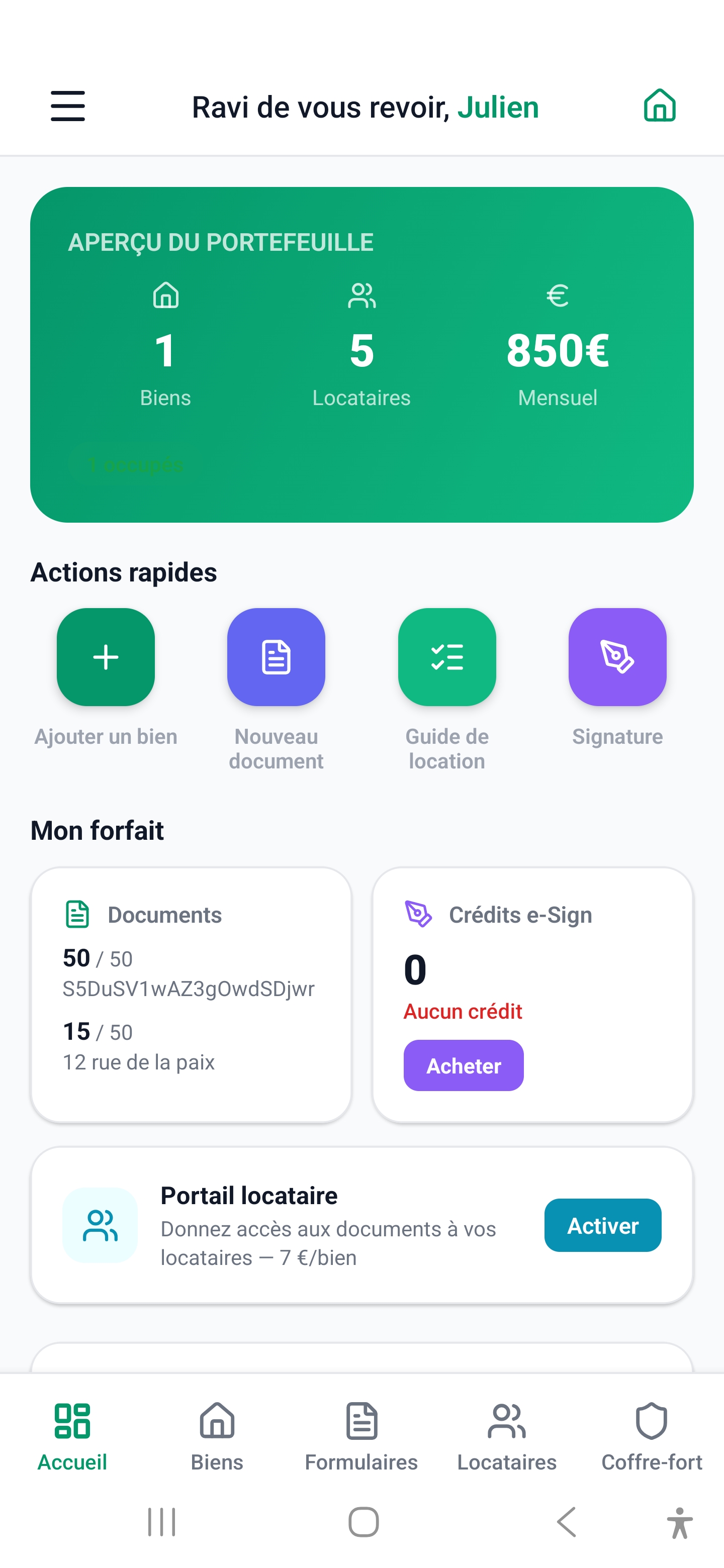
  • Required documents: RIB (your bank IBAN), the attestation de loyer (Cerfa 10842) signed by your landlord, a copy of your bail, your titre de séjour (non-EU), and a justificatif d'identité. Rent — Bail, Quittance, Loyer produces conformes attestations and quittances automatically.
  • Application is online at caf.fr → Faire une demande de prestation → Aide au logement. The first payment lands typically 6 to 8 weeks after dossier validation, paid the 5th of each month.
  • Guide: Démarches en France annotates every field on caf.fr in English (and 30+ other administrative sites) so you don't tick the wrong housing type or skip the proof-of-residence step.

The three CAF housing aids — APL vs ALF vs ALS

CAF administers three distinct schemes. They are not cumulative — you receive only one, automatically picked by CAF based on your housing and family situation.

  • APL — aide personnalisée au logement. The most common aid. Reserved for tenants of a **dwelling that is conventionné with the State**: this covers most HLM (social housing) and any private rental where the landlord signed a convention APL with the préfet. The convention status is on the bail or on the attestation de loyer; if you're unsure, ask the landlord or check on caf.fr's simulator.
  • ALF — allocation de logement familiale. Awarded based on family situation, when the dwelling is not conventionné. You qualify if: you receive family benefits (allocations familiales), you have at least one dependent child under 21, you are a married couple within the first 5 years of marriage with no children, you are pregnant and living alone, or you support an ascendant or descendant with a disability.
  • ALS — allocation de logement sociale. The catch-all: awarded when the dwelling is not conventionné and you don't qualify for ALF. Most students, young professionals and single working expats fall here.

All three use the same calculation formula — the difference is purely in who administers them and which budget line. CAF's online simulator (caf.fr/aides/aides-au-logement-simulation) tells you within 5 minutes which one applies and gives an indicative monthly amount. Note: from 1 July 2026, non-scholarship international students from outside the EU/EEA/Switzerland will no longer be eligible for APL — this is a significant tightening for incoming students.

Eligibility for expats — residency, titre de séjour, and the dwelling

Three layers of eligibility need to line up before CAF will open a file.

Layer 1 — stable and regular residence in France. You must reside in France habitually. CAF traditionally read this as at least 6 months per year on French territory. Since 1 January 2025, a tightened threshold of 9 months per year applies for non-EU nationals to access most social benefits including housing aid. EU/EEA/Swiss nationals keep the 6-month rule under EU free-movement rules.

Layer 2 — valid titre de séjour for non-EU nationals. The accepted documents are the carte de séjour temporaire, the carte pluriannuelle, the carte de résident (10 years), the récépissé bearing a work authorization, or a VLS-TS validated by OFII. Asylum seekers receive specific treatment via ADA, not via CAF housing aid. EU citizens do not need a titre de séjour but are still asked for an ID and proof of address.

Layer 3 — a dwelling that meets the décence criteria. The rental must be your principal residence (≥ 8 months/year), with a regular bail, and decent under the law of 6 July 1989. Minimum surface: 9 m² for one person, 16 m² for two, +9 m² per additional person, with a ceiling height of 2.20 m. Since 1 January 2023, energy decency is part of the criteria — for 2026 the dwelling must have at least DPE class F, tightening to E from 1 January 2028 and D from 2034. A class G rental is not eligible for CAF aid; ask for the DPE before signing.

If any of those layers fails, CAF will reject the file or suspend payment until the situation is regularised.

The 2021 reform: revenus contemporains explained

Until 31 December 2020, CAF housing aid used your income from two years earlier (N-2). A graduate who started working in 2019 saw an APL based on their 2017 student-grant income — generous in year one, bad-news in year three. The 2021 reform (entered into force 1 January 2021) flipped the model: CAF now uses revenus contemporains — your income over the last 12 months on a rolling basis — and recalculates the aid every 3 months, automatically.

In practice:

  • Your aid for April–May–June 2026 is calculated on income earned March 2025 – February 2026.
  • Your aid for July–August–September 2026 is recalculated on income earned June 2025 – May 2026.
  • And so on, with the window rolling forward each quarter.

Income is now collected automatically via the DSN (déclaration sociale nominative) employers file each month, and via the base ressources mensuelles. For housing aid you do NOT file a quarterly declaration of resources — that obligation only applies to RSA, prime d'activité and AAH beneficiaries. This is one of the most common confusions among new arrivals.

The net effect: the aid follows your situation in near-real time. A pay raise reduces APL after one quarter; a job loss raises it within 3 months. The flip side is volatility — each quarterly recalc can move the amount up or down, sometimes by hundreds of euros, with no warning beyond the message in your espace allocataire.

Get the next rental guide before your neighbours do

We send one practical landlord/tenant tip per week — bail, ALUR, DPE, quittance. No spam, unsubscribe anytime.

Required documents — the verified list

CAF asks for a tight list. Prepare these scans before opening the online dossier; missing one slows the file by weeks.

  • Pièce d'identité. Passport or national ID for EU/EEA/Swiss; passport + valid titre de séjour for non-EU. Both sides if it's a card.
  • Bail (lease). A complete copy with all signatures and the date of entry into the dwelling. The bail must be in your name (or that of one declared occupant); informal sublets are excluded unless explicitly authorized in the head lease.
  • Attestation de loyer (Cerfa 10842). A short form filled and signed by your landlord, certifying rent amount, surface, address, and the dwelling's décence criteria. CAF asks for this before any quittance — it is the principal proof that the rental is real and in line with French rules. Ask the landlord at lease signature; refusal is a red flag. Rent — Bail, Quittance, Loyer generates an attestation de loyer that matches the Cerfa exactly.
  • RIB (relevé d'identité bancaire). A French or EU IBAN in your name. Direct payment to a non-EU account is not supported. If you don't yet have a French account, see our expat bank account guide.
  • Justificatif de revenus. Last 3 payslips (or the most recent), or a sworn statement if you arrived very recently and have no French income yet. CAF cross-checks via DSN once you start working.
  • Composition du foyer. Marriage certificate, livret de famille, birth certificates of children, where relevant.

Quittance de loyer: in the standard case CAF asks for the attestation at the start, not monthly quittances. Quittances become relevant if CAF audits the file or if the aid is paid in tiers payant (directly to the landlord) — landlords then sometimes need to prove rent was actually due or paid. Our quittance template guide covers when and how to issue them.

Step-by-step application on caf.fr

The online dossier is straightforward if you take it in order.

Step 1 — Run the simulator first. Go to caf.fr → Aides et démarches → Aides au logement → Faire une simulation. The simulator asks for income, rent, household, dwelling type. It tells you which aid (APL/ALF/ALS), the indicative monthly amount, and whether you're eligible at all. Do this before signing the lease — knowing the aid amount may swing the rent budget.

Step 2 — Create your espace allocataire. Same page → Faire la demande. CAF assigns a numéro allocataire (7 digits + 1 control letter) at the end of the form. Save it; you'll use it on every future call, payment, or letter. If you've never been a CAF beneficiary anywhere in France, you'll fill out a full ID + address + family form. If you had a CAF file in another département, transfer it via Mon dossier → Changement de département.

Step 3 — Submit the housing-aid request. Inside Mon compte → Faire une demande de prestation → Aide au logement. Fill the form (rent, dwelling, dates), upload the documents listed above, validate. The system gives you a récépissé de dépôt — keep the PDF.

Step 4 — Track the dossier. Status appears in Mes dernières démarches. Statuses move En cours d'instruction → Pièce manquante (act fast) → Validé → Payé. CAF emails you when status changes if you've enabled notifications.

Step 5 — First payment. Counted from the first day of the month following your entrée dans les lieux, with one month of carence (no aid for the move-in month itself). The first transfer arrives the 5th of the month following validation, typically 6 to 8 weeks after submission. If your move-in date is 15 March 2026 and validation completes 20 April, the first payment hits 5 May for April's aid.

Guide: Démarches en France annotates every field on caf.fr field-by-field in English — handy when CAF asks whether the dwelling is conventionné or whether your titre de séjour is a VLS-TS or a CST. Try Guide: Démarches en France or grab the Android app.

After the application — payments, recalculations, change of situation

Once paid, the file lives a quiet life — but with two important rhythms.

Monthly payments. CAF pays the 5th of each month (or the next business day). The 2026 calendar shows one exception: April 2026's payment lands Tuesday 7 April because the 5th and 6th are Easter weekend. Aid is paid for the previous month — May's payment covers April's aid.

Quarterly recalculation. Every 3 months CAF recalculates using the most recent rolling 12-month income window. You'll see the new amount in your espace allocataire on the recalc date — typically late January, late April, late July, late October. The amount can rise or fall; if it falls, the change applies immediately.

No quarterly declaration for APL/ALF/ALS. Important: the déclaration trimestrielle de ressources you may have heard about is only for RSA, prime d'activité, and AAH. Housing aid is recalculated automatically from DSN data. Beneficiaries of those other prestations who also receive APL still file the trimestrielle for the other prestations, not for the housing aid.

Changes of situation must be declared immediately, not on a quarterly cycle. The list: change of address, change of bank, marriage, PACS, divorce, birth, death, departure of an occupant, change of employer, change of work hours, prolonged hospital stay, departure from France >3 months. Use Mon compte → Déclarer un changement — the new situation typically takes effect the month after declaration.

Tiers payant. APL/ALF/ALS can be paid directly to the landlord (tiers payant) at the landlord's request, in which case your rent invoice nets out the aid. If you change landlord or move out, the tiers payant must be terminated explicitly — otherwise the new landlord won't see the aid.

Common mistakes (and how to avoid them)

Five mistakes account for most rejected or delayed CAF housing-aid files.

  1. Picking the wrong aid in the simulator. Many expats tick "logement social" thinking ALS = social. Wrong: APL also applies to social housing if it's conventionné (which most HLM are). Let the simulator decide based on the bail and the dwelling type — don't manually override.
  2. Forgetting the attestation de loyer. The most common cause of Pièce manquante. Landlords sometimes confuse it with a quittance or a simple lease summary. Hand them the official Cerfa 10842 — or use Rent — Bail, Quittance, Loyer which prefills it correctly.
  3. Filing the trimestrielle de ressources for APL. It doesn't exist for APL/ALF/ALS. People who fill it out for housing aid are wasting the form and may be confusing CAF if they're also on RSA. Only fill the trimestrielle for RSA / prime d'activité / AAH.
  4. Not anticipating the carence. No aid is paid for the move-in month. Budget the first month's rent on your own; the first payment lands 6–8 weeks later for the second month onwards.
  5. Surprise from the rolling 12-month window. A bonus paid in November 2025 hits the income window of every quarterly recalc until November 2026, lowering aid for a full year. A job loss in April 2026 raises aid in July 2026, not before. Plan accordingly — don't expect APL to react instantly to a single month's bad luck.

If you are also navigating the broader rental setup, our French bail lease guide walks through clauses, deposits, and état des lieux.

Where AdminLanding fits

CAF is one of the most-used administrative sites in France — and one of the most opaque for non-French speakers. Two AdminLanding tools sit on either side of the CAF flow.

Guide: Démarches en France is a Chrome extension and Android app that overlays caf.fr (and 30+ other government sites — impots.gouv.fr, ameli.fr, service-public.fr, ANTS, URSSAF) with field-by-field annotations in English. On caf.fr it explains what conventionné means before you tick it, what your titre de séjour category is on the dropdown, and which Cerfa your landlord must fill — without sending any of your data to a server. Annotations render locally. Try it as a Chrome extension or as a mobile app on Google Play.

Rent — Bail, Quittance, Loyer sits on the landlord side. Landlords using Rent — Bail, Quittance, Loyer generate CAF-compliant attestations de loyer (Cerfa 10842) automatically from the bail data, plus monthly quittances that respect the strict format CAF and tribunals look for if a payment is ever contested. If your landlord is haphazard about paperwork — or if you are the landlord renting to a tenant who needs CAF aid — Rent — Bail, Quittance, Loyer closes the loop. Available on Google Play (Android) and the Apple App Store (iOS).

Neither tool replaces a CAF advisor for edge cases (cohabitation litigation, retroactive APL, RAFP for retired civil servants). Both flatten the parts that are mechanical but unforgiving.

Frequently Asked Questions

Am I eligible for CAF housing aid as an expat?

Yes, in most cases — provided three conditions are met. First, you reside in France habitually (≥ 6 months/year for EU/EEA/Swiss; ≥ 9 months/year for non-EU since 1 January 2025). Second, non-EU nationals hold a valid titre de séjour (carte de séjour, carte pluriannuelle, carte de résident, VLS-TS validated, or récépissé with work authorization). Third, your dwelling meets the décence criteria (minimum surface, DPE class F or better in 2026) and is your principal residence. Asylum seekers receive ADA, not CAF housing aid. From 1 July 2026, non-scholarship international students from outside the EU/EEA/Switzerland lose APL eligibility.

What is the difference between APL, ALF and ALS?

All three are housing aids that share the same calculation formula but apply to different situations and are not cumulative. **APL** is reserved for dwellings that are *conventionné* with the State — most HLM and any private rental whose landlord signed an APL convention. **ALF** applies to non-conventionné dwellings when you meet a family-situation criterion (family benefits, dependent child under 21, married within 5 years with no kids, pregnant and alone). **ALS** is the catch-all — non-conventionné dwelling, no qualifying family situation. CAF picks the right one automatically when you submit the dossier; you don't choose it manually.

How long does it take to receive the first CAF payment?

Typically **6 to 8 weeks** between submitting the dossier and the first payment landing in your account. The dossier is *en cours d'instruction* for 2 to 4 weeks after upload, then *validé*. From validation, payment lands the **5th of the month** following the validation. There is also a **carence of one month** — no aid is paid for the month you move in. Concretely: move-in 15 March 2026, dossier validated 20 April, the first payment hits 5 May 2026 covering April's aid. Plan to cover the first month's rent yourself.

Do I need a quittance de loyer to apply for CAF?

Not at the application stage. CAF asks for an **attestation de loyer** (Cerfa 10842) signed by the landlord — this certifies rent amount, surface, décence, and address. **Quittances** become relevant later: if CAF audits the file, if you switch to tiers payant (aid paid directly to the landlord), or if the landlord needs to prove rent was due. As a tenant, you have a legal right to a quittance for any month fully paid (article 21 of the law of 6 July 1989). Our <a href="/en/blog/2026-04-11-quittance-de-loyer-free-template-legal-guide">quittance template guide</a> covers the exact format.

How is CAF housing aid calculated?

Since the 1 January 2021 reform, the aid uses **revenus contemporains** — your income over the rolling last 12 months — and is recalculated **every 3 months** automatically. The formula combines your income, your rent (capped by a *loyer plafond* that depends on the city zone and household size), your household composition, and the dwelling type. The *loyers plafonds* are revised every January. Use the official simulator at caf.fr/aides/aides-au-logement-simulation for an indicative amount before applying — it takes 5 minutes and produces a number within a few euros of the actual aid.

What happens if my income changes after I apply?

It's automatic — no action needed for housing aid. CAF receives DSN data from your employer monthly and updates your *base ressources*. The next quarterly recalc (April, July, October, or January) folds the change into the new aid amount. A pay rise lowers the aid one quarter later; a job loss raises it within 3 months. **However**, you must still **declare any change of situation** that's not income-related — change of address, marriage, divorce, birth, departure of an occupant, departure from France >3 months — via *Mon compte → Déclarer un changement*. These changes take effect the month after declaration.

Can students get APL?

Yes, with two important caveats. EU/EEA/Swiss students and French students keep full APL access in 2026 — including in CROUS residences (which are *conventionné* and qualify for APL). For students whose parents claim them as dependent on the income tax declaration, CAF housing aid usually means the parents lose the dependant on their fiscal household — run the math both ways. **Major change for 2026:** from **1 July 2026**, **non-scholarship international students from outside the EU/EEA/Switzerland** will no longer be eligible for APL. Boursiers and EU students keep full access. Apply *before* 1 July 2026 if you're concerned.

What documents does CAF need from my landlord?

One document is critical: the **attestation de loyer (Cerfa 10842)**. The landlord fills and signs it once at lease signature, certifying rent amount, surface, address, décence, and energy class. CAF will not pay aid without it. Beyond that, CAF rarely contacts the landlord directly — but the landlord must be reachable to confirm rent paid if CAF audits, and must accept the **tiers payant** terms if you opt for direct-to-landlord payment. Rent — Bail, Quittance, Loyer generates the attestation in the exact Cerfa format and stores quittances landlords can produce on demand.

Stay updated

For more practical insights on this topic, explore our related articles:

  • Tenant Rights in France: Deposit, Repairs & the Written Proof That Wins Disputes
  • Rent by AdminLanding: Big 2026 Update for French Landlords
  • Non-Resident Landlord French Rental Tax: The 2026 Declaration Guide (2044 / 2042)
  • LMNP Furnished Rental Tax 2026: Micro-BIC vs Régime Réel Explained

Tool by AdminLanding

Manage your French rental in English, from your phone

Rent — Bail, Quittance, Loyer generates ALUR-compliant leases, rent receipts, digital états des lieux and 21 rental documents, plus built-in compliance & maintenance deadline tracking (boiler, chimney sweep, heat-pump/AC, gas & electrical checks, DPE, septic tank) with email reminders — eIDAS e-signature, bilingual FR/EN. First property free — 10 documents included, then €49/property (50 documents), €39 each additional. No subscription.

Get Rent — Bail, Quittance, Loyer

Conclusion: CAF housing aid is one of the few French administrative procedures where the math is generous to expats — APL/ALF/ALS often cover 20–40% of rent for moderate incomes — but the application unforgivingly punishes paperwork errors. Run the simulator before signing the lease. Get the attestation de loyer signed at lease signature, not later. Open the espace allocataire the day you move in. Plan for the **6–8 week** wait and the **one-month carence**. Don't waste time filing a déclaration trimestrielle for housing aid — it doesn't exist; it's only for RSA/prime d'activité/AAH. If the caf.fr fields confuse you, Guide: Démarches en France annotates every one in English, and Rent — Bail, Quittance, Loyer produces the conformes attestations and quittances automatically. File this week — by mid-summer the aid is in your account.

Tool by AdminLanding

Manage your French rental in English, from your phone

Rent — Bail, Quittance, Loyer generates ALUR-compliant leases, rent receipts, digital états des lieux and 21 rental documents, plus built-in compliance & maintenance deadline tracking (boiler, chimney sweep, heat-pump/AC, gas & electrical checks, DPE, septic tank) with email reminders — eIDAS e-signature, bilingual FR/EN. First property free — 10 documents included, then €49/property (50 documents), €39 each additional. No subscription.

Get Rent — Bail, Quittance, Loyer→

Stay Updated

1 tip per week, no spam.

About the author:

Julien Maurice is the founder of AdminLanding and writes the editorial guides on ExpatAdminHub covering European expat life, France-Switzerland cross-border work, and French administrative procedures. Contact: [email protected]

Related posts

Tenant Rights in France: Deposit, Repairs & the Written Proof That Wins Disputes
Housing•June 8, 2026

Tenant Rights in France: Deposit, Repairs & the Written Proof That Wins Disputes

If you rent in France, three searches probably brought you here: "landlord won't return deposit France", "how to force my landlord to do repairs", or "my landlord is ignoring my move-out notice." These are the most common — and most stressful — tenancy disputes, and they all share one quiet truth: the tenant who has a dated, written, provable record almost always wins. French rental law (the Loi n°89-462 du 6 juillet 1989) is genuinely protective of tenants, but the law only helps you if you can prove what happened and when. As a non-French-speaking expat, that paper trail matters even more — a clear, traceable record of every request closes the door on "I never received that" and "you never asked." This guide walks through getting your dépôt de garantie back, forcing repairs your landlord is dodging, giving notice correctly, and using the état des lieux as evidence — and shows the simplest way to keep all of it in one provable place.

Read the article
Rent by AdminLanding: Big 2026 Update for French Landlords
Housing•June 8, 2026

Rent by AdminLanding: Big 2026 Update for French Landlords

If you own a flat or house in France and you do the paperwork yourself — often from another country — you already know the real work isn't the rent, it's the bail, the monthly quittance de loyer, the état des lieux, the deposit, and the slow drip of compliance deadlines nobody reminds you about. Rent by AdminLanding (full name Rent — Bail, Quittance, Loyer) just shipped a substantial update across both its mobile apps (iPhone + Android) and its web back-office at adminlanding.com — and the headline for non-resident and expat landlords is simple: you can now run a French rental end-to-end, in English or French, from a phone in London or a laptop in New York, without paying an agency 6–10% to do it for you. This is a what's-new guide: what the update added, what each surface now does, and what it costs (the first property is free). If you manage a French rental from abroad, this is the update that closes the last gaps.

Read the article
Non-Resident Landlord French Rental Tax: The 2026 Declaration Guide (2044 / 2042)
Housing•May 15, 2026

Non-Resident Landlord French Rental Tax: The 2026 Declaration Guide (2044 / 2042)

If you live abroad and rent out a property in France, France taxes that rental income — wherever you are tax-resident. The rules that trip up non-resident landlords are specific: which form to file, the 20% minimum rate, the social-levy rate that depends on your health-insurance country, and the tax treaty that stops you being taxed twice. This guide walks through the 2026 declaration end to end, for unfurnished rentals taxed as revenus fonciers. (Furnished rentals follow the separate LMNP/BIC rules.)

Read the article