ExpatAdminHubEuropean expat guide
FR
Menu▾
HomePrivacyCookiesAboutContact
All guidesPreparationHousingFinanceHealthcareWorkFamily
ExpatAdminHubEuropean expat guide
HomePrivacyCookiesAboutContact
Categories
All guidesPreparation (checklists, visas, moving)Housing (rentals, utilities, neighborhoods)Finance (banking, taxes, budgeting)Healthcare (insurance, doctors, pharmacies)Work (jobs, contracts, work permits)Family (schools, childcare, family life)Culture (language, customs, integration)
FR

ExpatAdminHub

Practical guides for European expats navigating admin, housing, healthcare, and everyday life abroad.

Navigation

HomeAboutContactPrivacyTermsSitemap

Stay Updated

1 tip per week, no spam.

© 2026 ExpatAdminHub · European expat guide.
FR
  1. Home
  2. Blog
  3. Housing
  4. Managing a French Rental Property from Abroad: Mandataire vs DIY in 2026
Managing a French Rental Property from Abroad: Mandataire vs DIY in 2026
This article is also available in French.
Lire en français →

French rental law series

  • Rent by AL: app + web update
  • Tenant rights: deposit, repairs, proof
  • Non-resident landlord rental tax (2044)
  • LMNP furnished tax: micro-BIC vs réel
  • French bail lease: full guide
  • Landlord obligations: rent receipts
  • Free quittance template (legal guide)

Managing a French Rental Property from Abroad: Mandataire vs DIY in 2026

Published May 3, 2026

If you own a French rental property and don't live in France, every operational decision splits two ways: hire a mandataire de gestion (a regulated French property manager) and pay a percentage of every month's rent for the rest of the lease, or run the property yourself from another country and design around the time-zone, language and signature constraints that come with it. Both work in 2026 — French law has become materially friendlier to the at-distance landlord since the eIDAS regulation (EU 910/2014) made qualified electronic signatures legally equivalent to wet ink, since the lettre recommandée électronique (Décret n° 2018-347 of 9 May 2018) replaced the post-office trip for most legal notices, and since the digital lease and digital état des lieux became routine practice. This guide compares the two paths, walks through the legal infrastructure that makes DIY feasible, and shows where the work actually happens day-to-day for non-resident landlords.

Key facts

  • Mandataires de gestion are regulated by the Loi Hoguet (n° 70-9 of 2 January 1970): they must hold a carte professionnelle G (gestion immobilière), maintain a financial guarantee, and operate under a written mandate mandatory under Article 6.
  • Mandate fees must be disclosed in writing under Décret n° 72-678 (Loi Hoguet's application decree): no opaque pricing is legally allowed, and fee schedules are typically a percentage of rents collected.
  • Electronic signatures are legally equivalent to ink under Article 1367 of the Code Civil when the signature meets the eIDAS qualified-signature standard (Regulation EU 910/2014 art. 25-28).
  • Lettre Recommandée Électronique (LRE) has the same legal value as paper recommandé under Article L100 of the Code des postes et des communications électroniques and Décret n° 2018-347 — usable for congé, mise en demeure, and notice exchanges from anywhere with internet.
  • The bail (lease) does not require a French address for the landlord — it is permitted (and routine) to list a foreign address as the landlord's domicile in the contract, and tenant notices are validly sent to that address.

The remote-landlord problem in plain terms

Three friction points define the experience of running a French rental from abroad: language, in which legal documents and tax correspondence are exclusively French; time zones, where the deadline pressure comes mostly from regulatory windows that don't pause for you (10-day tenant observations on the état des lieux, 1-month on the deposit return, 6-month notice for unfurnished termination); and physical presence, occasionally needed for état des lieux d'entrée, état des lieux de sortie and any inspection where the tenant insists on a person rather than a delegate.

The choice is not between presence and absence — French rental law has accommodated remote landlords for decades. The choice is who carries the operational load: a paid mandataire who absorbs the language, the time zones and the physical presence; or you, with the right legal infrastructure to bridge the distance.

Mandataire-managed and self-managed are not all-or-nothing. Many non-resident owners use a mandataire only for the on-site moments (bail signing, état des lieux entrée and sortie) and run the recurring monthly admin themselves. This guide treats both pure paths and explains where the hybrid sits.

Mandataire de gestion: what it actually is

A mandataire de gestion is a regulated French property professional who manages a rental on behalf of the owner under a written contract called the mandat de gestion. The activity is regulated by Loi n° 70-9 du 2 janvier 1970 (Loi Hoguet) and its application decree, Décret n° 72-678 du 20 juillet 1972.

Carte professionnelle. Loi Hoguet, Article 3, requires anyone holding themselves out as a property manager to hold a carte professionnelle issued by the Chambre de Commerce et d'Industrie (CCI). For gestion locative the relevant card is the carte G (gestion immobilière); a carte T (transactions) is for sales/rentals brokerage and does not authorise gestion. Verifying a candidate's carte number — visible on every devis and contract — is the first due-diligence step before signing.

Financial guarantee. Anyone collecting client funds (rents on behalf of an owner) must carry a garantie financière under Articles 7 to 10 of Loi Hoguet — a banking or insurance guarantee covering at minimum the funds held. This protects you in the event of insolvency.

Written mandate. Article 6 of Loi Hoguet makes the mandat écrit mandatory. It must state, among other items, the duration, the scope (which acts the mandataire is authorised to perform — collect rent, sign quittances, handle minor repairs, represent at copropriété meetings), and the fee schedule. Décret 72-678 requires that fees be disclosed in writing on the mandate itself, on every devis, and visibly displayed in the agency.

What it costs. Mandataire fees are typically 6–10% TTC of rents collected for full gestion (rent collection, quittance issuance, repairs, accounting, tax-document preparation, occasional litigation), freely set by each provider under Loi Hoguet — there is no legal cap, and mandatory display of the fee schedule on the mandate, every devis and in the agency follows from the ALUR transparency obligations (Décret 72-678). Specific percentages vary by region and the bundle on offer; rent-collection-only mandates sit at the lower end of the range and full bundles toward the upper. Always require an itemised devis and compare three providers for the same scope before signing.

When a mandataire makes economic sense

A mandataire pays for itself when one or more of the following is true: the property generates enough monthly rent that the fee is rounded out by the time saved (for many owners, the threshold sits in the high-hundreds-of-euros monthly rent); your French is workable but not legally fluent; you cannot guarantee response time within the regulated windows (10 days, 1 month, 2 months for deposit return); or you have only one property and don't want to climb the operational learning curve.

A mandataire becomes harder to justify when: rent is low enough that the percentage fee eats a significant share of net yield; you have multiple properties and the per-property fee structure scales linearly while your fixed effort doesn't; you read French confidently and have organised back-office tools; or the property is an LMNP rented furnished where the tax accounting is already a separate professional engagement.

The hybrid. Most experienced non-resident owners settle on a partial mandate — paying a fixed fee or a one-off charge for the moments that legitimately require physical presence (état des lieux entrée and sortie, key handover, copropriété AGM in some cases) and self-managing the recurring monthly admin. ANIL's free legal helpline at anil.org publishes a model mandate that scopes such limited engagements.

Get the next rental guide before your neighbours do

We send one practical landlord/tenant tip per week — bail, ALUR, DPE, quittance. No spam, unsubscribe anytime.

The DIY infrastructure: how French law accommodates remote landlords

If you choose to run the property yourself, three pieces of legal infrastructure carry the weight at distance: the electronic signature, the lettre recommandée électronique (LRE), and the digital lease and état des lieux.

Electronic signature. Article 1366 of the Code Civil (introduced by the 2016 contract-law ordinance, replacing the older Article 1316-1) states that an electronic writing has the same probative force as a paper writing, provided the author can be identified and the integrity of the document is preserved. Article 1367 adds that an electronic signature must use "a reliable identification process guaranteeing the link between the signature and the act it relates to". The European framework — Regulation (EU) n° 910/2014 (eIDAS) — distinguishes three signature levels: simple, advanced (Article 26), and qualified (Article 28). Only a qualified electronic signature has the explicit legal presumption of equivalence to a handwritten signature under Article 25.2 of eIDAS. For lease contracts and état des lieux specifically, an advanced signature is normally sufficient; for serious notices (congé, mise en demeure), a qualified signature is the safer default.

Lettre Recommandée Électronique (LRE). The LRE is the digital equivalent of the paper lettre recommandée avec accusé de réception (LRAR). Legal basis: Article L100 of the Code des postes et des communications électroniques and Décret n° 2018-347 du 9 mai 2018. Service providers must be approved (typically La Poste's Lettre Recommandée Électronique product, or other listed eIDAS-qualified services). Once delivered, the LRE produces a preuve de dépôt and a preuve de réception with the same legal value as the paper recommandé — and it can be sent from any country with internet access, eliminating the need to physically post mail to a French postbox.

Digital bail and état des lieux. Loi ALUR (2014) explicitly authorised electronic conclusion of residential leases, and ALUR-aligned templates accept eIDAS signatures. Décret n° 2016-382 of 30 March 2016 sets the content of the état des lieux without imposing a paper format — a digital report with embedded photos and signatures meets the requirement. For details on the inspection itself, see our état des lieux complete guide.

Address for service of notices: foreign address allowed

A common worry among first-time non-resident landlords: must the lease list a French address for the landlord, or risk the tenant being unable to send legal notices? The answer is no. Loi 89-462 does not require a French domicile for the landlord. The bail must state the landlord's identity and address (Article 3 of the Décret n° 2015-587 setting out the lease-content requirements), but that address can be in any country. Tenant notices — congé du locataire, requests for quittances under Article 21, observations on the état des lieux d'entrée within 10 days — are validly served at the foreign address shown on the lease.

Practical caveat: the further the address, the longer postal time runs against you. A LRE sent by the tenant to a UK address arrives the same day; a paper LRAR may take 3–7 working days. This matters when the deadline is short (10 days for état des lieux observations, 21 days for tenant withdrawal of consent in certain procedures). The fix is to state in the lease that legal notices may be served by LRE — most ALUR-compliant digital templates already include such a clause; if your lease does not, an avenant adds it.

Routine ops: what monthly looks like at distance

Once the legal infrastructure is in place, the recurring work breaks into three buckets:

Monthly:

  • Verify rent received (bank credit confirmation)
  • Generate the monthly quittance de loyer if the tenant has requested ongoing receipts (Article 21 Loi 89-462). Many tenants only request a copy at year-end for CAF or visa applications; some want one every month for housing-aid renewals.
  • Send the quittance by email or LRE depending on the tenant's preference recorded in the bail.

Quarterly to half-yearly:

  • Review syndic communications (assemblées générales notices, charges décomptes). The syndic is contractually obligated to communicate with the listed property owner — copropriété notices are sent to the address on the registre des copropriétaires, which can be a foreign address.
  • Pay the taxe foncière (annual, falls in October) — direct debit from any IBAN works; the FISC accepts SEPA debits from any euro-zone account.
  • Reconcile rent vs charges récupérables once a year for the régulation des charges.

Once a year:

  • File the May tax declaration with the SIPNR (Service des Impôts des Particuliers Non-Résidents) — see our non-resident landlord first-year guide for the form set, deadlines and the Article 197 A 20%/30% minimum rate. The choice of regime (furnished BIC vs unfurnished revenus fonciers) determines which forms apply and how much régime-réel paperwork the May filing produces — see our furnished vs unfurnished decision guide for the trade-offs.

On-event:

  • Tenant change: prepare new bail, état des lieux d'entrée, dépôt de garantie. This is the moment most landlords either travel themselves or use a partial mandataire.
  • Tenant departure: état des lieux de sortie, restitution du dépôt within 1 month (no deductions) or 2 months (deductions documented) under Article 22 Loi 89-462.
  • Late rent: mise en demeure by LRE, then commandement de payer if escalating.

None of this requires a French desk. All of it requires that documents be filed at the moment they are created, in one place, retrievable from any device.

Where the work actually happens

Three years from now, when the FISC opens a control on the 2026 tax year (the 3-year window under Article L169 of the Livre des procédures fiscales), or when a tenant raises a deposit-deduction dispute, the file needs to assemble itself in minutes — not hours. For non-resident landlords, the surface where that file lives matters less than the discipline of filing every document under the lease at the moment it is created.

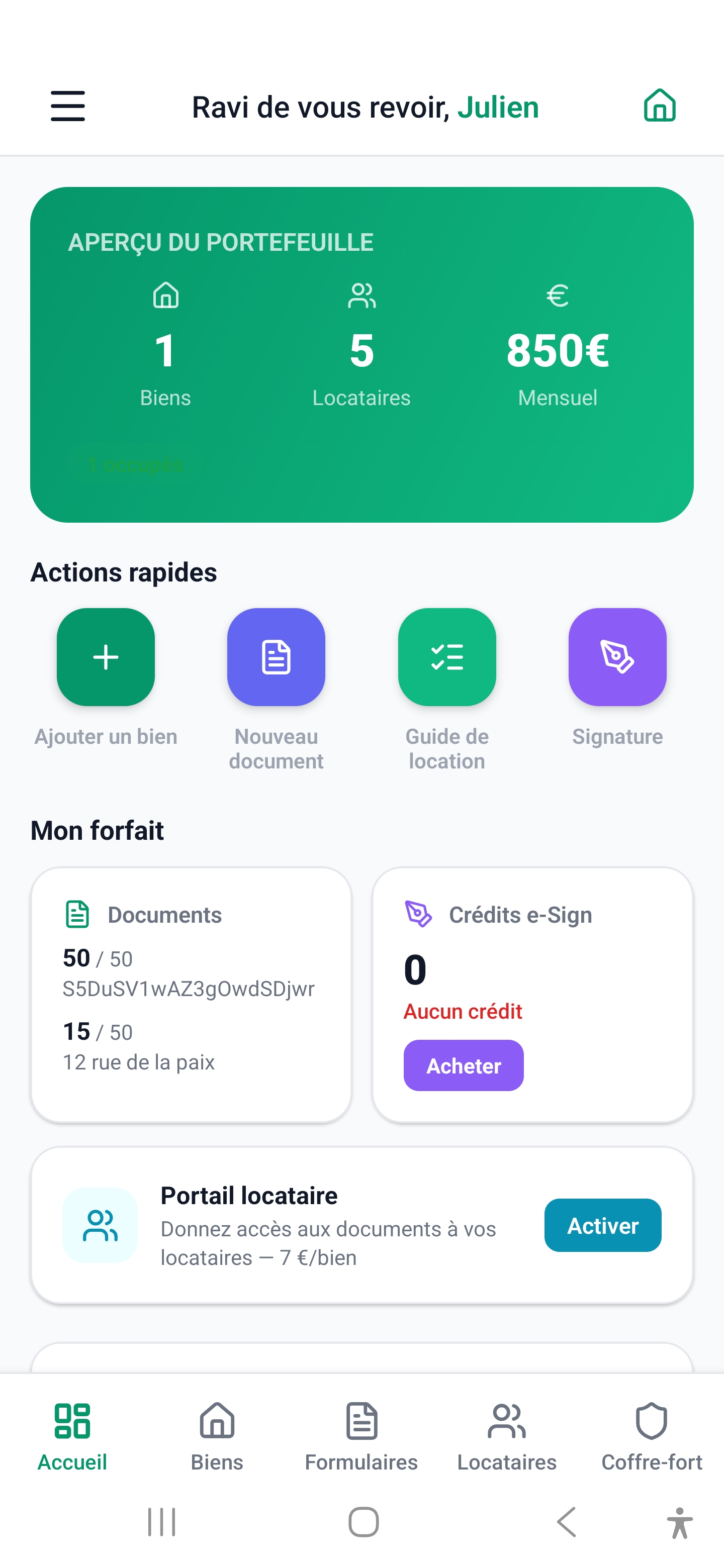
Two natural surfaces work for this. Web dashboards suit the routine monthly admin from a desk: drafting and signing quittances, tracking lease anniversaries across multiple properties, opening the encrypted vault to retrieve a state-des-lieux from 11 months ago. Mobile apps put the same workflows on a phone for the moments when you happen to be travelling, between meetings, or simply not at a desk — generating a quittance on a train, signing a lease amendment from a hotel, photographing and filing an invoice while collecting it at a syndic AGM.

The AdminLanding rental product covers both surfaces. For the dedicated non-resident handbook — eIDAS, LRE, foreign-address service, mandataire decision matrix and SIPNR taxation in one place — see adminlanding.com/manage-french-rental-abroad. The web dashboard at adminlanding.com/location handles the back-office work — quittance generation, multi-property organisation, lease anniversaries, encrypted document vault, eIDAS-qualified signature électronique conforme eIDAS. The same workflows are available on the Rent — Bail, Quittance, Loyer mobile app on Google Play (Android) and the Apple App Store (iOS) when you happen to be off the desk. A self-hosted cloud folder works equally well for a single property — the discipline of one place, one moment of filing matters more than the specific tool. What does not work is twelve sub-folders, half on a phone, half on a spouse's laptop, with the lease somewhere in an email thread.

Bookmark, don't memorise: the LRE provider you choose (typically La Poste at laposte.fr), ANIL's free legal helpline at anil.org, the SIPNR phone number (+33 1 72 95 20 42), and the quittance de loyer legal guide for the recurring monthly artefact. If your remote-managed property is approaching the décence énergétique calendar (G class banned since 2025, F from 2028), GreenDailyFix's MaPrimeRénov' for landlords guide walks through the renovation-aid dossier specifically when you're managing the file from abroad.
Frequently Asked Questions

Do I need a French phone number to be a remote landlord?

No. The lease requires the landlord's address but not a phone number, and tenant notices follow the address. A French phone number is convenient for syndic and artisan calls but not legally required. WhatsApp, Signal or email work for routine tenant communications when both parties consent.

Can my mandataire's carte G be checked online?

Yes. The CCI (Chambre de Commerce et d'Industrie) maintains the registre des cartes professionnelles, accessible per region. Loi Hoguet Article 3 requires the carte number to appear on the mandate, every devis and the agency's communications. Verify the carte before signing — an unlicensed mandataire's contract is void and your funds are unprotected.

Is a simple electronic signature enough for a French lease?

An advanced electronic signature under Article 26 of eIDAS is normally sufficient for a residential bail and an état des lieux. A qualified electronic signature under Article 28 has the explicit Article 25.2 presumption of equivalence with handwritten and is the safer default for sensitive notices (congé, mise en demeure). Most ALUR-compliant digital lease products use qualified signatures by default.

What if the tenant sends a paper LRAR to my foreign address?

It arrives, with a few extra days of postal transit. The legal effects of the LRAR — receipt, opposability of the deadline starting from receipt — apply normally. Tenants who want to be cautious will frequently send both an LRE (instant proof of dispatch) and a paper LRAR. Stating in the lease that LRE is an accepted notice channel discourages this duplication.

Can I sign a lease over Zoom/Teams with the tenant?

Yes, with eIDAS-compliant signature. The video meeting is irrelevant to legal validity — what matters is that both parties apply qualified electronic signatures (Article 1367 Code Civil + eIDAS art. 25-28) to the same digital lease document. several EU eIDAS-compliant providers and several French providers offer this directly. Print-and-scan workflows do not produce a legally valid signature; the signing must happen in the digital signing platform.

Stay updated

For more practical insights on this topic, explore our related articles:

  • Tenant Rights in France: Deposit, Repairs & the Written Proof That Wins Disputes
  • Rent by AdminLanding: Big 2026 Update for French Landlords
  • Non-Resident Landlord French Rental Tax: The 2026 Declaration Guide (2044 / 2042)
  • LMNP Furnished Rental Tax 2026: Micro-BIC vs Régime Réel Explained

Tool by AdminLanding

Manage your French rental in English, from your phone

Rent — Bail, Quittance, Loyer generates ALUR-compliant leases, rent receipts, digital états des lieux and 21 rental documents, plus built-in compliance & maintenance deadline tracking (boiler, chimney sweep, heat-pump/AC, gas & electrical checks, DPE, septic tank) with email reminders — eIDAS e-signature, bilingual FR/EN. First property free — 10 documents included, then €49/property (50 documents), €39 each additional. No subscription.

Get Rent — Bail, Quittance, Loyer

Conclusion: Running a French rental from another country in 2026 is materially easier than it was even five years ago: eIDAS signatures, the lettre recommandée électronique, ALUR-aligned digital leases and the SIPNR's online filing have removed almost every reason to keep a French desk. The mandataire de gestion remains the right answer for owners who would rather pay a percentage than learn the legal vocabulary; for everyone else, the DIY path is well-mapped, regulated and increasingly common. Pick the surface where the work actually fits your day — web dashboard, mobile app, or both — and file every document under the lease at the moment it is created.

Tool by AdminLanding

Manage your French rental in English, from your phone

Rent — Bail, Quittance, Loyer generates ALUR-compliant leases, rent receipts, digital états des lieux and 21 rental documents, plus built-in compliance & maintenance deadline tracking (boiler, chimney sweep, heat-pump/AC, gas & electrical checks, DPE, septic tank) with email reminders — eIDAS e-signature, bilingual FR/EN. First property free — 10 documents included, then €49/property (50 documents), €39 each additional. No subscription.

Get Rent — Bail, Quittance, Loyer→

Stay Updated

1 tip per week, no spam.

About the author:

Julien Maurice is the founder of AdminLanding and writes the editorial guides on ExpatAdminHub covering European expat life, France-Switzerland cross-border work, and French administrative procedures. Contact: [email protected]

Related posts

Tenant Rights in France: Deposit, Repairs & the Written Proof That Wins Disputes
Housing•June 8, 2026

Tenant Rights in France: Deposit, Repairs & the Written Proof That Wins Disputes

If you rent in France, three searches probably brought you here: "landlord won't return deposit France", "how to force my landlord to do repairs", or "my landlord is ignoring my move-out notice." These are the most common — and most stressful — tenancy disputes, and they all share one quiet truth: the tenant who has a dated, written, provable record almost always wins. French rental law (the Loi n°89-462 du 6 juillet 1989) is genuinely protective of tenants, but the law only helps you if you can prove what happened and when. As a non-French-speaking expat, that paper trail matters even more — a clear, traceable record of every request closes the door on "I never received that" and "you never asked." This guide walks through getting your dépôt de garantie back, forcing repairs your landlord is dodging, giving notice correctly, and using the état des lieux as evidence — and shows the simplest way to keep all of it in one provable place.

Read the article
Rent by AdminLanding: Big 2026 Update for French Landlords
Housing•June 8, 2026

Rent by AdminLanding: Big 2026 Update for French Landlords

If you own a flat or house in France and you do the paperwork yourself — often from another country — you already know the real work isn't the rent, it's the bail, the monthly quittance de loyer, the état des lieux, the deposit, and the slow drip of compliance deadlines nobody reminds you about. Rent by AdminLanding (full name Rent — Bail, Quittance, Loyer) just shipped a substantial update across both its mobile apps (iPhone + Android) and its web back-office at adminlanding.com — and the headline for non-resident and expat landlords is simple: you can now run a French rental end-to-end, in English or French, from a phone in London or a laptop in New York, without paying an agency 6–10% to do it for you. This is a what's-new guide: what the update added, what each surface now does, and what it costs (the first property is free). If you manage a French rental from abroad, this is the update that closes the last gaps.

Read the article
Non-Resident Landlord French Rental Tax: The 2026 Declaration Guide (2044 / 2042)
Housing•May 15, 2026

Non-Resident Landlord French Rental Tax: The 2026 Declaration Guide (2044 / 2042)

If you live abroad and rent out a property in France, France taxes that rental income — wherever you are tax-resident. The rules that trip up non-resident landlords are specific: which form to file, the 20% minimum rate, the social-levy rate that depends on your health-insurance country, and the tax treaty that stops you being taxed twice. This guide walks through the 2026 declaration end to end, for unfurnished rentals taxed as revenus fonciers. (Furnished rentals follow the separate LMNP/BIC rules.)

Read the article