ExpatAdminHubEuropean expat guide
FR
Menu▾
HomePrivacyCookiesAboutContact
All guidesPreparationHousingFinanceHealthcareWorkFamilyCultureVisas & Residence
ExpatAdminHubEuropean expat guide
HomePrivacyCookiesAboutContact
Categories
All guidesPreparation (checklists, visas, moving)Housing (rentals, utilities, neighborhoods)Finance (banking, taxes, budgeting)Healthcare (insurance, doctors, pharmacies)Work (jobs, contracts, work permits)Family (schools, childcare, family life)Culture (language, customs, integration)Visas & Residence (visa renewals, residence permits, paperwork)
FR

ExpatAdminHub

Practical guides for European expats navigating admin, housing, healthcare, and everyday life abroad.

Navigation

HomeAboutAuthor: Julien MauriceFrance hubSwitzerland hubContactPrivacyTermsSitemap

Stay Updated

1 tip per week, no spam.

© 2026 ExpatAdminHub · European expat guide.
FR

Work

jobs, contracts, work permits

How to Count Your Telework Days as a Frontalier: the 40% Tax Rule vs the 49.9% Social-Security Rule
Work · 05 August 2026

How to Count Your Telework Days as a Frontalier: the 40% Tax Rule vs the 49.9% Social-Security Rule

Every France–Switzerland frontalier who works from home now lives with two numbers: 40% and 49.9%. They look interchangeable. They are not. The 40% ceiling comes from the Franco-Swiss tax avenant signed on 27 June 2023 and decides which country taxes your salary from 1 January 2026. The 49.9% ceiling comes from the EU/EFTA social-security framework agreement in force since 1 July 2023 and decides which country's social system you contribute to. Two legal instruments, two reference bases, two sets of consequences — and one shared practical problem: you can only show you are under either line if you actually count your days. This guide is the counting how-to: what goes into each count, how mission days are treated, and a simple monthly method that holds up if anyone asks. It is general information drawn from official French, Swiss and EU sources — not personalised tax or legal advice — and for anything specific to your canton or contract it points you to the competent bodies.

Read the article
Teleworking rules for France–Switzerland cross-border workers: the 40% telework tax agreement
Work · 07 Jul 2026

Teleworking rules for France–Switzerland cross-border workers: the 40% telework tax agreement

If you live in France and work for a Swiss employer, the days you spend working from your kitchen table are no longer a legal grey zone. Since 1 January 2026 a permanent framework governs how much you can telework from France before your tax situation moves. The headline number is 40%: up to 40% of your annual working time can be performed as telework from your home in France without changing the country that taxes your salary or costing you your frontalier status. This guide explains the 40% tax rule from the avenant signed on 27 June 2023 (published in France by [décret n° 2025-838](https://www.legifrance.gouv.fr/jorf/id/JORFTEXT000052129841)), the separate 49.9% social-security threshold that people constantly confuse with it, what happens if you cross either line, the new employer reporting duties, and how to plan a realistic telework week. Figures and dates are drawn from official French and Swiss sources — this is information, not personalised tax advice, so verify your own case before acting.

Read the article
Family Allowances for France-Switzerland Cross-Border Workers: Swiss Allocations, the French Differential and CAF
Work · 07 Jul 2026

Family Allowances for France-Switzerland Cross-Border Workers: Swiss Allocations, the French Differential and CAF

If you live in France and work in Switzerland, your children's family allowances are governed not by one country but by a European coordination rule that decides who pays first and who tops up. The result surprises many frontaliers: Swiss allowances are usually higher than French ones, so the money often flows the opposite way to what people expect. This guide explains the priority rule under [Article 68 of Regulation (EC) No 883/2004](https://www.cleiss.fr/docs/textes/883-04/t3-8.html), the Swiss allowance amounts canton by canton, when the French complément différentiel is actually paid by the CAF, what happens when both parents work in different countries, and the exact paperwork — your Swiss employer's caisse plus the CAF and the E411 form. Figures are 2026 values; treat them as information, not personalised advice, and confirm the current amounts with your canton's caisse and your CAF before you rely on them.

Read the article
Unemployment benefits for France–Switzerland cross-border workers: who pays and how much
Work · 07 Jul 2026

Unemployment benefits for France–Switzerland cross-border workers: who pays and how much

When a France-resident cross-border worker loses a job in Switzerland, the first question is rarely emotional — it is administrative: who pays my unemployment, Switzerland or France? The Swiss salary was high, the contributions went to a Swiss fund, yet for a genuine daily commuter the answer is France. That rule flows from [EU Regulation (EC) No 883/2004](https://www.cleiss.fr/docs/textes/883-04/t3-6.html), Article 65, which sends a wholly unemployed frontier worker to the unemployment system of the country of residence. This guide walks the whole path: why France pays, the make-or-break line between full and partial unemployment, how to register with France Travail and obtain the Swiss PD U1 attestation, how your former Swiss salary becomes a French benefit (and where the ceiling bites), the 3-to-5-month reimbursement Switzerland owes France, and the 2026 reform that could shift the bill to the country of work. Every figure below is information, not personalised advice — verify the current numbers at the official source before acting.

Read the article
Quasi-resident tax status for France-Switzerland cross-border workers: who benefits and how to claim
Work · 07 Jul 2026

Quasi-resident tax status for France-Switzerland cross-border workers: who benefits and how to claim

Every year, tens of thousands of French residents who work in Geneva or Vaud watch a flat impôt à la source (withholding tax) come off their Swiss payslip, with none of the real deductions a Swiss resident enjoys. The quasi-resident status (statut de quasi-résident) is the legal route that closes that gap: it lets a non-resident who earns almost all of their income in Switzerland be taxed like an ordinary resident, deducting pension buy-ins, childcare, alimony and more. It is not automatic, it must be requested every year by 31 March, and, crucially, it does not help everyone. This guide decodes the 90% rule that gates eligibility, the deductions a taxation ordinaire ultérieure (TOU) unlocks, why Geneva and Vaud frontaliers are not in the same boat, and how to file with the AFC or ACI. Start from the official [impots.gouv.fr frontalier pages](https://www.impots.gouv.fr/international-particulier/salaries-en-suisse); this is information, not personalised advice, so verify every figure at the source before acting.

Read the article
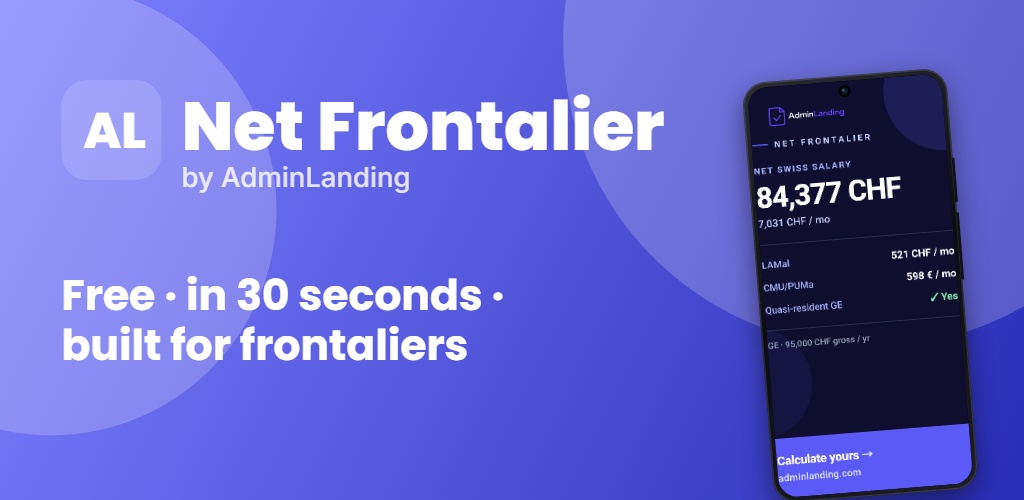
Net Frontalier: The Free App That Finally Tells You Your Real Swiss Net Salary
Work · 08 Jun 2026

Net Frontalier: The Free App That Finally Tells You Your Real Swiss Net Salary

You signed a Swiss contract with a gross salary in CHF, you live in France, and somewhere in the first three months you are supposed to make a permanent health-insurance choice between LAMal and CMU — in French, against a clock you barely understand. The single number nobody gives you is the one that matters: what actually lands in your account each month, and whether LAMal or CMU is cheaper for you. Net Frontalier is a free, anonymous, bilingual app that answers exactly that. Here is what it does, what it honestly does not do, and how to use it before your droit d'option deadline runs out.

Read the article
Permit G Switzerland: The Complete Guide for Cross-Border Workers (Frontaliers)
Work · 31 Mar 2026

Permit G Switzerland: The Complete Guide for Cross-Border Workers (Frontaliers)

The Permit G (Grenzgängerbewilligung / permis frontalier) is the residence document that allows you to live in an EU/EFTA country and work in Switzerland. With over 400,000 frontaliers crossing into Switzerland daily (OFS, 2025), it is one of the most common — and most misunderstood — work permits in Europe. Here is everything you need to know.

Read the article
Why Cross-Border Workers Pay Tax in the Wrong Country — Without Knowing It
Work · 27 Dec 2025

Why Cross-Border Workers Pay Tax in the Wrong Country — Without Knowing It

For many cross-border workers between France and Switzerland, taxes feel deceptively simple. Salary is paid in one country, life happens in another, and deductions appear automatically. Everything looks normal — until one day it doesn’t. Each year, thousands of frontaliers discover they have been paying tax in the wrong country, or in the wrong way, without ever intending to. This article explains why this mistake is so common, why it often goes unnoticed for years, and why correcting it is rarely as easy as people expect.

Read the article
Geneva Region 2025: Salaries, Taxes, Housing & Mobility — The New Reality for Expats and Cross-Border Workers
Work · 09 Dec 2025

Geneva Region 2025: Salaries, Taxes, Housing & Mobility — The New Reality for Expats and Cross-Border Workers

227,400 cross-border workers. A record number that captures the spectacular transformation of the Geneva region in 2025. Behind this statistic lies a complex reality: salaries among the highest in Europe, yet record housing pressure. Stricter tax rules, yet unique professional opportunities. Saturated daily mobility, yet constantly improving infrastructure. For the 15,000 expats and new cross-border workers arriving each year, understanding this new landscape is no longer optional. This 3,500-word guide analyzes in depth the sectoral salaries, Franco-Swiss tax mechanisms, housing market reality, mobility strategies, and administrative traps to avoid. With 2025 data, concrete examples, and detailed budgets, this is the only guide you need to succeed in your relocation to the Lake Geneva region.

Read the article
France–Switzerland 2024–2025: The Coming Cross-Border Earthquake
Work · 29 Nov 2025

France–Switzerland 2024–2025: The Coming Cross-Border Earthquake

A silent earthquake is reshaping the France–Switzerland relationship. Beyond speeches and press releases, the rules are shifting fast: cross-border taxes, health insurance, banking, work permits, daily commuting. More than 220,000 workers now cross the border, and they sit at the centre of an unprecedented transformation. This investigative-style guide explains what is changing, what may come next, and how to prepare practically for 2025.

Read the article
Europe's International School Rush: Admissions, Waitlists, Cost Explosion — The 2025 Truth Guide
Work · 24 Nov 2025

Europe's International School Rush: Admissions, Waitlists, Cost Explosion — The 2025 Truth Guide

Every expat parent feels it now: getting a seat in an international school has become one of the toughest parts of moving to Europe. In 2025, pressure has reached a new level, with long waitlists, rising tuition fees, new admission rules, and fierce competition between expat families, locals, and cross-border workers. This guide explains what is happening, which schools are under the most pressure, and practical strategies to secure a place even in very competitive schools.

Read the article
France–Switzerland 2025: The Coming Cross-Border Earthquake (Taxes, Healthcare, Rail, Jobs, Housing)
Work · 23 Nov 2025

France–Switzerland 2025: The Coming Cross-Border Earthquake (Taxes, Healthcare, Rail, Jobs, Housing)

2025 is shaping up to be the most turbulent year for France–Switzerland cross-border workers in two decades. Pressure on tax treaties, heated [CMU](/en/blog/2026-03-28-lamal-vs-cmu-health-insurance-cross-border-worker) debates, housing inflation on the French side, saturated rail lines, renegotiated health coverage and Swiss employers struggling to hire all at once point to a coming cross-border earthquake. This article explains what is already changing, what could change next, how it may hit your wallet and which strategies can keep you ahead of the curve.

Read the article
The End of the Digital Nomad Golden Age: Why the Model Is Slowing in 2025 and How Expats Can Adapt
Work · 18 Nov 2025

The End of the Digital Nomad Golden Age: Why the Model Is Slowing in 2025 and How Expats Can Adapt

For a decade, working from Lisbon, Tbilisi or Tallinn symbolised the modern work dream: freedom, sun, Wi-Fi cafés, borderless living. But in 2025, the trend is reversing. Companies tighten rules, governments reinforce tax controls, and the European Union introduces new labour and social-security obligations. Are we witnessing the end of an era? This guide brings together data, real scenarios, and action plans so you can adjust your expat life instead of being forced to move or change jobs in a rush.

Read the article
International Schools in France: 2025 Pillar Guide (IB, British, American, Bilingual, Admissions, Costs)
Work · 11 Nov 2025

International Schools in France: 2025 Pillar Guide (IB, British, American, Bilingual, Admissions, Costs)

Moving to France with kids seems simple—until school comes into play. IB, British, American, bilingual… the options are vast but confusing. This 2025 pillar guide breaks down real differences, notable schools, and practical steps for a smooth enrollment—from first contact to first day.

Read the article
Mastering Your First Year Abroad: Budget, Bureaucracy & Belonging
Work · 08 Nov 2025

Mastering Your First Year Abroad: Budget, Bureaucracy & Belonging

The first six months abroad are the hardest. You juggle everything—housing, health, banking, taxes, and that mysterious 'number' everyone keeps asking for. But most expats eventually find their rhythm—with the right roadmap. This guide is your first-year blueprint, balancing finances, paperwork, and real life.

Read the article
Working Remotely Across Borders: How to Stay Compliant Between Two EU Countries
Work · 27 Oct 2025

Working Remotely Across Borders: How to Stay Compliant Between Two EU Countries

More and more expats work for a company in one country while living in another. It's convenient—but taxes, social security, and residence can quickly get tricky. Here's a practical guide to enjoy cross-border remote work without breaking any rules.

Read the article
France-Switzerland Cross-Border Worker Guide 2026: Tax, Healthcare, Permit G & Telework
Work · 24 Oct 2025

France-Switzerland Cross-Border Worker Guide 2026: Tax, Healthcare, Permit G & Telework

Around 235,000 French residents commute daily to a Swiss employer, making the France-Switzerland corridor the largest single cross-border labour flow in the European Economic Area. The rules governing this status are dense: two separate tax regimes depending on which Swiss canton employs you, a healthcare choice that must be made within three months of starting work and locks for a long time after, a Swiss residence permit (permit G) that requires you to return home at least once a week, two pension pillars to coordinate with the French régime général, and — since the post-pandemic Avenant signed on 27 June 2023 — a 40% cap on telework if you want to keep the frontalier tax regime. Get any of these wrong and the cost is real: double taxation, retroactive [LAMal](/en/blog/2026-03-28-lamal-vs-cmu-health-insurance-cross-border-worker) premiums, lost AVS quarters, an unenforceable contract. This guide walks through every layer in plain English with the legal references and forms you actually need, and shows where AdminLanding's tools fit into the workflow.

Read the article
Working remotely from another EU country: rights, taxes, and work-life balance
Work · 20 Oct 2025

Working remotely from another EU country: rights, taxes, and work-life balance

More and more expats keep their original job while living elsewhere in Europe. But behind the freedom of cross-border remote work lie practical questions: taxes, social security, health coverage, and daily rhythm. Here's how to stay compliant and balanced.

Read the article
Finding your first job abroad: how to localize your CV, get replies, and negotiate without feeling awkward
Work · 12 Oct 2025

Finding your first job abroad: how to localize your CV, get replies, and negotiate without feeling awkward

Job hunting in a new country feels like learning a new game with familiar pieces. The rules change a little—how you format your CV, when people answer, how offers are written—but the goal is the same: show your value clearly and politely. This guide walks you from the first profile tweak to a signed contract, with examples you can reuse.

Read the article