ExpatAdminHubEuropean expat guide
FR
Menu▾
HomePrivacyCookiesAboutContact
All guidesPreparationHousingFinanceHealthcareWorkFamily
ExpatAdminHubEuropean expat guide
HomePrivacyCookiesAboutContact
Categories
All guidesPreparation (checklists, visas, moving)Housing (rentals, utilities, neighborhoods)Finance (banking, taxes, budgeting)Healthcare (insurance, doctors, pharmacies)Work (jobs, contracts, work permits)Family (schools, childcare, family life)Culture (language, customs, integration)
FR

ExpatAdminHub

Practical guides for European expats navigating admin, housing, healthcare, and everyday life abroad.

Navigation

HomeAboutContactPrivacyTermsSitemap

Stay Updated

1 tip per week, no spam.

© 2026 ExpatAdminHub · European expat guide.
FR
  1. Home
  2. Blog
  3. Housing
  4. Tenant Rights in France: Deposit, Repairs & the Written Proof That Wins Disputes
Tenant Rights in France: Deposit, Repairs & the Written Proof That Wins Disputes
This article is also available in French.
Lire en français →

French rental law series

  • Rent by AL: app + web update
  • Non-resident landlord rental tax (2044)
  • LMNP furnished tax: micro-BIC vs réel
  • French bail lease: full guide
  • Landlord obligations: rent receipts
  • Free quittance template (legal guide)

Tenant Rights in France: Deposit, Repairs & the Written Proof That Wins Disputes

Published June 8, 2026

If you rent in France, three searches probably brought you here: "landlord won't return deposit France", "how to force my landlord to do repairs", or "my landlord is ignoring my move-out notice." These are the most common — and most stressful — tenancy disputes, and they all share one quiet truth: the tenant who has a dated, written, provable record almost always wins. French rental law (the Loi n°89-462 du 6 juillet 1989) is genuinely protective of tenants, but the law only helps you if you can prove what happened and when. As a non-French-speaking expat, that paper trail matters even more — a clear, traceable record of every request closes the door on "I never received that" and "you never asked." This guide walks through getting your dépôt de garantie back, forcing repairs your landlord is dodging, giving notice correctly, and using the état des lieux as evidence — and shows the simplest way to keep all of it in one provable place.

Key facts

  • Your dépôt de garantie must be returned within 1 month if the move-out état des lieux matches the move-in one, or 2 months if there are justified deductions (Loi du 6 juillet 1989, art. 22).
  • Late return is penalised at 10% of one month's rent for every month started beyond the deadline — automatically, no judge required.
  • Repairs that aren't normal wear-and-tear are the landlord's legal obligation; a documented request, then a mise en demeure by recommandé AR, is your escalation path.
  • Move-out notice (congé / préavis) is 3 months for an unfurnished lease, 1 month for furnished or in a zone tendue — and you must keep proof it was received.
  • The état des lieux (entry and exit) plus dated photos is the single most powerful piece of evidence in almost every tenancy dispute.
  • A tenant portal keeps every message, letter and document in one dated, exportable trail — ask your landlord to switch it on for your rental.

The tenant portal

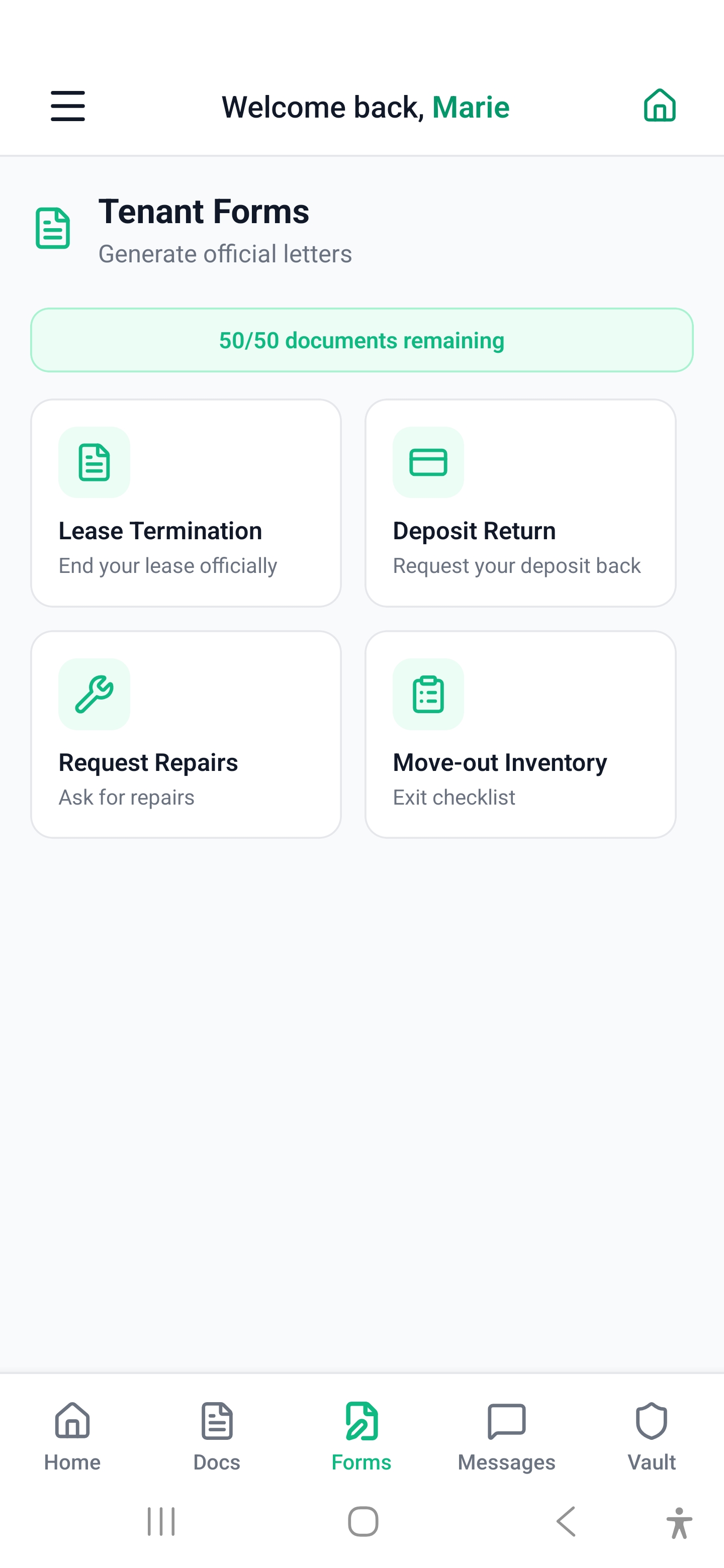
Everything in one place: your messages, your letters and your documents — available any time.

Your dashboard
Your dashboard
Message your landlord
Ready-made letters
Ready-made letters

The one rule behind every tenancy dispute: keep proof

Before we get into deposits, repairs and notices, understand the through-line of this entire guide: in a French tenancy dispute, evidence beats argument every time.

The Loi du 6 juillet 1989 gives tenants strong rights, but it places the burden of proof on whoever is making a claim. If you say you asked for a repair and the landlord says you didn't, the version with a dated, written, received record wins. If your landlord deducts €600 from your deposit for "damage," the entry état des lieux and your move-in photos decide whether that deduction stands.

This is why French tenancy practice revolves around a few specific, traceable tools:

  • The lettre recommandée avec accusé de réception (recommandé AR) — registered post with proof of receipt. It date-stamps your request and proves the landlord received it.
  • The mise en demeure — a formal "final demand" letter that legally puts the landlord en demeure (on notice) and starts the clock on remedies.
  • The état des lieux — the move-in/move-out inventory, signed by both parties, plus dated photos.
  • A written, timestamped exchange history — every request, reply and document in one place.

As an expat who may not be fully comfortable arguing in French, this is doubly important. You don't need to win a verbal exchange. You need a record that speaks for itself. Everything below builds on this single principle.

Getting your dépôt de garantie back (deposit return deadlines)

The dépôt de garantie (security deposit) is the number-one tenancy dispute in France — "dépôt de garantie non rendu, que faire ?" is searched constantly. Here is exactly how it works.

The legal deadlines (Loi du 6 juillet 1989, art. 22):

  1. 1 month to return the full deposit if the move-out état des lieux (exit inventory) is identical to the move-in one — i.e. no new damage.
  2. 2 months if the landlord is making deductions (retenues) — for repairs, unpaid rent, or outstanding charges.

The clock starts the day you hand back the keys (remise des clés). The deposit is usually one month's rent for an unfurnished lease and up to two months for furnished.

Deductions must be justified. A landlord cannot keep money on a vague claim. Each deduction must be backed by evidence: the entry vs. exit état des lieux, plus quotes (devis) or invoices (factures) for repairs. "Normal wear and tear" (vétusté / usure normale) is not chargeable — faded paint after years of living there, minor wear on flooring, and small marks are the landlord's cost, not yours.

The 10% penalty. If the landlord misses the deadline, the law applies an automatic penalty of 10% of one month's rent for every month started late. No judge needed — it accrues by operation of law. On a €900 rent, that's €90 per late month added to what you're owed.

If the deposit isn't returned:

  1. Send a mise en demeure de restituer le dépôt de garantie by recommandé AR, citing art. 22 and the deadline that has passed, and including the 10% penalty.
  2. If there's no response, refer the matter to the Commission départementale de conciliation (CDC) — free, and required before some court actions.
  3. If conciliation fails, the juge des contentieux de la protection (small-claims housing judge) settles deposit disputes, often without a lawyer.

Every step above depends on proof: your dated état des lieux, your move-in photos, and a recommandé you can show was received.

Forcing repairs your landlord won't do

"Demande de travaux propriétaire" and "how do I force my landlord to make repairs" are the second-biggest cluster of tenant searches. French law is clear: the landlord must deliver and maintain a logement décent (decent dwelling) and carry out all repairs that are not minor day-to-day upkeep.

Who pays for what?

  • Landlord (bailleur): structural issues, heating/boiler failure, plumbing, electrical safety, water infiltration, mould from a building defect, broken windows from wear, anything affecting habitability.
  • Tenant (locataire): small everyday maintenance (réparations locatives) — changing light bulbs, unblocking a sink, minor seals, garden upkeep.

If the problem is the landlord's responsibility, here is the escalation ladder — each rung adds proof:

  1. First written request. Report the issue in writing (not just a phone call or verbal mention). Describe the problem, date it, and ask for repair within a reasonable deadline. Keep a copy.
  2. Mise en demeure by recommandé AR. If nothing happens, send a formal mise en demeure de réaliser les travaux, by registered post with acknowledgement of receipt, setting a firm deadline (e.g. 15 days). This is the legal pivot point.
  3. Commission départementale de conciliation. Free mediation that can produce a written agreement.
  4. Tribunal. The judge can order the works under an astreinte (a daily fine until done), authorise the tenant to have urgent repairs done and deduct the cost, or reduce the rent.

Do not stop paying rent to pressure the landlord — withholding rent unilaterally puts you in breach and can justify eviction. The correct lever is the documented mise en demeure, not a rent strike.

Notice the pattern again: written request → recommandé AR → conciliation → tribunal. Every rung is a piece of dated evidence.

Get the next rental guide before your neighbours do

We send one practical landlord/tenant tip per week — bail, ALUR, DPE, quittance. No spam, unsubscribe anytime.

Ask your landlord to switch on the tenant portal

By now you've seen the pattern in every dispute: you win when you have a dated, written, provable trail — and you struggle when it's scattered across SMS, WhatsApp, half-remembered phone calls and a shoebox of letters.

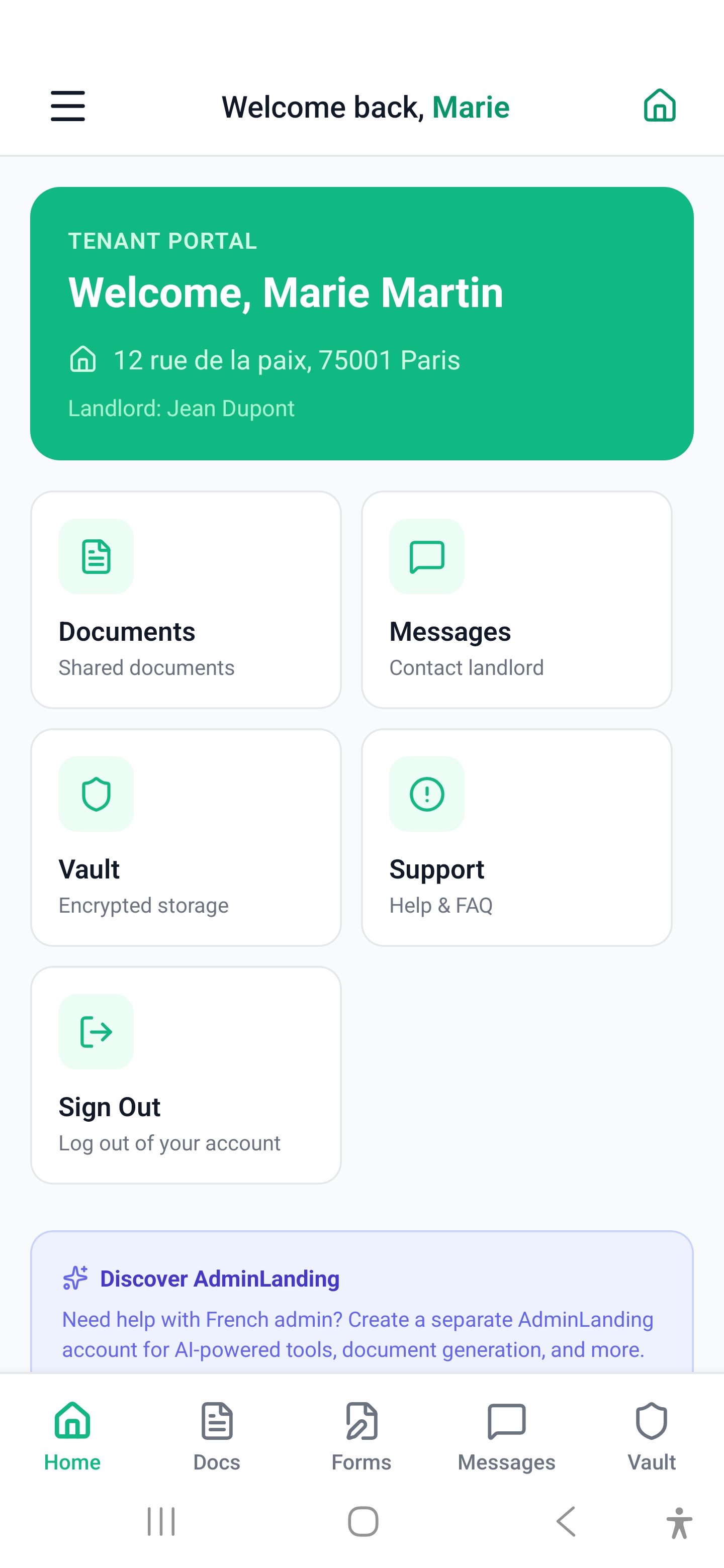
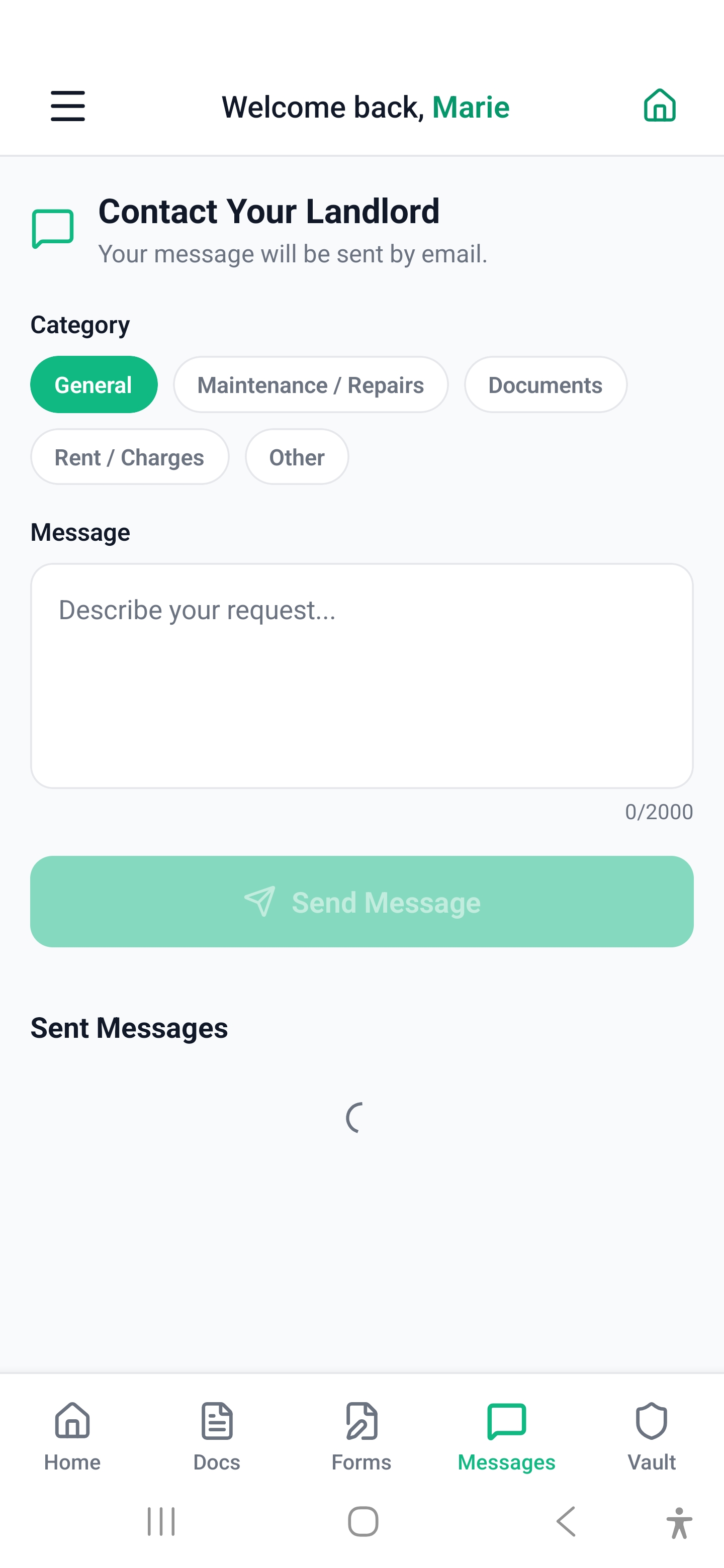
The simplest way to keep that trail is a tenant portal: a logged-in space tied to your specific rental where you and your landlord exchange structured, timestamped messages, where you can generate ready-made letters (deposit-return request, repair request, lease termination, move-out inventory), and where every document lives in one vault you can export.

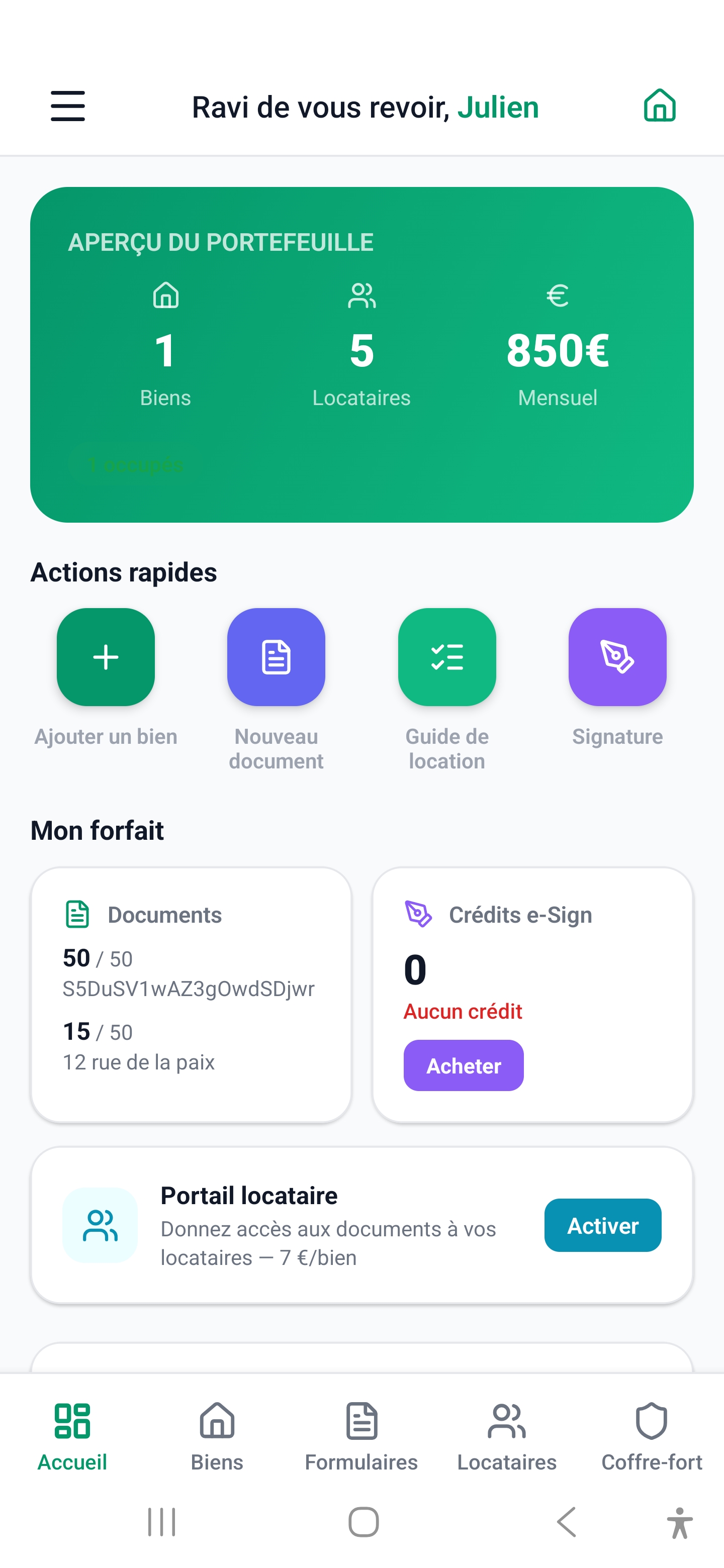
Many French landlords already manage their rentals through AdminLanding's Rent product. For them, turning on the tenant portal for your unit is a one-time €7 per property — and it gives you, the tenant, a clean record of everything.

So here's a concrete, empowering step you can take today: ask your landlord to enable the tenant portal for your rental. A short, friendly message works well — "Would you mind switching on the tenant portal so we have repair requests, the état des lieux and quittances all in one place? I believe it's a one-off €7 on your side." It helps both of you: fewer lost messages, faster repairs, and a clean handover when you leave.

👉 Landlord-facing page to share with them: adminlanding.com/french-tenant-portal
Giving notice (congé / préavis) the right way

"Préavis non pris en compte" — a landlord ignoring or denying your move-out notice — is a real and stressful problem, and almost always a proof problem. When you leave a rental, you give notice (congé) to the landlord, and the notice period (préavis) must be respected.

Notice periods:

  • Unfurnished lease: 3 months by default.
  • Reduced to 1 month if the property is in a zone tendue (most large cities and tight rental markets), or for specific reasons such as a job transfer (mutation), first job, job loss, a new job after losing one, a health reason certified by a doctor, receiving RSA/AAH, or being assigned social housing.
  • Furnished lease: 1 month, always.

How to give notice — and prove it: Send your congé by lettre recommandée avec accusé de réception, by acte de commissaire de justice (bailiff), or by hand delivery against a signed receipt (récépissé or émargement). Email or a verbal heads-up does not legally start the préavis.

The préavis starts on the day the landlord receives the letter (the date on the accusé de réception), not the day you posted it. This is exactly why the AR matters: if your landlord later claims "I never got your notice," the signed accusé de réception ends the argument and pins down your move-out date.

Tip: keep the AR slip and a copy of the letter. If you're invoking the reduced 1-month préavis, state the reason in the letter and attach proof (e.g. your employment letter or the zone tendue status), so the shortened period is documented from day one.

The état des lieux: your strongest piece of evidence

If there is one document to get right, it is the état des lieux (inventory of fixtures). There are two: the état des lieux d'entrée (move-in) and the état des lieux de sortie (move-out). The landlord compares them, and the difference between the two is what can legally be charged against your deposit.

At move-in:

  • Be thorough and honest. Note every existing mark, scratch, stain, and faulty item, even small ones. What you don't record at entry, you can be charged for at exit.
  • Take dated photos of everything — walls, floors, appliances, sanitary fittings, window frames. Photo metadata and a clear date are gold.
  • If you spot defects after signing, you have 10 days to ask for the entry état des lieux to be amended (and for heating, until the end of the first heating period).
  • Both parties sign; you keep a copy.

At move-out:

  • The exit inventory is done together when you hand back the keys. Compare it line-by-line with the entry document.
  • Distinguish normal wear (vétusté) — not chargeable — from real damage. Years of normal living are not your liability.
  • Take dated exit photos too.

If you can't agree on the exit état des lieux, it can be drawn up by a commissaire de justice (bailiff); the cost is usually shared. A signed, photo-backed pair of inventories is what makes a wrongful deposit deduction collapse — and "état des lieux litige" disputes almost always turn on who documented what.

How to write a letter that actually works (mise en demeure)

Across deposits, repairs and notice, the same instrument keeps appearing: the lettre recommandée, and specifically the mise en demeure. Searches like "lettre propriétaire recommandé" and "mise en demeure réparations" show how central this is. Here's what a mise en demeure needs to do its job:

  1. Clear heading: the words "Mise en demeure" in the subject line — this signals legal intent.
  2. Identify the parties and the property: your name, the landlord's name, the rental address, and the lease (bail) date.
  3. State the facts and the legal basis: what's wrong, since when, and the relevant article (e.g. art. 22 de la loi du 6 juillet 1989 for the deposit; the décence/repair obligations for works).
  4. A precise demand and a deadline: exactly what you want (return €X, carry out Y repair) and by when (e.g. "sous 8 jours" or "sous 15 jours").
  5. The consequence: that failing this, you will refer the matter to the Commission départementale de conciliation and, if needed, the tribunal.
  6. Send by recommandé AR and keep the slip.

You don't need a lawyer to write one, but it must be accurate and in correct French — which is precisely where many expats hesitate. Pre-built, fill-in letter templates (deposit return, repair request, lease termination) remove that friction and make sure the legal references and structure are right.

A polite first request resolves most issues. The mise en demeure is the escalation that shows you're serious — and creates the proof you'll need if it goes further.

Put it all in one place — and a note for expats

Step back and look at what every section above required: a request you can date, a letter the landlord provably received, an inventory backed by photos, and a history you can produce on demand. Managed by hand, that's a mess of recommandé slips, phone screenshots and PDFs in three different inboxes. Managed in a tenant portal, it's one tidy, exportable record.

That's the practical case for asking your landlord to switch on the tenant portal for your rental: structured messaging that timestamps every exchange, ready-made letters for exactly the situations above, and a document vault holding your lease, your quittances de loyer, and both états des lieux. It costs your landlord a one-time €7 per property and gives you a clean trail you control.

If you want to understand the contract underneath all of this, our French bail (lease) guide breaks down your rights and obligations clause by clause.

A specific note for expats: when French isn't your first language, the risk isn't that the law is against you — it's that you can't easily prove your side in a phone call or argue a deduction on the spot. A written, traceable trail levels that completely. The accusé de réception doesn't care what language you speak; the dated photo doesn't need translating; the timestamped message in a portal is the same evidence whether you're a Paris native or three months off the plane. Keep everything in writing, keep proof of receipt, and the system that feels stacked against you starts working the way it's supposed to.

👉 Ask your landlord to enable it: adminlanding.com/french-tenant-portal
Frequently Asked Questions

My landlord won't return my deposit in France — what can I do?

First send a mise en demeure by lettre recommandée avec accusé de réception, citing article 22 of the Loi du 6 juillet 1989, the deadline that has passed (1 month if the exit inventory matches the entry one, 2 months if there are deductions), and the automatic 10% penalty per late month. If there's no response, refer the dispute to the free Commission départementale de conciliation, and finally to the juge des contentieux de la protection if needed. Your entry/exit état des lieux and dated photos are your evidence.

How long does a landlord have to return the security deposit?

One month from the day you return the keys if the move-out état des lieux is identical to the move-in one (no new damage), or two months if the landlord is making justified deductions. Past that deadline, the deposit owed increases by 10% of one month's rent for every month started late, automatically and without a court order.

How do I force my landlord to do repairs?

Start with a dated written request. If it's ignored, send a mise en demeure de réaliser les travaux by recommandé AR with a firm deadline (e.g. 15 days). If that fails, use the Commission départementale de conciliation, then the tribunal, which can order the works under a daily penalty (astreinte) or reduce your rent. Do not stop paying rent to apply pressure — that puts you in breach.

My landlord says they never received my move-out notice. What now?

This is why notice (congé) must be sent by lettre recommandée avec accusé de réception, by bailiff, or hand-delivered against a signed receipt — never by email or verbally. The préavis runs from the date the landlord receives the letter, shown on the accusé de réception. That signed slip is your proof and fixes your move-out date, ending any 'I never got it' dispute.

What counts as normal wear and tear versus chargeable damage?

Normal wear (vétusté or usure normale) — faded paint, minor flooring wear, small marks from ordinary living over the years — is the landlord's cost and cannot be deducted from your deposit. Chargeable damage is new, beyond normal use: holes, broken fittings, stains, missing items. The comparison between your entry and exit état des lieux, backed by dated photos, decides which is which.

Does the tenant portal cost me, the tenant, anything?

No. The tenant portal is enabled by the landlord as a one-time €7 per property through AdminLanding's Rent product. For you as the tenant, it's simply a logged-in space to exchange timestamped messages, generate ready-made letters, and store your lease, quittances and états des lieux. You ask your landlord to switch it on for your rental.

Stay updated

For more practical insights on this topic, explore our related articles:

  • Rent by AdminLanding: Big 2026 Update for French Landlords
  • Non-Resident Landlord French Rental Tax: The 2026 Declaration Guide (2044 / 2042)
  • LMNP Furnished Rental Tax 2026: Micro-BIC vs Régime Réel Explained
  • Best Rental Management Apps for French Landlords in 2026

Tool by AdminLanding

Manage your French rental in English, from your phone

Rent — Bail, Quittance, Loyer generates ALUR-compliant leases, rent receipts, digital états des lieux and 21 rental documents, plus built-in compliance & maintenance deadline tracking (boiler, chimney sweep, heat-pump/AC, gas & electrical checks, DPE, septic tank) with email reminders — eIDAS e-signature, bilingual FR/EN. First property free — 10 documents included, then €49/property (50 documents), €39 each additional. No subscription.

Get Rent — Bail, Quittance, Loyer

Conclusion: French rental law is genuinely on the tenant's side — your deposit must come back on time, repairs that aren't your fault are the landlord's job, and your notice counts the moment it's received. But none of that protection activates on its own. It activates when you can show a **dated, written, provable record** of what you asked, when, and that it was received. Get the entry état des lieux right with photos, put every request in writing, escalate with a mise en demeure by recommandé AR when needed, and never let your proof scatter across phone calls and chat apps. The cleanest way to hold that trail is a tenant portal — so the single most useful thing you can do today is ask your landlord to switch one on for your rental. This guide is general information, not personalised legal advice; for a specific dispute, the free ADIL or the Commission départementale de conciliation can guide you on your exact situation.

Tool by AdminLanding

Manage your French rental in English, from your phone

Rent — Bail, Quittance, Loyer generates ALUR-compliant leases, rent receipts, digital états des lieux and 21 rental documents, plus built-in compliance & maintenance deadline tracking (boiler, chimney sweep, heat-pump/AC, gas & electrical checks, DPE, septic tank) with email reminders — eIDAS e-signature, bilingual FR/EN. First property free — 10 documents included, then €49/property (50 documents), €39 each additional. No subscription.

Get Rent — Bail, Quittance, Loyer→

Stay Updated

1 tip per week, no spam.

About the author:

Julien is a European expat guide sharing practical, tested advice for navigating life abroad. Contact: [email protected]

Related posts

Rent by AdminLanding: Big 2026 Update for French Landlords
Housing•June 8, 2026

Rent by AdminLanding: Big 2026 Update for French Landlords

If you own a flat or house in France and you do the paperwork yourself — often from another country — you already know the real work isn't the rent, it's the bail, the monthly quittance de loyer, the état des lieux, the deposit, and the slow drip of compliance deadlines nobody reminds you about. Rent by AdminLanding (full name Rent — Bail, Quittance, Loyer) just shipped a substantial update across both its mobile apps (iPhone + Android) and its web back-office at adminlanding.com — and the headline for non-resident and expat landlords is simple: you can now run a French rental end-to-end, in English or French, from a phone in London or a laptop in New York, without paying an agency 6–10% to do it for you. This is a what's-new guide: what the update added, what each surface now does, and what it costs (the first property is free). If you manage a French rental from abroad, this is the update that closes the last gaps.

Read the article
Non-Resident Landlord French Rental Tax: The 2026 Declaration Guide (2044 / 2042)
Housing•May 15, 2026

Non-Resident Landlord French Rental Tax: The 2026 Declaration Guide (2044 / 2042)

If you live abroad and rent out a property in France, France taxes that rental income — wherever you are tax-resident. The rules that trip up non-resident landlords are specific: which form to file, the 20% minimum rate, the social-levy rate that depends on your health-insurance country, and the tax treaty that stops you being taxed twice. This guide walks through the 2026 declaration end to end, for unfurnished rentals taxed as revenus fonciers. (Furnished rentals follow the separate LMNP/BIC rules.)

Read the article
LMNP Furnished Rental Tax 2026: Micro-BIC vs Régime Réel Explained
Housing•May 13, 2026

LMNP Furnished Rental Tax 2026: Micro-BIC vs Régime Réel Explained

Rent out a furnished property in France and your income is not revenus fonciers — it is BIC (industrial and commercial profit), under the LMNP regime. That single difference changes everything: the allowances, the ability to deduct depreciation, and even how your eventual sale is taxed after the 2025 reform. Here is how LMNP works in 2026, the micro-BIC vs régime réel choice that decides your tax bill, and the recent rule changes every furnished landlord should know.

Read the article