ExpatAdminHubEuropean expat guide
FR
Menu▾
HomePrivacyCookiesAboutContact
All guidesPreparationHousingFinanceHealthcareWorkFamilyCultureVisas & Residence
ExpatAdminHubEuropean expat guide
HomePrivacyCookiesAboutContact
Categories
All guidesPreparation (checklists, visas, moving)Housing (rentals, utilities, neighborhoods)Finance (banking, taxes, budgeting)Healthcare (insurance, doctors, pharmacies)Work (jobs, contracts, work permits)Family (schools, childcare, family life)Culture (language, customs, integration)Visas & Residence (visa renewals, residence permits, paperwork)
FR

ExpatAdminHub

Practical guides for European expats navigating admin, housing, healthcare, and everyday life abroad.

Navigation

HomeAboutAuthor: Julien MauriceFrance hubSwitzerland hubContactPrivacyTermsSitemap

Stay Updated

1 tip per week, no spam.

© 2026 ExpatAdminHub · European expat guide.
FR
  1. Home
  2. Blog
  3. Housing
  4. Renting Out Your French Property in 2026: The Rules That Changed (Le Meur, DPE, Registry)
Renting Out Your French Property in 2026: The Rules That Changed (Le Meur, DPE, Registry)
This article is also available in French.
Lire en français →

French rental law series

  • Tenant notice period: 1 or 3 months?
  • Security deposit: rules, deductions & disputes
  • IRL rent revision (landlord guide)
  • Recoverable rental charges
  • Ending a tenancy (congé bailleur)
  • Short-term rental: meublé de tourisme rules
  • Rent — Lease & Short-Term: app + web update
  • Tenant rights: deposit, repairs, proof
  • Non-resident landlord rental tax (2044)
  • LMNP furnished tax: micro-BIC vs réel
  • French bail lease: full guide
  • Landlord obligations: rent receipts
  • Free quittance template (legal guide)

Renting Out Your French Property in 2026: The Rules That Changed (Le Meur, DPE, Registry)

Published 26 July 2026

If you own a French property and rent it out — or planned to start this summer — three sets of rules moved under your feet, and July 2026 is when they all become visible at once. The loi Le Meur tax split showed up for the first time in this spring's income declaration (it applies to 2025 income). The national registration teleservice for short-term lets came into force on 20 May 2026. And the DPE letting-ban calendar keeps tightening, now reaching tourist rentals too. This guide walks a non-resident or expat owner through what actually changed, what it costs to ignore, and what to check before the next tenant or guest arrives. It is general information, not legal or tax advice.

Key facts

  • The micro-BIC split is now real money. From 2025 income (declared spring 2026): a non-classified tourist let gets a 30% allowance capped at €15,000 of receipts; a classified meublé de tourisme keeps 50% up to €77,700.
  • The national short-term registry is in force since 20 May 2026. New declarations go through the single State teleservice, which issues the registration number your listing must display.
  • DPE letting bans: class G banned since 1 January 2025, F from 2028, E from 2034 for long-term lets — and the loi Le Meur adds an energy floor to tourist lets (A–E for new changement-d'usage authorisations, class D for all by 2034).
  • Night caps: 120 nights a year on a primary residence, and your commune may have cut it to 90 since the loi Le Meur.
  • Taxe de séjour is enforced: fines for collection and declaration breaches range from €750 to €12,500.

1. Three fronts moved at once — tax, registry, energy

The loi Le Meur (law no. 2024-1039 of 19 November 2024) was voted in late 2024, but 2026 is the year its machinery actually engages, on three fronts at the same time:

  • Tax. The rewritten micro-BIC brackets applied to 2025 income — so the declaration you (or your accountant) filed this spring was the first one under the new split. If you did not adjust, your 2026 avis d'imposition may be a surprise.
  • Registry. The single national teleservice for registering short-term rentals came into force on 20 May 2026. Registration is no longer a patchwork of commune-by-commune portals.
  • Energy. The DPE letting bans that already govern long-term leases keep marching (G banned since 2025, F next in 2028), and the loi Le Meur extends an energy floor to meublés de tourisme.

Each front has its own deadlines and its own fines. The rest of this guide takes them one by one.

2. Your spring 2026 declaration used the new micro-BIC split

The most concrete change for most owners is fiscal. Since 2025 income, the micro-BIC regime for short-term furnished lets is split in two:

  • Non-classified meublé de tourisme: flat allowance cut to 30%, ceiling cut to €15,000 of gross receipts (it was 50% / €77,700).
  • Classified meublé de tourisme (the official 1–5 star grading): keeps a 50% allowance up to €77,700.

Two practical consequences. First, if your receipts passed €15,000 without classification, micro-BIC is no longer available at all — you fall into the régime réel, with real bookkeeping (which, to be fair, often ends up more favourable once amortisation is deducted; the Le Meur law also reintegrates that amortisation into the taxable capital gain when you sell). Second, classification now pays: a one-off inspection, valid five years, can double your allowance.

Non-residents add a layer: French rental income stays taxable in France, with the 20% minimum rate and social levies to factor in. AdminLanding's guide to LMNP for non-resident owners walks through the regime choice from abroad, and our own micro-BIC vs réel guide covers the arithmetic in detail.

3. The national registry is live — since 20 May 2026

Until this year, the numéro d'enregistrement was something only certain communes required, each through its own portal. The loi Le Meur generalised the obligation, and the national teleservice came into force on 20 May 2026: new short-term rental declarations now go through the single State platform, which issues the registration number that must appear on every listing (Airbnb, Booking, Abritel, or your own site).

What this means in practice:

  • Starting a new let? Register on the national teleservice before you publish. Platforms increasingly refuse or delist announcements without a number.
  • Already registered with your commune? Existing numbers remain valid, but check your mairie's instructions — renewals and changes flow through the national system.
  • Declaring the wrong status (calling a second home your primary residence, for instance) is where the serious fines live: civil fines can reach €10,000 for a missing registration and €20,000 for a false declaration.

The step-by-step process — documents, deadlines, what the mairie can ask for — is covered in AdminLanding's meublé de tourisme registration walkthrough.

Get the next rental guide before your neighbours do

We send one practical landlord/tenant tip per week — bail, ALUR, DPE, quittance. No spam, unsubscribe anytime.

4. The DPE now decides what you may let — long-term and short-term

On the long-term side the calendar is unchanged but relentless: a dwelling rated G has been unrentable since 1 January 2025, F follows on 1 January 2028, and E on 1 January 2034 (décence énergétique, loi Climat et Résilience). Rents on F and G units have been frozen since August 2022 — no IRL revision, no increase between tenants.

What changed with the loi Le Meur is that short-term letting stopped being the escape route. In communes operating a changement d'usage regime, a DPE rated A–E is required to obtain a new authorisation — an F or G property must be renovated first. And from 2034, every meublé de tourisme that is not the owner's primary residence must reach at least class D, the same threshold long-term rentals hit that year.

If you own an F or G unit, the sequence to check is: current lease (still valid, but rent frozen), next reletting (blocked for G, blocked for F from 2028), and tourist conversion (already gated in regulated communes). Our meublé de tourisme obligations guide covers the short-term side in full.

5. Taxe de séjour and night caps: the small rules with real fines

Two obligations owners still treat as folklore, and shouldn't:

  • Taxe de séjour. Guests owe it per night; you (or the platform) collect and remit it to the commune. Platforms handle it on their own bookings, but direct bookings are entirely on you, and classification changes the applicable rate band. Breaches — not collecting, not declaring, not remitting — carry fines from €750 up to €12,500. AdminLanding's taxe de séjour guide explains rates, exemptions and the declaration calendar.
  • The night cap. A primary residence may be let short-term 120 nights per year — and since the loi Le Meur your commune may have lowered that to 90 by council vote. Platforms must block the listing once the cap is hit, and they share data with communes.

6. A July 2026 checklist for owners

Fifteen minutes with this list is cheaper than any of the fines above:

  1. Tax: confirm which micro-BIC bracket your 2025 receipts fell into — and whether classification or the régime réel is worth it for 2026.
  2. Registry: verify your registration number is valid post-20 May and displayed on every listing.
  3. DPE: pull the current class, check it against the 2025/2028/2034 calendar and, for tourist lets, the changement-d'usage floor in your commune.
  4. Taxe de séjour: confirm who collects on each booking channel and when you must declare.
  5. Night cap: check whether your commune moved to 90 nights.

For the consolidated version of all of this — caps, registry, DPE, tax, copropriété — AdminLanding maintains a single 2026 Airbnb & short-term rules page for France, kept current as decrees land.

Frequently Asked Questions

What tax allowance applies to my 2025 Airbnb income in France?

Under the loi Le Meur split, first applied to 2025 income declared in spring 2026: a non-classified tourist rental gets a 30% micro-BIC allowance up to €15,000 of gross receipts; a classified meublé de tourisme keeps 50% up to €77,700. Above your ceiling, or on option, the régime réel applies instead.

Do I have to re-register my short-term rental on the national teleservice?

The national registration teleservice came into force on 20 May 2026 for new declarations. Existing commune-issued numbers remain valid, but changes and renewals flow through the national system — check your mairie's current instructions. The number must appear on every listing.

Can I still rent out a class F or G property in France?

Class G has been banned from new long-term lets since 1 January 2025; class F follows on 1 January 2028 and E in 2034. An existing lease continues, but the rent is frozen. On the short-term side, communes with a changement d'usage regime now require a DPE of A–E for new authorisations, and all tourist lets outside primary residences must reach class D by 2034.

How many nights per year can I let my primary residence?

120 nights per calendar year nationally — but since the loi Le Meur, communes can lower the cap to 90 nights by deliberation, and a growing number have. Platforms must block the listing once the cap is reached.

What are the fines for taxe de séjour mistakes?

Fines for taxe de séjour breaches — failing to collect, declare or remit — range from €750 to €12,500 depending on the breach. Platforms collect on their own bookings, but direct bookings remain the host's responsibility, and you stay responsible for declarations either way.

Stay updated

For more practical insights on this topic, explore our related articles:

  • French Rental Notice Period for Expats: 1 or 3 Months? The 2026 Rules
  • Ending a French Tenancy as a Landlord: Congé for Sale, Personal Use (Reprise), or Legitimate Cause
  • Recoverable rental charges (charges récupérables) in France: what a landlord can bill the tenant
  • IRL Rent Revision in France: When and How a Landlord Can Raise the Rent (and the F/G Energy Freeze)

Tool by AdminLanding

Manage your French rental in English, from your phone

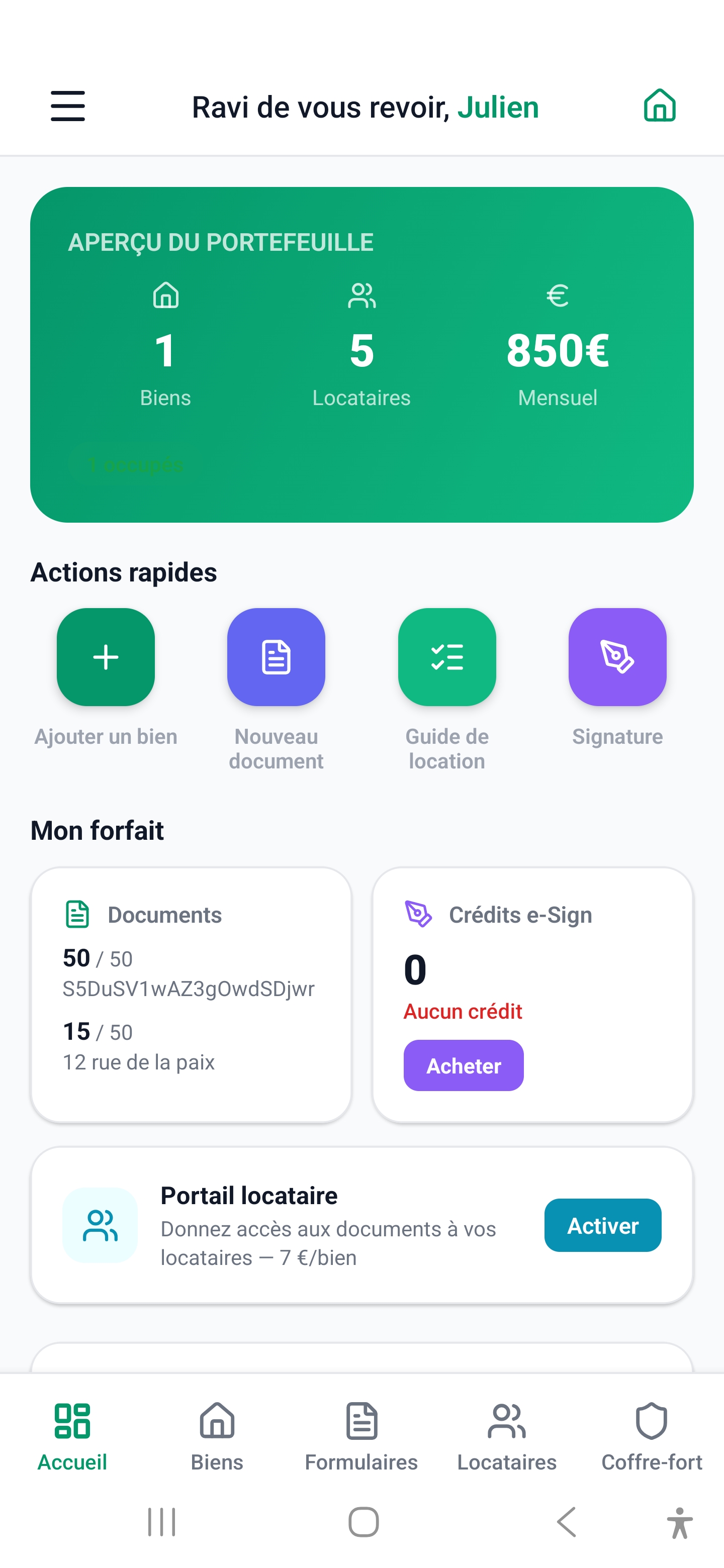
Rent — Lease & Short-Term generates ALUR-compliant leases, rent receipts, digital états des lieux and 23 rental documents — long-term AND short-term / meublé de tourisme — plus a per-property compliance check (DPE letting-ban, mandatory diagnostics, SIRET/LMNP, short-term registration, taxe de séjour) with email reminders — eIDAS e-signature, bilingual FR/EN. First property free — 10 documents included, then €49/property (50 documents), €39 each additional. No subscription.

Get Rent — Lease & Short-Term

Conclusion: None of the 2026 changes makes letting a French property unviable — but each one quietly moved a default: the tax allowance you assumed, the registration you thought optional, the energy class that used to be cosmetic. The owners who get caught are rarely the negligent ones; they are the ones running on 2023 assumptions. Check the five points on the checklist once, put the deadlines in your calendar, and 2026 becomes an administrative year like any other. This article is general information as of July 2026, not legal or tax advice — confirm your situation with your mairie and a French professional.

Tool by AdminLanding

Manage your French rental in English, from your phone

Rent — Lease & Short-Term generates ALUR-compliant leases, rent receipts, digital états des lieux and 23 rental documents — long-term AND short-term / meublé de tourisme — plus a per-property compliance check (DPE letting-ban, mandatory diagnostics, SIRET/LMNP, short-term registration, taxe de séjour) with email reminders — eIDAS e-signature, bilingual FR/EN. First property free — 10 documents included, then €49/property (50 documents), €39 each additional. No subscription.

Get Rent — Lease & Short-Term→

Stay Updated

1 tip per week, no spam.

About the author:

Julien Maurice is the founder of AdminLanding and writes the editorial guides on ExpatAdminHub covering European expat life, France-Switzerland cross-border work, and French administrative procedures. Contact: [email protected]

Related posts

French Rental Notice Period for Expats: 1 or 3 Months? The 2026 Rules
Housing•17 July 2026

French Rental Notice Period for Expats: 1 or 3 Months? The 2026 Rules

You've found a new flat, accepted a job in another city, or you're leaving France altogether — and now you need to give notice on your French rental. How long is the préavis? The honest answer is "it depends, precisely": three months by default for an unfurnished lease, one month for a furnished one, and one month for an unfurnished lease if your commune or your personal situation qualifies — under conditions most blog posts get subtly wrong. Get the reduced notice wrong and you owe up to two extra months of rent; get the delivery wrong and the clock never starts at all. This guide walks through the 2026 rules under art. 15 of loi n°89-462 as an expat tenant actually experiences them: which notice applies, the zone tendue list subtlety that trips up even French sites, when the countdown really begins, the exact end-date arithmetic, and how to claim the one-month notice without accidentally forfeiting it. This is general information, not personalised legal advice — verify your own case against the official sources linked throughout.

Read the article
Ending a French Tenancy as a Landlord: Congé for Sale, Personal Use (Reprise), or Legitimate Cause
Housing•7 July 2026

Ending a French Tenancy as a Landlord: Congé for Sale, Personal Use (Reprise), or Legitimate Cause

Ending a tenancy in France is not something a landlord can do freely. Unlike in many countries, French law lets an owner reclaim a rented home only at the natural term of the lease, and only for three tightly defined reasons: to sell it (congé pour vente), to move in or house a close relative (congé pour reprise), or for a legitimate and serious cause (motif légitime et sérieux), such as a tenant's repeated breaches. Miss the notice period, use the wrong wording, or pick a ground you cannot justify, and the congé is void — the lease simply renews for another term. This guide covers the rules for unfurnished and furnished lets under the [loi n°89-462 of 6 July 1989](https://www.legifrance.gouv.fr/loda/id/JORFTEXT000000509310), the six- and three-month notice windows, the exact content a valid congé must contain, the tenant's right of first refusal on a sale, and the extra protection the law gives elderly and low-income tenants. This is general information, not personalised legal advice — verify current figures at the official source before acting.

Read the article
Recoverable rental charges (charges récupérables) in France: what a landlord can bill the tenant
Housing•7 July 2026

Recoverable rental charges (charges récupérables) in France: what a landlord can bill the tenant

If you rent out a home in France, you cannot bill your tenant for whatever you like. The law draws a hard line between the rent — which you set freely, subject to rent-control zones — and the charges récupérables, the running costs of the building you are allowed to pass on. That list is closed: it was fixed by decree in 1987, and only what appears on it can be recovered. Get it wrong and a tenant can reclaim years of overcharges. This guide explains, for landlords and tenants alike, exactly what is recoverable, how the yearly régularisation works, your right to see the invoices behind the numbers, the three-year window that limits claims in both directions, and why a furnished (meublé) or mobility lease follows different rules. Figures and references are drawn from [service-public.fr](https://www.service-public.gouv.fr/particuliers/vosdroits/F947) and the underlying legal texts. Treat this as information, not personalised advice — verify any figure against the source before acting.

Read the article