ExpatAdminHubEuropean expat guide
FR
Menu▾
HomePrivacyCookiesAboutContact
All guidesPreparationHousingFinanceHealthcareWorkFamilyCultureVisas & Residence
ExpatAdminHubEuropean expat guide
HomePrivacyCookiesAboutContact
Categories
All guidesPreparation (checklists, visas, moving)Housing (rentals, utilities, neighborhoods)Finance (banking, taxes, budgeting)Healthcare (insurance, doctors, pharmacies)Work (jobs, contracts, work permits)Family (schools, childcare, family life)Culture (language, customs, integration)Visas & Residence (visa renewals, residence permits, paperwork)
FR

ExpatAdminHub

Practical guides for European expats navigating admin, housing, healthcare, and everyday life abroad.

Navigation

HomeAboutAuthor: Julien MauriceFrance hubSwitzerland hubContactPrivacyTermsSitemap
© 2026 ExpatAdminHub · European expat guide.
FR
  1. Home
  2. Blog
  3. Housing
  4. France's New Lease Template From 1 October 2026: What Changes for Landlords and Tenants
France's New Lease Template From 1 October 2026: What Changes for Landlords and Tenants
This article is also available in French.
Lire en français →

French rental law series

  • Your AI assistant + real French rules (MCP)
  • 2026 rule changes: Le Meur, DPE, registry
  • Tenant notice period: 1 or 3 months?
  • Security deposit: rules, deductions & disputes
  • IRL rent revision (landlord guide)
  • Recoverable rental charges
  • Ending a tenancy (congé bailleur)
  • Short-term rental: meublé de tourisme rules
  • Rent — Lease & Short-Term: app + web update
  • Tenant rights: deposit, repairs, proof
  • Non-resident landlord rental tax (2044)
  • LMNP furnished tax: micro-BIC vs réel
  • French bail lease: full guide
  • Landlord obligations: rent receipts
  • Free quittance template (legal guide)

France's New Lease Template From 1 October 2026: What Changes for Landlords and Tenants

Published 27 September 2026

From 1 October 2026, every residential lease signed or renewed in France must follow an updated official template. The change comes from Décret n° 2026-596 of 6 July 2026. It is a short text, and most of a lease stays exactly as it was. But one clause is now written by the State word for word, and a lease drafted from an old model will no longer match. This guide explains what changed, what did not, and what to check before you sign.

Key facts

  • Décret n° 2026-596 du 6 juillet 2026 amends the official lease templates of Décret n° 2015-587. It applies to leases signed or renewed from 1 October 2026.
  • The clause résolutoire (automatic termination clause) becomes a fixed paragraph. It covers unpaid rent, unpaid charges and an unpaid security deposit, and takes effect six weeks after a formal order to pay.
  • A new optional mention, the servitude de résidence principale, applies only to dwellings under Article L. 151-14-1 of the Code de l'urbanisme.
  • The landlord's and the tenant's mobile phone number may now appear in the lease. It is optional.
  • Durations, deposit ceilings, notice periods and mandatory annexes are unchanged.

What the decree is, and when it applies

Since 2015, a French residential lease for a main home must follow a contrat type, an official template set by Décret n° 2015-587. There are two of them: Annexe 1 for an unfurnished let, Annexe 2 for a furnished one. Each has eleven sections, from the parties (I) to the annexes (XI).

Décret n° 2026-596 of 6 July 2026 was published in the Journal officiel of 7 July 2026. It amends both templates. Its Article 3 sets the date: it applies to contracts concluded or renewed from 1 October 2026.

Two consequences follow:

• A lease signed before 1 October 2026 is not rewritten. It keeps its wording.

• A lease signed on or after that date must use the new wording, even if the landlord's model was compliant in September.

You can read the consolidated text on Légifrance.

The five changes, one by one

The decree makes five edits to each template.

Where in the leaseWhat changesWho is concerned
---------
Scope of the templateA legal reference is updated (Article L. 831-1 of the Code de la construction et de l'habitation replaces L. 351-2)Nobody in practice: it is a technical correction
I. Parties, landlordThe landlord's mobile phone number may be added, optionalEvery lease
I. Parties, tenantThe tenant's mobile phone number may be added, optionalEvery lease
II. B. Use of the premisesNew mention: servitude de résidence principaleOnly dwellings under Article L. 151-14-1 of the Code de l'urbanisme
VIII. Clause résolutoireThe clause becomes a fixed paragraph, with optional extra groundsEvery lease

The last two are the ones that matter.

The clause résolutoire: now written for you

The clause résolutoire lets a lease end automatically when the tenant fails to meet certain obligations. Until now, each landlord wrote it in their own words. The template now fixes the first paragraph. In French, it reads:

« Le contrat de location est résilié de plein droit pour défaut de paiement du loyer ou des charges aux termes convenus ou pour non versement du dépôt de garantie. La clause de résiliation de plein droit ne produit effet que six semaines après la date d'un commandement de payer demeuré infructueux. »

In plain English: the lease ends by operation of law if the rent, the charges or the security deposit are not paid. But only six weeks after a formal order to pay, served by a commissaire de justice, has gone unanswered.

The six-week period is not new. It has been in Article 24 of the Loi n° 89-462 du 6 juillet 1989 since 29 July 2023. What is new is that the lease must now say it in these words.

The template then allows optional grounds, which the parties may add:

• no tenant insurance, effective one month after a formal order;

• nuisance to neighbours, when established by a final court decision;

• for dwellings under the principal-residence easement, failure to live there as a main home.

A landlord cannot add any other ground. Article 4 of the 1989 law treats it as unwritten.

The principal-residence easement: a rare case

Since the Loi n° 2024-1039 of 19 November 2024, a commune may require that new homes in certain areas be used only as a main residence. This is the servitude de résidence principale, set out in Article L. 151-14-1 of the Code de l'urbanisme.

When a dwelling is under this obligation, the lease must now say so, in section II. B. The tenant then commits to live there as their main home. Article 7 of the 1989 law makes this a tenant obligation.

Most homes are not concerned. The mention is preceded by « le cas échéant », which means it appears only when it applies. If you are not sure, ask the town hall (mairie) of the commune.

What does not change

The decree does not touch the rules most people ask about.

RuleUnfurnished letFurnished let
---------
Minimum duration3 years, or 6 years when the landlord is a company (a family société civile follows the 3-year term)1 year, or 9 months for a student
Security deposit ceiling1 month of rent, excluding charges2 months of rent, excluding charges
Tenant's notice3 months, or 1 month in the cases the law lists1 month
Landlord's notice6 months, for the end of the lease3 months, for the end of the lease

The mandatory annexes are also the same: the information notice, the technical diagnostics including the DPE, the entry inventory (état des lieux), and for a furnished let the furniture inventory.

For the detail, see our guides on the security deposit, the tenant's notice period and the French lease in general.

What to check before you sign

If you are a landlord

  1. Check the date of your lease model. A model last updated before July 2026 will not carry the new clause.
  2. Read section VIII. The first paragraph must match the official text above.
  3. Check that the lease follows the eleven sections of the template, in order.
  4. Do not add penalties for late payment. Article 4 of the 1989 law forbids them.
  5. Ask your mairie whether the dwelling is under the principal-residence easement, if it is a recent build.

If you are a tenant

  1. Look for the mention of the decree, or of the template, near the title.
  2. Read section VIII. It should name only the grounds listed above.
  3. Check the mentions that protect you: the surface area, the rent, the deposit, the DPE class.
  4. Remember that either party can ask the other, at any time, for a lease that complies with the law. This is in Article 3 of the 1989 law.

Generating a compliant lease with AdminLanding

AdminLanding's lease generator follows the official template section by section, for both the furnished and the unfurnished lease. The fixed paragraphs are printed word for word, in French, as the law requires.

The lease is always issued in French. The interface and the explanations are available in English.

A field you leave empty is printed as a blank. The generator does not fill in a value on your behalf. Before it generates, it lists the mentions that would stay blank, so that you can complete them first. And it refuses, before any charge, a lease that would break the law on its face, such as a deposit above the legal ceiling.

Your first property is free. See the lease generator.

This article is general information. It is not legal advice.

Frequently Asked Questions

Does my current lease become invalid on 1 October 2026?

No. The decree applies to leases concluded or renewed from 1 October 2026. A lease signed before that date keeps its wording.

What is the clause résolutoire?

It is the clause that ends the lease automatically when the tenant does not pay the rent, the charges or the security deposit. It only takes effect six weeks after a formal order to pay, served by a commissaire de justice, has gone unanswered. An eviction always requires a court decision.

Is the six-week period new?

No. It has been in Article 24 of the Loi n° 89-462 du 6 juillet 1989 since 29 July 2023. The decree makes the lease state it in fixed words.

Do I have to give my mobile phone number in the lease?

No. The template now has a place for the landlord's and the tenant's mobile number, and marks both as optional.

What is the servitude de résidence principale?

It is an obligation, set by some communes for new homes in defined areas, to use the dwelling only as a main residence. It comes from Article L. 151-14-1 of the Code de l'urbanisme. The lease mentions it only when the dwelling is concerned.

Can a landlord add other grounds for automatic termination?

No. Beyond unpaid rent, charges and deposit, the law allows only missing tenant insurance, nuisance to neighbours established by a final court decision, and, where it applies, breach of the principal-residence obligation. Any other ground is treated as unwritten under Article 4 of the 1989 law.

Stay updated

For more practical insights on this topic, explore our related articles:

  • Rent 1.1.0: a Faster App, Signature Tracking You Can Trust & Insurance Reminders
  • Can Your AI Assistant Handle French Admin? MCP, Explained for Expats
  • Renting Out Your French Property in 2026: The Rules That Changed (Le Meur, DPE, Registry)
  • French Rental Notice Period for Expats: 1 or 3 Months? The 2026 Rules

Tool by AdminLanding

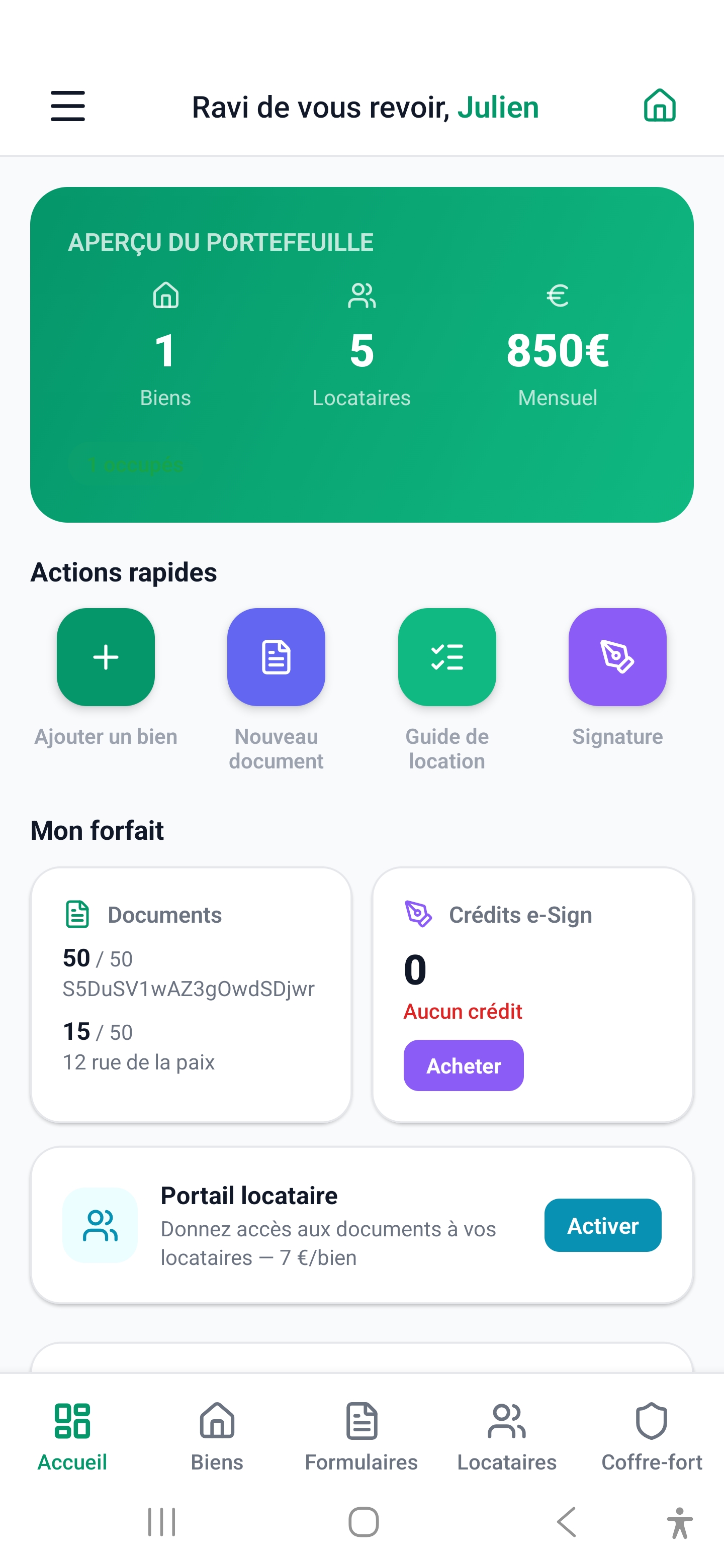
Manage your French rental in English, from your phone

Rent — Lease & Short-Term generates ALUR-compliant leases, rent receipts, digital états des lieux and 23 rental documents — long-term AND short-term / meublé de tourisme — plus a per-property compliance check (DPE letting-ban, mandatory diagnostics, SIRET/LMNP, short-term registration, taxe de séjour) with email reminders — eIDAS e-signature, bilingual FR/EN interface. Rent receipts free on every account (up to 20/month); first property free — 10 documents included, then €49/property (50 documents), €39 each additional. No subscription.

Get Rent — Lease & Short-Term

Conclusion: The October 2026 change is small on paper and easy to miss. One clause is now written by the State, one rare mention is added, and two phone numbers become possible. Everything else in the lease stays as it was. The practical risk is simple: a lease drafted from a model that predates July 2026 will not match the official template. Check the date of your model before you sign.

Tool by AdminLanding

Manage your French rental in English, from your phone

Rent — Lease & Short-Term generates ALUR-compliant leases, rent receipts, digital états des lieux and 23 rental documents — long-term AND short-term / meublé de tourisme — plus a per-property compliance check (DPE letting-ban, mandatory diagnostics, SIRET/LMNP, short-term registration, taxe de séjour) with email reminders — eIDAS e-signature, bilingual FR/EN interface. Rent receipts free on every account (up to 20/month); first property free — 10 documents included, then €49/property (50 documents), €39 each additional. No subscription.

Get Rent — Lease & Short-Term→

About the author:

Julien Maurice is the founder of AdminLanding and writes the editorial guides on ExpatAdminHub covering European expat life, France-Switzerland cross-border work, and French administrative procedures. Contact: [email protected]

Related posts

Rent 1.1.0: a Faster App, Signature Tracking You Can Trust & Insurance Reminders
Housing•23 August 2026

Rent 1.1.0: a Faster App, Signature Tracking You Can Trust & Insurance Reminders

Version 1.1.0 of Rent — Lease & Short-Term (Rent — Bail & Courte Durée in French) is the biggest under-the-hood release the app has had: it moves to a new rendering engine that makes everything feel faster and smoother. Around that foundation, the August 2026 wave adds the features self-managing landlords asked for after 1.0.10: an e-signature queue you can actually trust (honest status chips, signed documents that leave the queue on their own), a tenant home-insurance reminder card that appears at each lease anniversary, an iPhone widget with the month's rents on your Home and Lock Screen, and a round of legal-accuracy fixes — including one that matters: the acte de cautionnement is no longer offered for e-signature, because French law (article 2297) requires the guarantor's handwritten mention on paper. Everything from 1.0.10 stays: free rent receipts on every account (up to 20 a month), property photos, the monthly wrap-up. And the pricing model hasn't moved — first property free, one-time packs, never a subscription.

Read the article


Can Your AI Assistant Handle French Admin? MCP, Explained for Expats
Housing•23 August 2026

Can Your AI Assistant Handle French Admin? MCP, Explained for Expats

Ask a chatbot whether Lyon is in a zone tendue, or what notice period applies to your tenant, and you will get a confident answer — which may be quietly wrong. French administrative rules change by decree, by quarter and by commune, faster than any AI model's training data. In 2026 there is a better way: the Model Context Protocol (MCP) lets your assistant call real, maintained legal calculators instead of guessing. Here is what that means in practice, what you can already do free of charge, and where the limits are.

Read the article
Renting Out Your French Property in 2026: The Rules That Changed (Le Meur, DPE, Registry)
Housing•26 July 2026

Renting Out Your French Property in 2026: The Rules That Changed (Le Meur, DPE, Registry)

If you own a French property and rent it out — or planned to start this summer — three sets of rules moved under your feet, and July 2026 is when they all become visible at once. The loi Le Meur tax split showed up for the first time in this spring's income declaration (it applies to 2025 income). The national registration teleservice for short-term lets came into force on 20 May 2026. And the DPE letting-ban calendar keeps tightening, now reaching tourist rentals too. This guide walks a non-resident or expat owner through what actually changed, what it costs to ignore, and what to check before the next tenant or guest arrives. It is general information, not legal or tax advice.

Read the article