ExpatAdminHubEuropean expat guide
FR
Menu▾
HomePrivacyCookiesAboutContact
All guidesPreparationHousingFinanceHealthcareWorkFamily
ExpatAdminHubEuropean expat guide
HomePrivacyCookiesAboutContact
Categories
All guidesPreparation (checklists, visas, moving)Housing (rentals, utilities, neighborhoods)Finance (banking, taxes, budgeting)Healthcare (insurance, doctors, pharmacies)Work (jobs, contracts, work permits)Family (schools, childcare, family life)Culture (language, customs, integration)
FR

ExpatAdminHub

Practical guides for European expats navigating admin, housing, healthcare, and everyday life abroad.

Navigation

HomeAboutContactPrivacyTermsSitemap

Stay Updated

1 tip per week, no spam.

© 2026 ExpatAdminHub · European expat guide.
FR
  1. Home
  2. Blog
  3. Work
  4. Net Frontalier: The Free App That Finally Tells You Your Real Swiss Net Salary
Net Frontalier: The Free App That Finally Tells You Your Real Swiss Net Salary
This article is also available in French.
Lire en français →

Franco-Swiss cross-border series

  • Permit G: the complete guide
  • LAMal vs CMU: which health cover?
  • Swiss 2nd pillar LPP for frontaliers

Net Frontalier: The Free App That Finally Tells You Your Real Swiss Net Salary

Published June 8, 2026

You signed a Swiss contract with a gross salary in CHF, you live in France, and somewhere in the first three months you are supposed to make a permanent health-insurance choice between LAMal and CMU — in French, against a clock you barely understand. The single number nobody gives you is the one that matters: what actually lands in your account each month, and whether LAMal or CMU is cheaper for you. Net Frontalier is a free, anonymous, bilingual app that answers exactly that. Here is what it does, what it honestly does not do, and how to use it before your droit d'option deadline runs out.

Key facts

  • Net Frontalier is 100% free, works in English and French, and is on both iPhone (App Store) and Android (Google Play) — useful if French administrative jargon is not your first language.
  • It is anonymous: no signup, no account, no email, no personal data stored. You type numbers, it does maths, nothing leaves your phone.
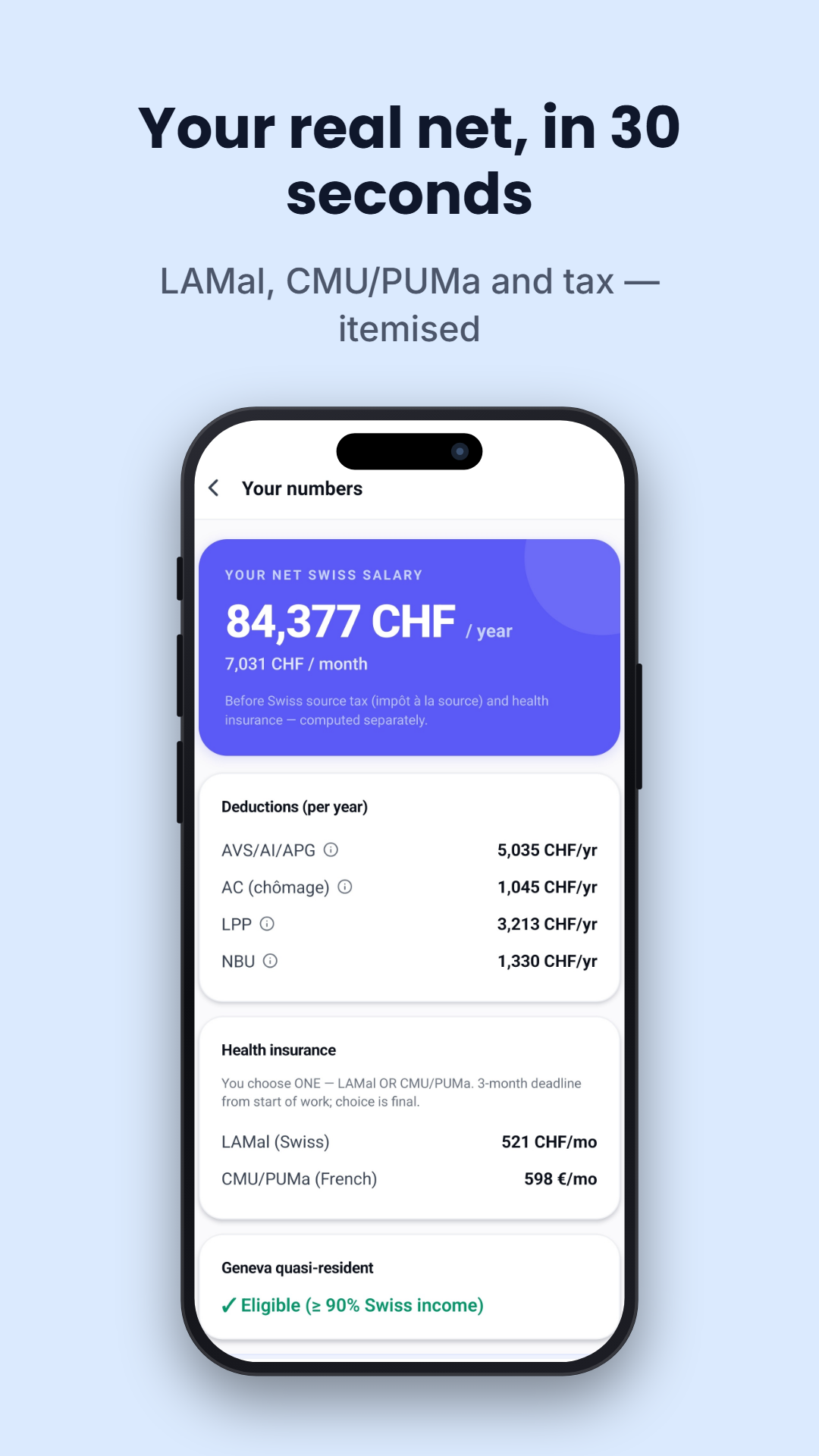
  • It estimates your Swiss NET salary by deducting the official 2026 social charges — AVS/AI/APG, AC (unemployment), LPP (2nd pillar), and NBU (non-occupational accident).
  • It compares your LAMal monthly premium vs your CMU/PUMa monthly cotisation side by side, so you can finally answer 'which is cheaper for me?' before the 3-month droit d'option deadline.
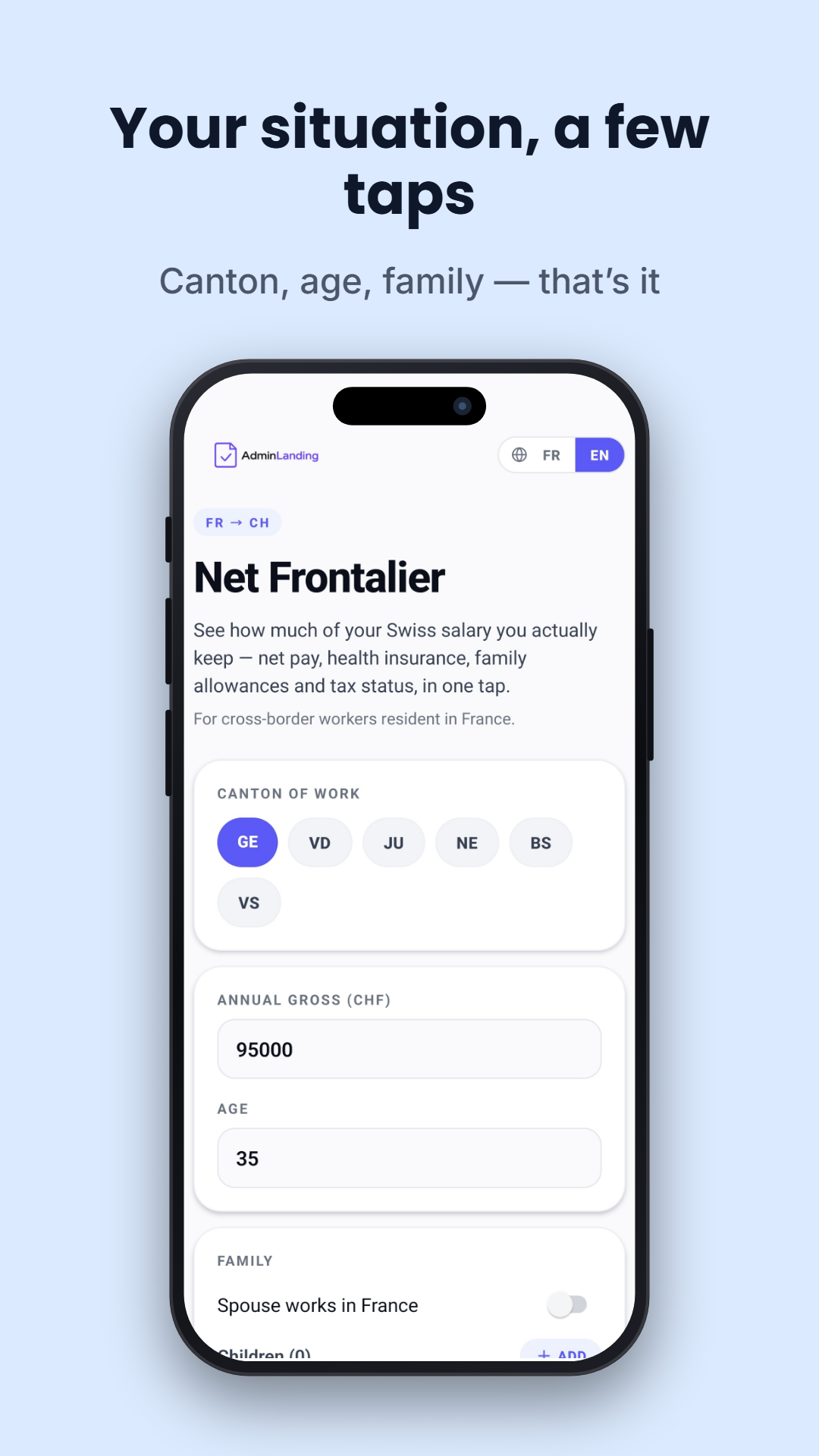
  • It covers six border cantons only — Geneva, Vaud, Jura, Neuchâtel, Basel and Valais — and flags Geneva quasi-resident eligibility, which can let some Geneva frontaliers reclaim tax.
  • It is a planning estimate, not tax or legal advice: it shows net salary before income tax and health premiums, LAMal figures are averages, and the exchange rate is a fixed reference, not live.

Net Frontalier at a glance

Free, no account, on iPhone and Android.

Net take-home
Net take-home
Full pay breakdown
Full pay breakdown
Net per hour
Net per hour
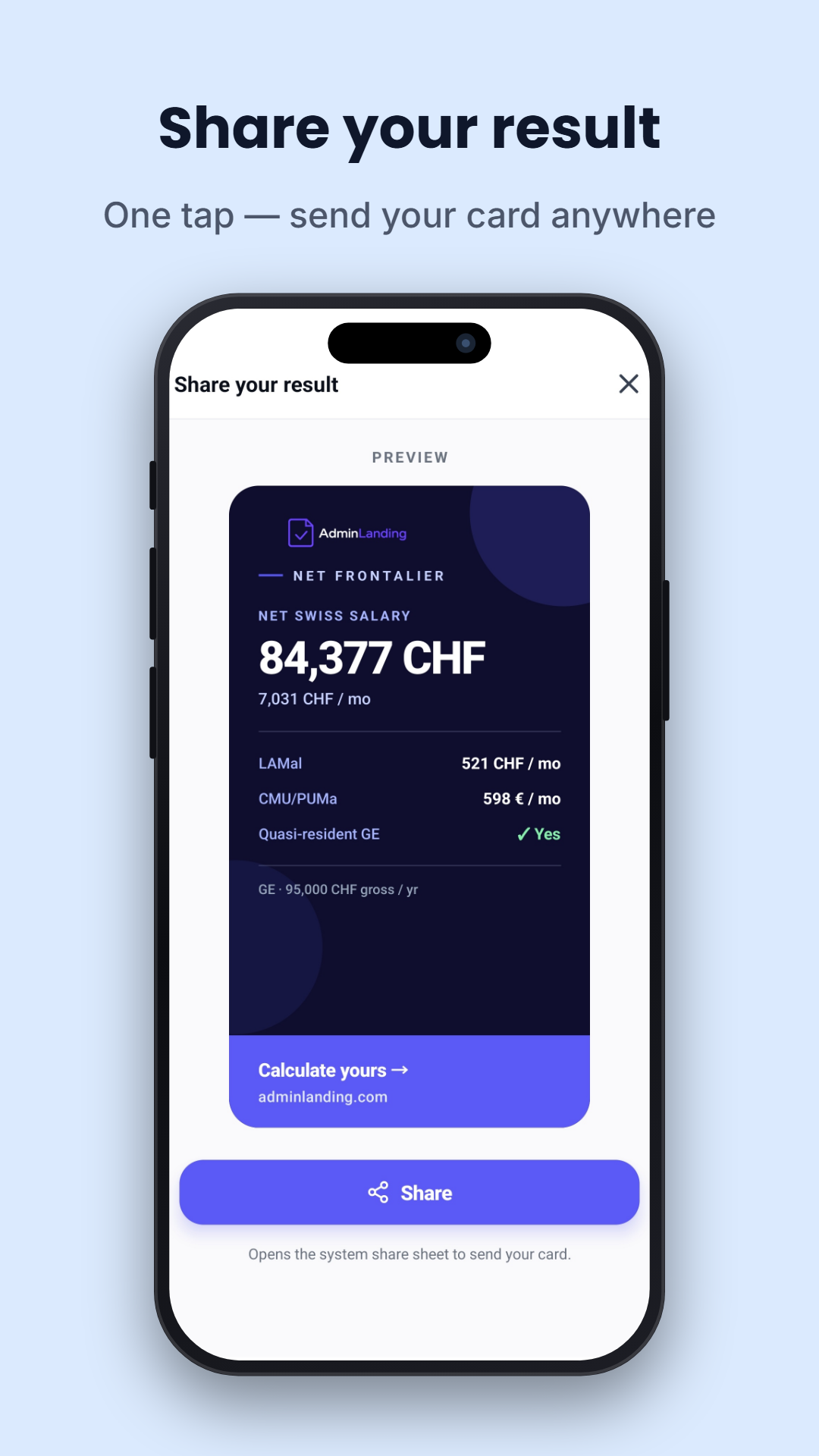
Share your result
Share your result

The number nobody gives you: your real monthly net

Your Swiss employer quotes you a gross figure in francs. Your payslip then subtracts a stack of contributions with initials you have never seen — AVS, AI, APG, AC, LPP, NBU — and what you actually receive bears little resemblance to the headline number. If you are an Anglophone frontalier, you are decoding all of this in a second language, often before your first payslip even arrives.

Net Frontalier deducts each of those charges using the official 2026 rates and shows you a plain-language breakdown of every line:

  • AVS/AI/APG — old-age, disability and loss-of-earnings insurance
  • AC — unemployment insurance
  • LPP — your 2nd-pillar occupational pension
  • NBU — non-occupational accident cover

The result is the single figure you actually wanted: an estimate of what hits your account each month. The app shows this before income tax and health-insurance premiums, which it displays separately as reference rather than silently subtracting — so you always know what each number means.

LAMal or CMU: answering 'which is cheaper for me?'

Within three months of starting your Swiss job you exercise your droit d'option — a meant-to-be-permanent choice between Swiss LAMal health insurance and French CMU/PUMa. Get it wrong and you are locked in for the duration of the contract. The problem is that the two systems are priced in completely different ways, so you cannot compare them in your head:

  • LAMal is a fixed monthly premium set by your insurer, age and canton — real premiums vary roughly CHF 350–700/month depending on insurer and franchise.
  • CMU/PUMa is income-based: roughly 8% of your income above a deduction of 25% of the PASS, billed by the French CNTFS.

Net Frontalier puts both side by side for your actual salary. It uses an average LAMal figure (real quotes vary by insurer, so treat this as a starting point) and the CMU formula, so for the first time you get an apples-to-apples monthly comparison. For the full rules behind this decision, read our companion guide on LaMal vs CMU.

Get the app (it is free and anonymous)

There is no paywall, no trial, no account. Download it, type your gross salary and canton, and you have your numbers in under a minute — nothing is uploaded.

  • Android: Net Frontalier on Google Play
  • iPhone / iPad: Net Frontalier on the App Store

Because it works in English and French, you are not forced to reverse-engineer French abbreviations to understand your own payslip — a genuine relief if you have just arrived and the whole frontalier vocabulary is new.

Franco-Swiss frontalier updates in your inbox

One email per week on permit G, LAMal, LPP, tax at source and the stuff nobody warns you about. Unsubscribe anytime.

The CAF differential and Swiss family allowances

If you have children, your family benefits can come from two countries at once, and the rules are not intuitive. Under EU Regulation 883/2004, when a frontalier works in Switzerland and a spouse works in France, France generally pays first and Switzerland tops up the difference (the differential), or vice-versa depending on who works where.

Net Frontalier computes this CAF differential / Swiss family-allowance top-up across the cantons it covers, and it specifically handles the mixed-household rule — the common case where one parent works in Switzerland and the other works in France. Instead of guessing whether you are owed a top-up, you get an estimate of the gap between the French and Swiss allowances for your household.

Geneva is the exception: tax at source, not in France

This is the single most misunderstood point for new frontaliers, so be precise about it:

  • If you work in Geneva, your salary is taxed at source in Switzerland (impôt à la source). You are not taxed in France on that salary.
  • If you work in Vaud, Neuchâtel, Jura, Basel or Valais (the 1983-accord cantons), your salary is generally taxed in France, and Switzerland does not withhold income tax.

So the lazy summary you will hear — 'you work in Switzerland, so you're taxed in France' — is simply wrong for Geneva, where the majority of frontaliers actually work. Net Frontalier keeps these straight by canton and never subtracts a phantom French tax from a Geneva salary.

Geneva quasi-resident status: a chance to reclaim tax

Geneva frontaliers taxed at source may qualify as a quasi-resident (quasi-résident) if they earn at least 90% of their worldwide income in Switzerland. Qualifying lets you file an ordinary Geneva tax return (TOU) and deduct real expenses — pension buy-ins, childcare, alimony, professional costs — which the flat at-source rate ignores. For many that means reclaiming several thousand francs.

Net Frontalier checks whether you cross the ≥90% threshold and flags your eligibility. Be clear on the limit: this is an eligibility flag only, not a tax computation. It tells you the door is open; it does not file your TOU return or calculate your refund. Treat a positive flag as a prompt to look into it (or speak to a fiduciary), not as a finished tax filing.

A plain-language breakdown you can share

Two things make the app actually usable rather than just another calculator:

  1. Per-deduction explanations. Every line — AVS, AC, LPP, NBU, the CMU cotisation, the family differential — comes with a short plain-English note on what it is and why it is there. You are not left staring at acronyms.
  2. A shareable result card. Once you have your numbers, the app generates a clean summary card you can send to a partner, an accountant, or a fiduciary when you discuss your options.

That second point matters for the droit d'option in particular: a one-tap snapshot of 'here is my net, here is LAMal vs CMU for me' is far easier to discuss than a wall of payslip abbreviations.

What it does NOT do (so you trust the numbers)

Honesty about the limits is what makes an estimate trustworthy. Net Frontalier:

  • Does not file anything with any administration — it is a calculator, not a portal.
  • Shows net salary before income tax and health-insurance premiums; those appear separately as reference, not subtracted from your net.
  • Uses average LAMal figures — real premiums vary by insurer (~CHF 350–700), so confirm with an actual quote.
  • Uses a fixed reference exchange rate, not a live FX feed — fine for planning, not for the franc you'll see on a given day.
  • Treats quasi-resident as an eligibility flag only, not a tax calculation.
  • Covers six border cantons, not every Swiss canton.
  • Is not tax or legal advice — the app's own disclaimer says exactly this.

Within those limits it does the one thing that is genuinely hard to do by hand: turn a CHF gross number into a realistic monthly picture you can actually plan around.

Going deeper than an estimate

An estimate is the right starting point. When you are ready to act on it — actually exercise the droit d'option, affiliate with CPAM, or file a Geneva quasi-resident return — you will want guided, document-level help rather than a single number.

That is what the AdminLanding cross-border France–Switzerland toolkit is for: a deeper LAMal-vs-CMU simulation, the affiliation steps, and the forms, built specifically for France-Switzerland frontaliers. Use Net Frontalier to understand your situation; use the toolkit when it is time to file.

Frequently Asked Questions

Is the Net Frontalier app really free?

Yes — completely free, with no trial, no paywall and no account. It is also anonymous: there is no signup and no personal data is stored. You enter numbers, it returns estimates, and nothing leaves your phone.

Which cantons does it support?

Six border cantons only: Geneva (GE), Vaud (VD), Jura (JU), Neuchâtel (NE), Basel (BS) and Valais (VS). It does not cover every Swiss canton, so if you work outside these six the figures will not apply.

Does it tell me whether LAMal or CMU is cheaper?

It puts both side by side for your salary: an average LAMal monthly premium against your CMU/PUMa cotisation (roughly 8% of income above a 25%-of-PASS deduction). LAMal figures are averages and real premiums vary by insurer (~CHF 350–700), so use it to see the direction of the answer, then confirm with a real quote.

If I work in Geneva, am I taxed in France?

No. Geneva taxes frontaliers at source in Switzerland (impôt à la source), so you are not taxed in France on that salary. Only the 1983-accord cantons — Vaud, Neuchâtel, Jura, Basel, Valais — are taxed in France. The app keeps this distinction by canton.

What is quasi-resident status and does the app calculate my refund?

Quasi-resident status lets a Geneva frontalier who earns at least 90% of worldwide income in Switzerland file an ordinary return and deduct real expenses, potentially reclaiming several thousand francs. The app only flags whether you appear eligible — it does not file your return or compute the refund.

Does the app file anything with the administration?

No. It is a calculator, not a government portal. It does not submit your droit d'option, your CMU affiliation or any tax return. It estimates the numbers so you can plan and then act through the proper channels.
Stay updated

For more practical insights on this topic, explore our related articles:

  • Permit G Switzerland: The Complete Guide for Cross-Border Workers (Frontaliers)
  • Why Cross-Border Workers Pay Tax in the Wrong Country — Without Knowing It
  • Geneva Region 2025: Salaries, Taxes, Housing & Mobility — The New Reality for Expats and Cross-Border Workers
  • France–Switzerland 2024–2025: The Coming Cross-Border Earthquake

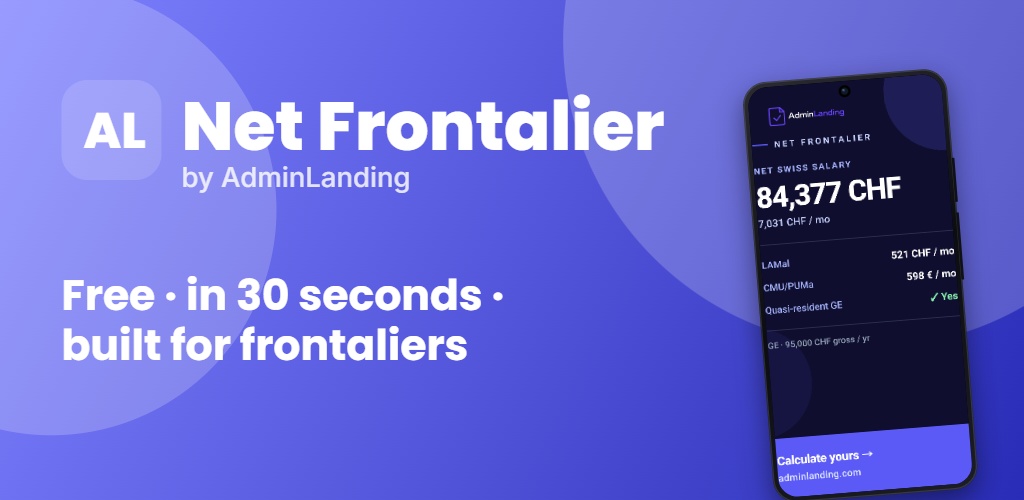
App by AdminLanding

Net Frontalier — your France-Switzerland cross-border calculator

Estimate your take-home pay as a France-Switzerland cross-border worker, compare LAMal vs CMU health insurance, and check your tax situation. Free on iPhone and Android.

Get Net Frontalier — free app

Conclusion: The hardest part of becoming a frontalier is not the work — it is making a permanent health-insurance choice, in a second language, around a salary number nobody has actually shown you. Net Frontalier closes that gap: free, anonymous, bilingual, and honest about its limits. Use it to see your real monthly net, to settle the LAMal-vs-CMU question for your own salary, to check whether you are owed a family top-up, and to find out if Geneva quasi-resident status could put francs back in your pocket. Then, when it is time to file, move to a guided toolkit. Get the numbers first — everything else is easier once you can see them.

Net Frontalier — your France-Switzerland cross-border calculator

App by AdminLanding

Net Frontalier — your France-Switzerland cross-border calculator

Estimate your take-home pay as a France-Switzerland cross-border worker, compare LAMal vs CMU health insurance, and check your tax situation. Free on iPhone and Android.

Get Net Frontalier — free app→

Stay Updated

1 tip per week, no spam.

About the author:

Julien is a European expat guide sharing practical, tested advice for navigating life abroad. Contact: [email protected]

Related posts

Permit G Switzerland: The Complete Guide for Cross-Border Workers (Frontaliers)
Work•March 31, 2026

Permit G Switzerland: The Complete Guide for Cross-Border Workers (Frontaliers)

The Permit G (Grenzgängerbewilligung / permis frontalier) is the residence document that allows you to live in an EU/EFTA country and work in Switzerland. With over 400,000 frontaliers crossing into Switzerland daily (OFS, 2025), it is one of the most common — and most misunderstood — work permits in Europe. Here is everything you need to know.

Read the article
Why Cross-Border Workers Pay Tax in the Wrong Country — Without Knowing It
Work•December 27, 2025

Why Cross-Border Workers Pay Tax in the Wrong Country — Without Knowing It

For many cross-border workers between France and Switzerland, taxes feel deceptively simple. Salary is paid in one country, life happens in another, and deductions appear automatically. Everything looks normal — until one day it doesn’t. Each year, thousands of frontaliers discover they have been paying tax in the wrong country, or in the wrong way, without ever intending to. This article explains why this mistake is so common, why it often goes unnoticed for years, and why correcting it is rarely as easy as people expect.

Read the article
Geneva Region 2025: Salaries, Taxes, Housing & Mobility — The New Reality for Expats and Cross-Border Workers
Work•December 9, 2025

Geneva Region 2025: Salaries, Taxes, Housing & Mobility — The New Reality for Expats and Cross-Border Workers

227,400 cross-border workers. A record number that captures the spectacular transformation of the Geneva region in 2025. Behind this statistic lies a complex reality: salaries among the highest in Europe, yet record housing pressure. Stricter tax rules, yet unique professional opportunities. Saturated daily mobility, yet constantly improving infrastructure. For the 15,000 expats and new cross-border workers arriving each year, understanding this new landscape is no longer optional. This 3,500-word guide analyzes in depth the sectoral salaries, Franco-Swiss tax mechanisms, housing market reality, mobility strategies, and administrative traps to avoid. With 2025 data, concrete examples, and detailed budgets, this is the only guide you need to succeed in your relocation to the Lake Geneva region.

Read the article