
ExpatAdminHubEuropean expat guide
FR
Menu▾
HomePrivacyCookiesAboutContact
All guidesPreparationHousingFinanceHealthcareWorkFamily
ExpatAdminHubEuropean expat guide
HomePrivacyCookiesAboutContact
Categories
All guidesPreparation (checklists, visas, moving)Housing (rentals, utilities, neighborhoods)Finance (banking, taxes, budgeting)Healthcare (insurance, doctors, pharmacies)Work (jobs, contracts, work permits)Family (schools, childcare, family life)Culture (language, customs, integration)
FR

ExpatAdminHub

Practical guides for European expats navigating admin, housing, healthcare, and everyday life abroad.

Navigation

HomeAboutContactPrivacyTermsSitemap

Stay Updated

1 tip per week, no spam.

© 2026 ExpatAdminHub · European expat guide.
FR
  1. Home
  2. Blog
  3. Healthcare
  4. Europe's Hidden Health Gap: Why Expats Pay More and How to Get the Best Coverage in 2025
Europe's Hidden Health Gap: Why Expats Pay More and How to Get the Best Coverage in 2025

Europe's Hidden Health Gap: Why Expats Pay More and How to Get the Best Coverage in 2025

Published November 27, 2025

Across Europe, expats report rising health costs, longer waits and more complex paperwork. In 2025, the continent quietly widens the gap between nationals and newcomers. The good news: this gap is largely administrative and strategic, not medical, and you can close much of it with the right choices.

1) Why expats pay more than locals

Arriving in a new European country does not put you on the same track as long-term residents. Three mechanisms explain most of the extra costs:

  • Later access to the national system because registration takes time and documents are incomplete.
  • Mandatory private cover at the start, sometimes required by employers or schools.
  • "Tourist" or private pricing while your residency and social security status are still unclear.

In practice this leads to very concrete situations:

  • In France, an expat who has not yet registered with CPAM often pays full price upfront with no third-party payment.
  • In Germany, clinics may bill you as a private patient until your Krankenkasse is clearly identified.
  • In Spain, without a Seguridad Social registration, most care goes through private clinics.
  • In Switzerland, basic insurance under the LAMal law is mandatory within three months; late registration can mean retroactive premiums.

On top of this, many expats delay care because they are unsure how reimbursement works, or they use travel-style coverage long after becoming residents, which rarely matches real life needs.

2) The most expensive systems for expats in 2025

Not all European systems feel the same when you arrive as a newcomer. Some are generous but costly, others more affordable but with higher deductibles or longer waits.

  • Switzerland (LAMal): for adults, entry level premiums of roughly 350 to 450 Swiss francs per month are common, plus a yearly deductible. Official information in English and German is available via the Federal Office of Public Health at bag.admin.ch.
  • France: the base system via CPAM covers many essentials, but a top-up policy is now almost unavoidable for everyday care, dental and eyewear. For families with several children, cumulative premiums are significant.
  • Netherlands: mandatory basic insurance for all residents with a local contract includes a substantial monthly premium and a yearly excess. Official portals and comparison tools help, but the first year still comes as a shock for many newcomers.
  • Cross-border workers between France and Switzerland: choosing between LAMal and French coverage has a direct impact on net salary and tax planning. The dedicated cross-border guide on this site details the trade-offs.

Which system is "best" depends on income, family size, health history and how long you plan to stay. A system that looks expensive can be efficient if you understand how to use it and how to combine it with private cover.

3) Common traps that inflate your medical budget

A few recurring mistakes explain a large share of the extra money expats spend on healthcare:

  • Letting the European Health Insurance Card expire, then being billed at full private rates while travelling. The article on EHIC renewal published on 2 November shows how to check dates before each trip.
  • Submitting an incomplete registration file to CPAM or another national system: missing proof of address, unclear work contract, or no evidence of stable residence. This often leads to months without a health card or assigned family doctor.
  • Relying on low cost international insurance with long exclusion lists for pregnancy, pre-existing conditions or mental health.
  • Choosing very high deductibles in Switzerland or on international policies to save on monthly premiums, then paying everything out of pocket during the first part of the year.
  • Staying in "visitor" status even though you already live, work or study in the country, which confuses reimbursement rules and the right institution in charge of you.

If you read this article together with the broader 2025 healthcare guide and the practical guide on finding doctors and dentists abroad, you will recognise many of these traps and be able to avoid them.

4) How to reduce costs without downgrading care

The starting point is to clarify your status: resident, detached worker, cross-border commuter, student, or self-employed. Each category maps to specific rights and forms such as S1 or S2 in some cases.

Concrete levers include:

  • Registering with the local system (CPAM, Krankenkasse, Seguridad Social, LAMal) as soon as you meet the criteria, even if you keep an international policy in parallel during the transition.
  • Using third-party payment and preferred provider networks whenever available so you do not advance large sums.
  • Comparing top-up policies in France or deductibles in Switzerland based on your real usage instead of a generic profile.
  • Favouring strong public hospitals for heavy procedures, and specialists located outside the most expensive city centres for follow-up care.
  • Planning an annual check-up in your home country or a nearby lower-cost country, after checking reimbursement rules and any required pre-authorisation.
  • In France, reviewing your eligibility for support schemes such as the complementary health solidarity via the family benefits office. The official site caf.fr provides simulators and conditions.

The goal is not to chase every last euro but to move from random, reactive care to a clear structure that matches your life stage: everyday care, pregnancy, chronic disease follow-up, dental work or mental health support.

5) Three real-life expat profiles

Profile 1: employee from the United States in France

He moves to Paris with an international policy paid by his employer. For six months he never registers with CPAM, pays full price at every GP visit and never declares a family doctor. By combining fast registration, a conventioned GP and a simple top-up, his annual bill could have been roughly halved.

Profile 2: France–Switzerland cross-border commuter

She works in Lausanne and lives in Haute-Savoie. Unsure between LAMal and French cover, she picks a cheap option with a very high deductible without modelling the impact of regular exams she needs. A simple calculation, like those shown in the France–Switzerland cross-border guide, would have revealed the true yearly cost.

Profile 3: student in Italy

He enrols at an Italian university but keeps only his initial travel insurance, without understanding the regional health system. He later discovers that some exams are only fully covered when ordered by a registered family doctor inside the regional network. The guide on finding doctors and specialists abroad explains how to avoid this type of dead end.

6) Recommended articles to go further

To turn these principles into practical decisions, use this guide together with other articles already published on the site:

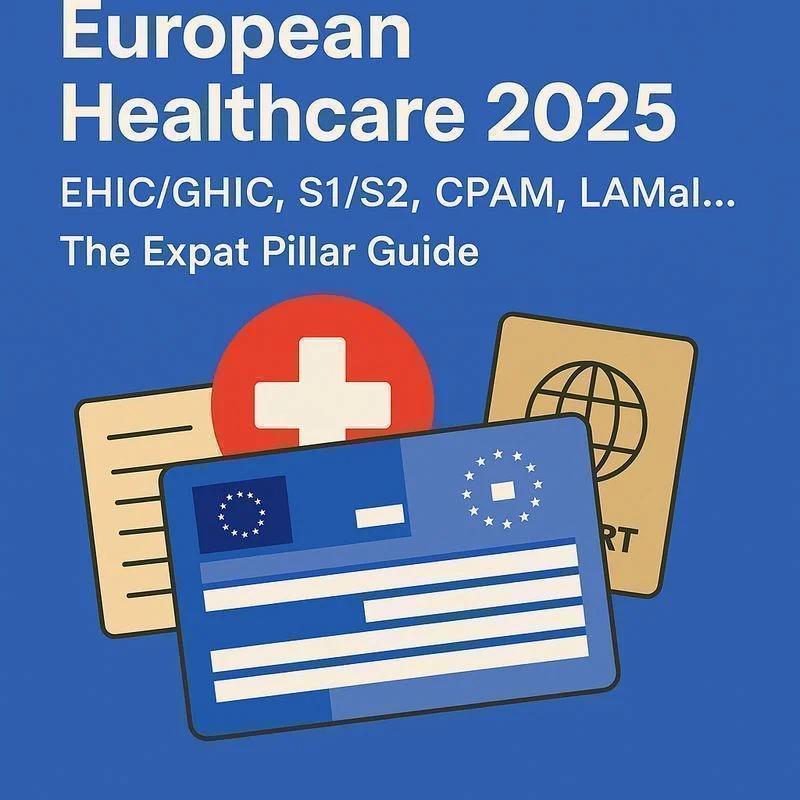
  • Understand the overall 2025 healthcare landscape: European Healthcare 2025.
  • Renew and use your European Health Insurance Card correctly: EHIC Renewal Made Simple.
  • Find reliable doctors, dentists and specialists abroad: Doctors and dentists abroad guide.
  • Keep energy and housing costs under control, which weigh as much on your overall budget as health: Energy supplier and housing charges.
  • Build a long term healthcare strategy for your family: Healthcare for European expats.

Frequently Asked Questions

Which insurance should newcomers choose when they first arrive?

For the first months, a solid international policy that clearly covers hospital care and emergencies is often the simplest starting point. In parallel, start registering with the local system as soon as you qualify so you can later switch to a mix of national coverage and a local top-up policy.

Is the European Health Insurance Card enough for living in Europe full time?

No. EHIC or GHIC is designed for temporary stays and medically necessary care. Once you are a resident, the real protection comes from proper registration with the local system and, if needed, a well chosen top-up policy.

Stay updated

For more practical insights on this topic, explore our related articles:

  • CPAM & Ameli Registration in France: Step-by-Step Guide for Expats (Sécurité Sociale 2026)
  • LAMal vs CMU: How to Choose Health Insurance as a Cross-Border Worker in Switzerland
  • Your Health Insurance Stopped 6 Months Ago (You Just Don't Know It Yet)
  • The Peptide Craze Is Exploding in 2025 — What Expats in Europe Need to Know Before Crossing a Legal Line

Tool by AdminLanding

AI assistant for 25+ French admin sites

Guide: Démarches en France helps you fill Ameli, CAF, impots.gouv, France Travail, ANTS forms field-by-field. Procedure cards, chat support, bilingual EN/FR. Free Chrome extension; AI features use 5 free credits/month, top-up packs available.

Try Guide: Démarches en France

Conclusion: Understanding local rules, choosing the right status and anticipating costs will transform your healthcare experience in Europe. Well prepared expats pay less and often receive better care than those who leave everything to chance.

Tool by AdminLanding

AI assistant for 25+ French admin sites

Guide: Démarches en France helps you fill Ameli, CAF, impots.gouv, France Travail, ANTS forms field-by-field. Procedure cards, chat support, bilingual EN/FR. Free Chrome extension; AI features use 5 free credits/month, top-up packs available.

Try Guide: Démarches en France→

Stay Updated

1 tip per week, no spam.

About the author:

Related posts

CPAM & Ameli Registration in France: Step-by-Step Guide for Expats (Sécurité Sociale 2026)
Healthcare•April 25, 2026

CPAM & Ameli Registration in France: Step-by-Step Guide for Expats (Sécurité Sociale 2026)

Any person stably and regularly residing in France for at least 3 months is entitled to French public health insurance under the Protection Universelle Maladie (PUMA), codified in Article L160-1 of the Code de la Sécurité Sociale. That sentence sounds simple — and yet, every single week, expats arriving in Paris, Lyon, Lille or Annemasse get stuck in the same loop: which CPAM should I apply to, which form opens my rights, what counts as a justificatif de domicile, why has my dossier been silent for ten weeks, when does the carte vitale actually arrive? PUMA replaced [CMU](/en/blog/2026-03-28-lamal-vs-cmu-health-insurance-cross-border-worker) in 2016, the student régime étudiant disappeared in 2019, the espace assuré on ameli.fr was redesigned in 2024, and not a single official page is written for someone whose first language isn't French. This guide walks through every stage of the CPAM registration in plain English: who qualifies and through which scheme, the exact list of supporting documents, how to fill form S1106, the carte vitale timeline, the médecin traitant declaration, and the five mistakes that delay coverage by months. By the end, you'll know exactly what to send, where, and what to expect back.

Read the article


LAMal vs CMU: How to Choose Health Insurance as a Cross-Border Worker in Switzerland
Healthcare•March 28, 2026

LAMal vs CMU: How to Choose Health Insurance as a Cross-Border Worker in Switzerland

If you live in France and work in Switzerland, you must choose between the Swiss LAMal system and the French CMU (now PUMa) within three months of starting work. This decision has long-term financial and practical consequences — here is what you need to know to make the right call.

Read the article
Your Health Insurance Stopped 6 Months Ago (You Just Don't Know It Yet)
Healthcare•January 8, 2026

Your Health Insurance Stopped 6 Months Ago (You Just Don't Know It Yet)

Your health coverage didn't end the day you moved. It ended quietly. Months ago. Everything looked fine. Your card was still in your wallet. No warnings arrived. Then came the doctor visit, the pharmacy bill, the reimbursement refusal. That's when you discovered the truth: you've been uninsured for months. This isn't negligence. It's how European health systems work. This article shows why coverage gaps hit thousands of expats, why no one warns you, and how you end up uninsured without ever deciding to be.

Read the article