ExpatAdminHubEuropean expat guide
FR
Menu▾
HomePrivacyCookiesAboutContact
All guidesPreparationHousingFinanceHealthcareWorkFamily
ExpatAdminHubEuropean expat guide
HomePrivacyCookiesAboutContact
Categories
All guidesPreparation (checklists, visas, moving)Housing (rentals, utilities, neighborhoods)Finance (banking, taxes, budgeting)Healthcare (insurance, doctors, pharmacies)Work (jobs, contracts, work permits)Family (schools, childcare, family life)Culture (language, customs, integration)
FR

ExpatAdminHub

Practical guides for European expats navigating admin, housing, healthcare, and everyday life abroad.

Navigation

HomeAboutContactPrivacyTermsSitemap

Stay Updated

1 tip per week, no spam.

© 2026 ExpatAdminHub · European expat guide.
FR
  1. Home
  2. Blog
  3. Healthcare
  4. CPAM & Ameli Registration in France: Step-by-Step Guide for Expats (Sécurité Sociale 2026)
CPAM & Ameli Registration in France: Step-by-Step Guide for Expats (Sécurité Sociale 2026)
This article is also available in French.
Lire en français →

French healthcare series

  • LAMal vs CMU: which health cover?

CPAM & Ameli Registration in France: Step-by-Step Guide for Expats (Sécurité Sociale 2026)

Published April 25, 2026

Any person stably and regularly residing in France for at least 3 months is entitled to French public health insurance under the Protection Universelle Maladie (PUMA), codified in Article L160-1 of the Code de la Sécurité Sociale. That sentence sounds simple — and yet, every single week, expats arriving in Paris, Lyon, Lille or Annemasse get stuck in the same loop: which CPAM should I apply to, which form opens my rights, what counts as a justificatif de domicile, why has my dossier been silent for ten weeks, when does the carte vitale actually arrive? PUMA replaced [CMU](/en/blog/2026-03-28-lamal-vs-cmu-health-insurance-cross-border-worker) in 2016, the student régime étudiant disappeared in 2019, the espace assuré on ameli.fr was redesigned in 2024, and not a single official page is written for someone whose first language isn't French. This guide walks through every stage of the CPAM registration in plain English: who qualifies and through which scheme, the exact list of supporting documents, how to fill form S1106, the carte vitale timeline, the médecin traitant declaration, and the five mistakes that delay coverage by months. By the end, you'll know exactly what to send, where, and what to expect back.

Key facts

  • 3-month residency rule: under Article L160-1 CSS, anyone stably and regularly residing in France for at least 3 months qualifies for PUMA — the universal public health insurance.
  • Form S1106 (Cerfa 15763*02) is the entry form to open your rights as a non-affiliated resident; it is sent to the CPAM of your home address.
  • Carte vitale is typically issued 2 to 3 weeks after the CPAM validates your file; an attestation provisoire de droits covers you in the meantime.
  • Médecin traitant must be declared via Cerfa 12485*03 (S3704). Without one, the conventional reimbursement rate drops from 70% to 30% on consultations 'hors parcours de soins'.
  • Guide: Démarches en France annotates every field on ameli.fr — including how to declare a médecin traitant, change CPAM after a move, or reactivate suspended rights.

What CPAM is, and how PUMA actually works

CPAM stands for Caisse Primaire d'Assurance Maladie — the local branch of the French public health insurance fund. There are 101 CPAMs in France (one per département + overseas, plus a non-resident centre in Rubelles for non-residents and a CNAM for the national level). The CPAM you register with is determined by your home address, not your nationality, employer, or previous coverage.

PUMA — Protection Universelle Maladie. Since 1 January 2016, PUMA has replaced the older CMU (Couverture Maladie Universelle). Codified in Article L160-1 of the Code de la Sécurité Sociale, it states that any person working in France, or — when not exercising a professional activity — residing in France in a stable and regular manner, is entitled to public health insurance for illness and maternity.

Two critical sub-rules:

  • Stable residence = at least 3 consecutive months in France for non-workers (Art. R111-2 CSS). Workers covered through their employer are exempt from this delay.
  • Justification of residence = ability to prove 6 months in France over the last 12 months at any time the CPAM asks (typically when renewing your attestation).

PUMA does not mean care is free. It means your CPAM applies the taux de remboursement conventionnel — typically 70% on doctor visits, 80% on hospitalisation, 60% on prescription drugs — and you pay the ticket modérateur (the rest) yourself unless you have a mutuelle complémentaire (covered later).

Who qualifies — and which path to take

PUMA is universal, but the administrative path depends on your situation. Pick yours from the five most common scenarios below — your dossier and the form you send are not identical from one to the next.

  • Salaried workers (private sector). Your employer declares you to URSSAF on your first payslip via the DSN (déclaration sociale nominative). URSSAF transmits the data to your CPAM, which contacts you for the missing documents (titre de séjour, RIB, birth certificate). You do not need to send S1106 yourself — but you must follow up with the CPAM if 4 weeks pass without contact.
  • Self-employed and auto-entrepreneurs. Since 1 January 2020 the SSI (Sécurité Sociale des Indépendants) has been folded into the régime général. You are affiliated to your local CPAM via URSSAF when you register your activity on the guichet unique INPI. Same dossier follow-up as employees.
  • Students (EU and non-EU). Since the rentrée 2019, students are no longer in a separate régime étudiant. Enrolment at a French university auto-registers you with the régime général. EU students can use their EHIC for short stays; for stays > 3 months, you create your espace assuré on ameli.fr after the university has transmitted your data.
  • Retirees with a foreign EU/EEA pension. If your only income is a pension from another EU member state, your home country issues an S1 form (formerly E121). You file the S1 with your CPAM and remain covered at the expense of your pension country — France just handles the medical paperwork. UK retirees living in France post-Brexit also use an S1 if entitled.
  • Inactive residents (no employer, no pension, just savings). This is the path that uses form S1106. You wait until you have proof of 3 months of stable residence, then send the dossier described in the next section. You may later be liable for the cotisation subsidiaire maladie (CSM) if your capital income exceeds 50% of the PASS (€24,030 for 2026).
  • Dependents (ayant droit). Spouses, registered partners and children under 16 of an insured person are automatically covered as ayants droit. From 18, each adult must have their own affiliation — but the régime universal means there's no gap as long as residence is stable.

Documents required for CPAM registration

The complete list, verified against ameli.fr and service-public.fr R45084. Send photocopies, never originals — the CPAM will not return them. Originals stay with you for the eventual CPAM appointment.

Mandatory for everyone:

  • Form S1106 (Cerfa 15763*02), filled in and signed. Download it from ameli.fr → Formulaires.
  • Identity proof. EU/EEA/Swiss citizens: valid passport or national ID. Non-EU: passport + valid titre de séjour or visa long séjour valant titre de séjour (VLS-TS) validated on the administration-etrangers-en-france.interieur.gouv.fr portal.
  • Full birth certificate (extrait d'acte de naissance avec filiation) issued within the last 12 months. If not in French, translation by a sworn translator (traducteur assermenté). For non-EU countries without a treaty exemption, the document must carry an apostille or be légalisé by the French consulate in the country of issue.
  • Justificatif de domicile. A recent (less than 3 months old) bill in your name from EDF, Engie, Veolia, a French ISP, a landline operator, or a quittance de loyer. If you live with someone, an attestation d'hébergement + the host's ID + the host's own bill.
  • RIB (Relevé d'Identité Bancaire) of a French or SEPA bank account in your name (Wise, Revolut, N26 with French IBAN are accepted; foreign IBANs work too if SEPA-compliant).

Required if applicable:

  • Attestation employeur + a copy of your latest payslip if employed.
  • Marriage certificate / livret de famille (less than 12 months) if registering a spouse as ayant droit.
  • Proof of stable residence (3 months) if you have no salaried activity: 3 consecutive bills, or rent receipts, or an attestation d'accueil + host bills.

Address, not email. The dossier goes by post (registered mail with receipt is recommended) to the CPAM of your home département. Find the correct one on ameli.fr → "Adresses et contacts" by typing your postal code.

CMU, LAMal, Carte Vitale — made simple

One practical health-coverage tip per week for expats and cross-border workers in France. Unsubscribe anytime.

Step-by-step registration on ameli.fr

Two scenarios: you have a numéro de sécurité sociale provisoire (assigned by URSSAF when an employer declared you), or you have nothing yet (inactive new arrival).

Step 1 — Find your CPAM. Go to ameli.fr → "Adresses et contacts" → enter your postal code. Note the postal address. Do not send your file to the wrong département — it will be returned 6-8 weeks later.

Step 2 — Fill in form S1106. Page 1 = identity (use the names exactly as written on your birth certificate, not your French preferred name). Page 2 = situation (employed / self-employed / inactive / pensioner). Page 3 = address and dependents. Pay attention to the date d'arrivée en France — that's what the CPAM uses to count the 3-month delay.

Step 3 — Compile the dossier. Use the document list above. Add a short cover letter in French stating your situation in 4-5 lines ("je sollicite l'ouverture de mes droits à l'Assurance Maladie au titre de la PUMA"). A clean, ordered dossier processes faster.

Step 4 — Send by post. Recommended: lettre recommandée avec accusé de réception. Cost ~5 €. Keep the AR slip — it is your only proof if the dossier is lost.

Step 5 — Wait for the numéro de Sécurité Sociale. Once received and validated by the CPAM, you receive a definitive 13-digit numéro de Sécurité Sociale (replacing any provisional one) by post. Average delay: 2 to 12 weeks depending on the département. Paris CPAMs are notoriously slower; rural CPAMs faster.

Step 6 — Create your espace assuré on ameli.fr. Click "Créer un compte". You'll need the 13-digit number, your date of birth, your postal code, and the code provisoire sent on a separate letter. This is where you see your reimbursements, upload documents, request a carte vitale, and message the CPAM. The 2024 redesign of the espace assuré made this step considerably faster — but you still need the activation code, which is sent only by post.
Carte vitale — timeline, photo, common rejections

Once your dossier is validated and you have your numéro definitif, you can request the carte vitale. This green chip card is what pharmacies and doctors swipe to bill the CPAM directly (third-party payment, tiers payant) — without it, you pay upfront and wait weeks for reimbursement.

Timeline. The card is issued in 2 to 3 weeks after the CPAM validates the file (source: ameli.fr, service-public.fr F265). Online request via the espace assuré is typically the fastest path; postal request can extend to 3-4 weeks. If 4 weeks pass without delivery, log in to ameli.fr → "Mes démarches" → "Suivre ma demande de carte vitale" or call 3646 (free from a French line, Mon-Fri 08:30-17:30).

The photo. Since 2017 the carte vitale carries your photo. You can upload it directly from your espace assuré or send a passport-format photo by post. Common rejection reasons (we've seen all of them):

  • Photo is too dark, too small, or has a coloured background — must be neutral white/light grey.
  • Smile / mouth open / glasses with reflections — same rules as a passport photo.
  • Wearing a hat / headphones / hood — refused unless religious exemption with documentation.

While you wait — the attestation provisoire de droits. Downloadable from the espace assuré once your file is validated. It is a one-page A4 document showing your name, numéro de Sécurité Sociale, and rights status. Doctors and pharmacies accept it for tiers payant exactly like a carte vitale, but the reimbursement is processed manually and is therefore slower (2-3 weeks vs same-day with the card).

If you lose your carte vitale. Declare it via the espace assuré or by calling 3646. A replacement is dispatched in 2-3 weeks. The lost card is not blocked — it could still be used by a third party until expiry — but reimbursements are processed only against the new one.

Choosing and declaring a médecin traitant

The médecin traitant is your designated reference doctor — usually a médecin généraliste, occasionally a specialist for specific conditions. Declaring one is mandatory from age 16 under the parcours de soins coordonnés introduced by the 13 August 2004 reform. The mechanism: when you are referred by your médecin traitant to a specialist, the specialist's reimbursement stays at the conventional rate (70%). When you go directly to a specialist without referral, the reimbursement drops to 30% — a 40-percentage-point penalty, and dépassements d'honoraires (overcharges) are no longer reimbursable by your mutuelle.

The declaration form. Use **Cerfa 12485*03 (also called S3704)** — Déclaration de choix du médecin traitant. It is co-signed by you and the doctor, then sent to your CPAM. The doctor often submits it electronically via Sesam-Vitale during your first appointment; if not, mail it yourself. Verify the latest version on ameli.fr.

Switching médecin traitant. No formal procedure — simply fill in a new Cerfa 12485*03 with the new doctor and send it in. The previous declaration is automatically superseded. There is no waiting period; the new declaration takes effect immediately.

Specialists you can see directly without referral. Even within the parcours de soins, four categories of specialists are en accès direct without losing the conventional rate: ophthalmologists, gynaecologists, paediatricians (for under-16s), and stomatologists / dental surgeons.

Without a médecin traitant. First-year expats who haven't yet found one are not immediately penalised — the CPAM tolerates a transitional period. But the longer you wait, the more out-of-pocket spending accumulates that you'll never recover. Practical advice: pick a généraliste in walking distance of home or work, even temporarily. You can switch later in 5 minutes.

Mutuelle complémentaire — why nearly everyone has one

PUMA covers the tarif de convention, but rarely 100%. The remaining cost — ticket modérateur + participations forfaitaires + dépassements d'honoraires — falls on you unless you have a mutuelle complémentaire santé. In 2026, fewer than 5% of French residents are without one.

What a mutuelle covers.

  • Ticket modérateur — the part of the tarif de convention not reimbursed by the CPAM (e.g. the 30% on a généraliste consultation).
  • Forfait journalier hospitalier — €20/day during hospitalisation, not covered by PUMA.
  • Dépassements d'honoraires — overcharges by sector-2 doctors (frequent in Paris, Lyon, Lille). Coverage depends on your formula: 100% TC, 200% TC, 300% TC.
  • 100% Santé. Since 2021, dental crowns, optical (frames + lenses), and hearing aids are reimbursed in full by CPAM + mutuelle for products in the panier 100% Santé. Outside that basket, normal co-payment rules apply.

Employer obligation. Since 1 January 2016 (loi ANI 2013, codified in Art. L911-7 of the Code du Travail), every private-sector employer must offer and partially fund a mutuelle d'entreprise covering the employee. Spouses can usually be added at extra cost. Public-sector employees were progressively covered from 2024 under the protection sociale complémentaire reform.

Choosing a mutuelle as an expat. Online comparators (LesFurets, LeLynx, Hyperassur) work, but always check three things: the actual reimbursement table per category (TC%, real €), the délai de carence (waiting period) for hospitalisation and dental, and whether your country of origin's residual coverage is recognised — some mutuelles refuse to cover the first 3 months for new arrivals from non-EU countries.

CSS — Complémentaire Santé Solidaire. If your household revenue is below the eligibility threshold (~€10,166/year for a single person in 2026), you qualify for free or low-cost (€8-30/month per person depending on age) public-mutuelle coverage. Apply via your espace assuré → "Démarches" → "Demander la CSS".

Common expat mistakes — and where AdminLanding fits

Five mistakes account for the overwhelming majority of avoidable problems we see in the expat population:

  1. Sending the dossier to the wrong CPAM. Each département has one. If you live in Versailles, your CPAM is the CPAM des Yvelines — not the Paris CPAM, even if your French address is your employer's office. Returned dossiers cost 6-8 weeks. Verify on ameli.fr → Adresses et contacts.
  2. Unclear or expired titre de séjour. Non-EU expats often send a récépissé (receipt of application) instead of the actual titre de séjour. CPAMs accept récépissés but only if dated within the last 3 months. If yours is older, request a new one at your prefecture before submitting.
  3. Forgetting to declare a médecin traitant. As covered above — the cost is silent: you simply receive smaller reimbursements for months. Set a calendar reminder for week 4 after registration to find a généraliste.
  4. Moving without notifying the CPAM. A new postal address inside the same département: update via the espace assuré (5 minutes). A new département: you must request a transfert de dossier via your old CPAM, which forwards everything to the new one. Carte vitale stays the same; reimbursements may pause for 2-4 weeks during the transfer.
  5. Language confusion on form S1106. The form's wording is dense legal French. The line "Activité professionnelle salariée actuelle" is asking whether you are currently employed, not whether you have ever been. The "date d'arrivée en France" is your physical arrival, not the date of your visa. Misfilling these fields delays the dossier by weeks while the CPAM clarifies.

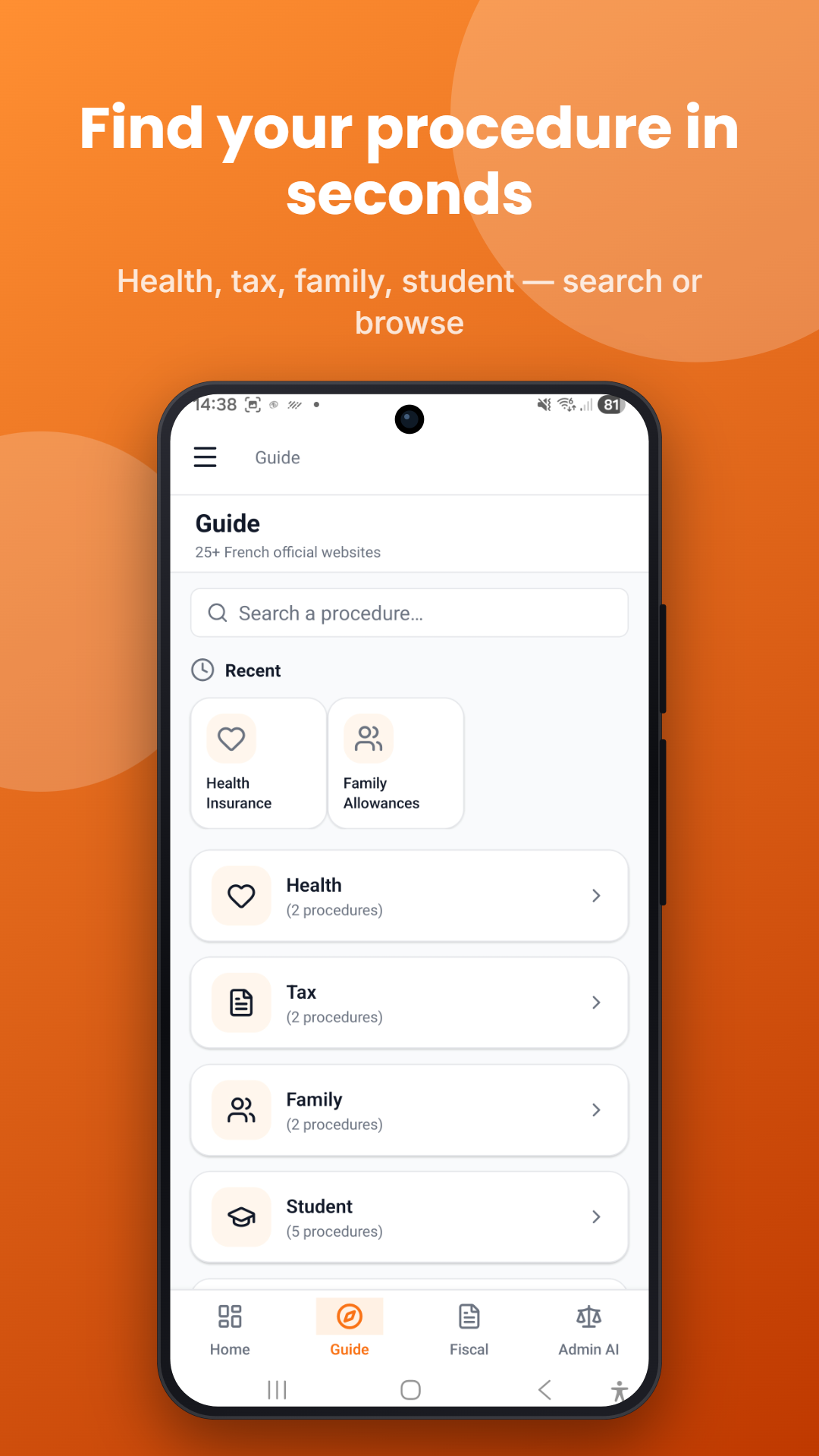
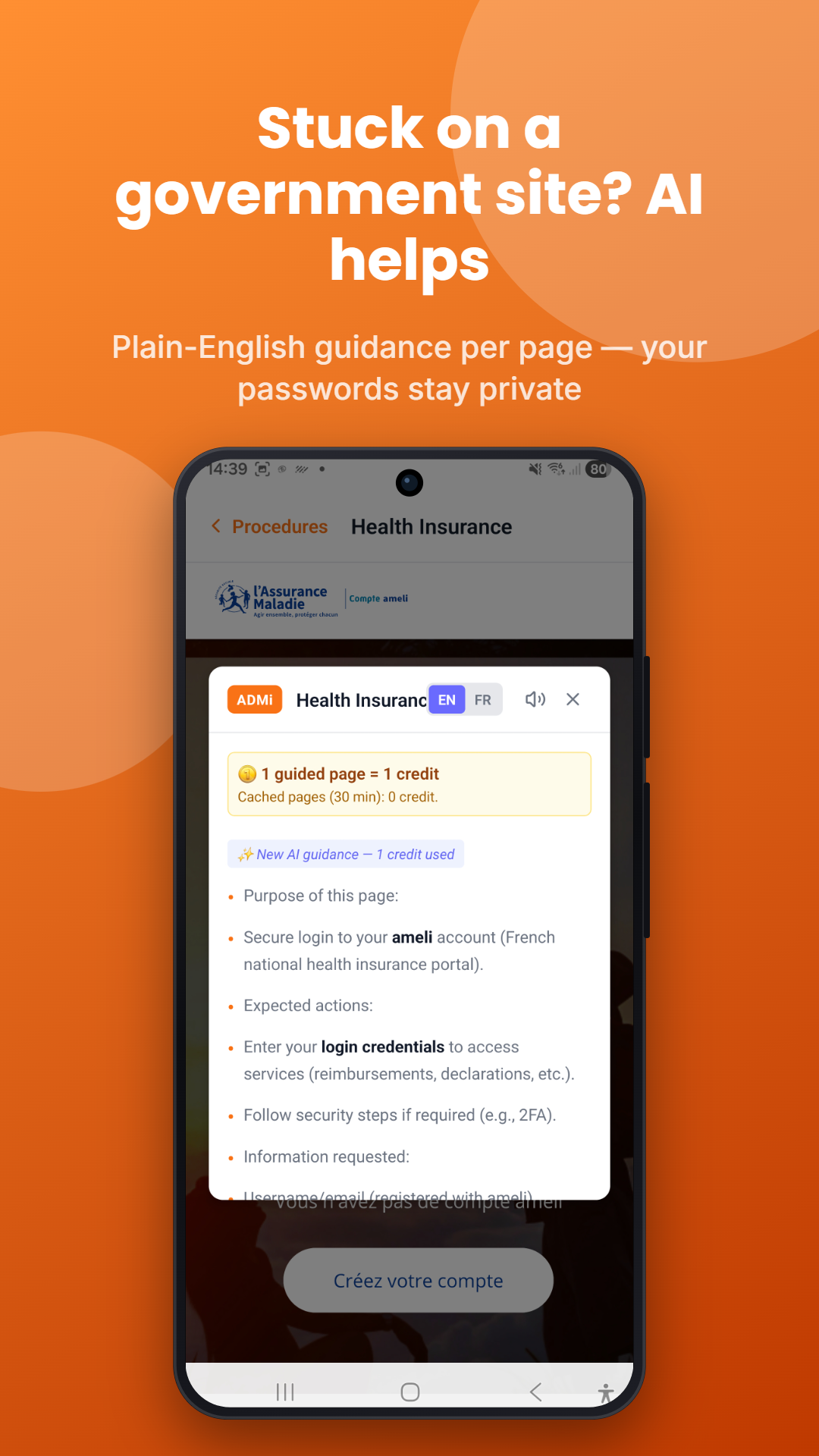
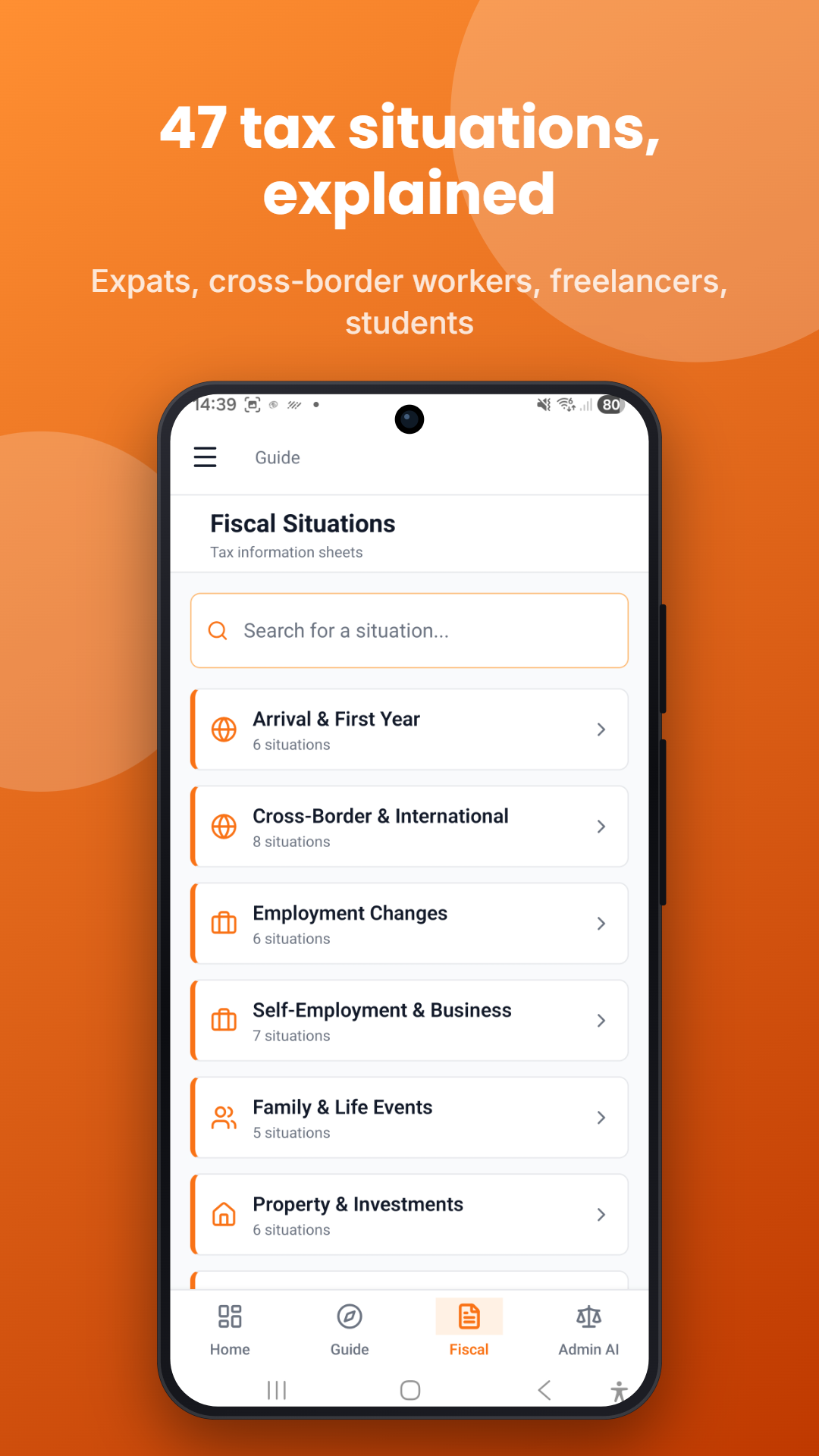
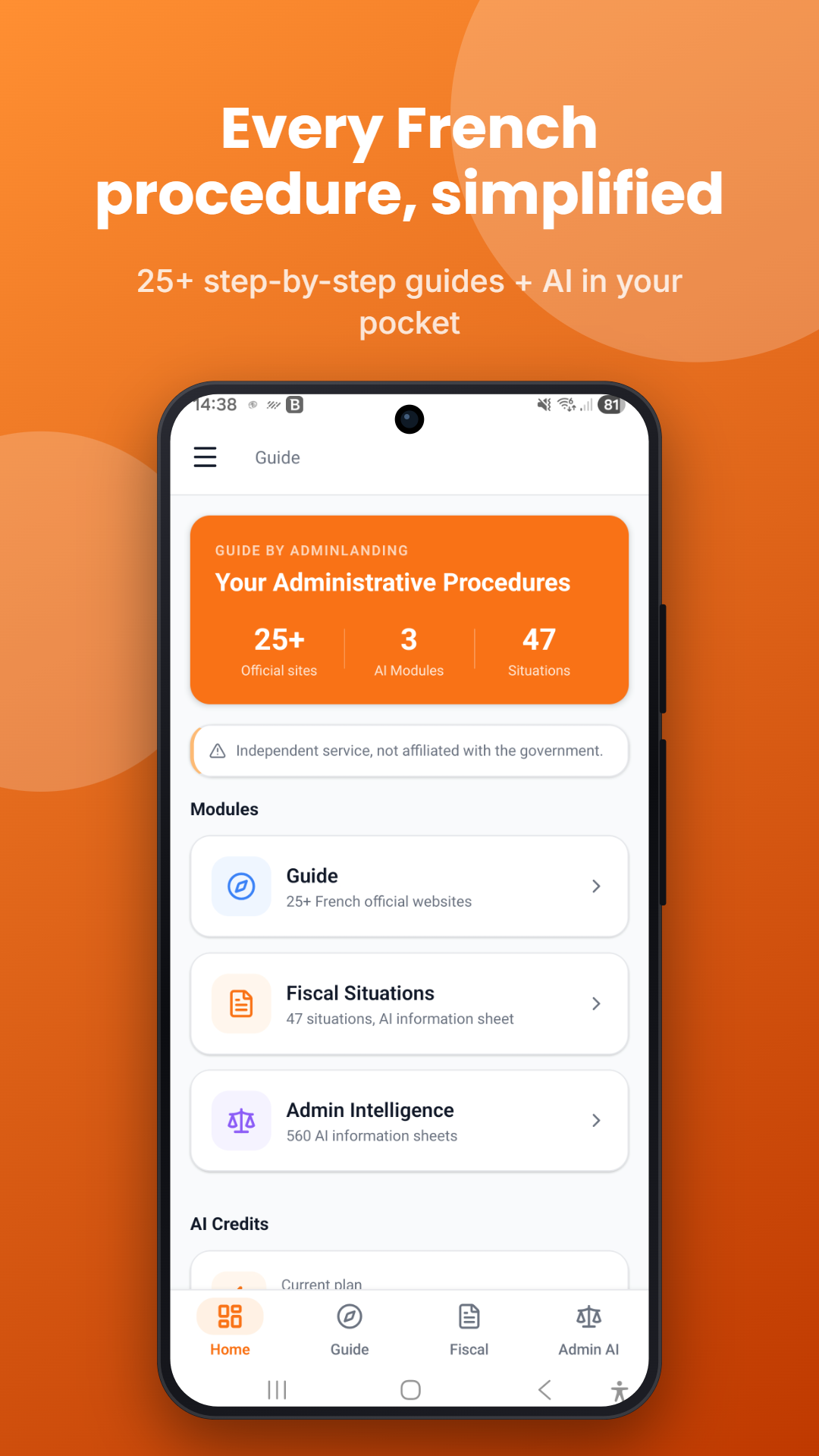
Where AdminLanding fits. The whole CPAM workflow — finding your CPAM, filling S1106, declaring a médecin traitant, handling a département change, requesting CSS — happens on ameli.fr. Guide: Démarches en France is a Chrome extension and Android app that sits on top of ameli.fr and annotates every field, in English or French, in real time. It explains what each S1106 box means in plain English, flags which document is missing from your dossier, walks through the médecin traitant declaration, and never sends your data to a server (annotations are rendered locally). You can grab it as a Chrome extension or a mobile app on Google Play or App Store, or read the full feature page at adminlanding.com/guide-ia. For frontaliers comparing French and Swiss systems, see also our LAMal vs CMU guide; for a broader European overview, the European healthcare overview covers the cross-country picture.

Frequently Asked Questions

Who is entitled to French public health insurance?

Under Article L160-1 of the Code de la Sécurité Sociale, anyone working in France or — when not professionally active — residing in France in a stable and regular manner is entitled to PUMA, the Protection Universelle Maladie. 'Stable' means at least 3 consecutive months of residence for non-workers (workers covered through their employer are exempt from the delay). 'Regular' means the residence is lawful: EU/EEA/Swiss citizens by default, non-EU citizens with a valid titre de séjour or VLS-TS. Asylum seekers are covered from the date of their asylum application as a specific exception.

How long does it take to get a carte vitale?

The carte vitale is issued in 2 to 3 weeks after the CPAM validates your dossier. Online requests via the espace assuré on ameli.fr are typically the fastest path; postal requests can stretch to 3-4 weeks. If you do not receive the card within 4 weeks, log into your espace assuré → 'Mes démarches' to track the request, or call 3646 (free from a French line, Mon-Fri 08:30-17:30). While you wait, the *attestation provisoire de droits* (downloadable from your espace assuré) acts as proof of coverage and is accepted by doctors and pharmacies.

Which documents do I need to register with CPAM?

The mandatory list: form S1106 (Cerfa 15763*02), valid passport or national ID (titre de séjour for non-EU), full birth certificate less than 12 months old (translated by a sworn translator if not in French, with apostille for non-treaty countries), a justificatif de domicile less than 3 months old (utility bill, rent receipt, or attestation d'hébergement + host's ID and bill), and a RIB of a French or SEPA bank account in your name. If you have a salaried job, add your latest payslip and an attestation employeur. If you're inactive, add 3 successive bills proving 3 months of stable residence. Send copies, not originals.

How do I find my local CPAM?

Go to ameli.fr → 'Adresses et contacts' → enter your postal code. The site returns the postal address and contact details of the CPAM that covers your département. Each French département has exactly one CPAM (101 in total nationwide). Your CPAM is determined by your home address, not your nationality, employer, or previous coverage. If you live in Versailles for instance, your CPAM is the CPAM des Yvelines. Sending your dossier to the wrong CPAM will get it returned 6-8 weeks later — always verify before posting.

What is a médecin traitant and is it mandatory?

The médecin traitant is your designated reference doctor — usually a *médecin généraliste*. Declaring one is mandatory from age 16 under the *parcours de soins coordonnés* introduced by the 13 August 2004 reform. The declaration is made via Cerfa 12485*03 (also called S3704), co-signed by you and the doctor, then transmitted to your CPAM (often electronically by the doctor during your first appointment). Without a declared médecin traitant, the CPAM reimbursement rate on consultations 'hors parcours de soins' drops from 70% to 30% — a 40-percentage-point penalty — and dépassements d'honoraires are no longer covered by your mutuelle.

Do I need a mutuelle on top of CPAM?

Practically yes — fewer than 5% of French residents are without one. PUMA covers the *tarif de convention* (typically 70% on doctor visits, 80% on hospitalisation, 60% on prescription drugs), but the remaining *ticket modérateur*, the €20/day forfait journalier hospitalier, and *dépassements d'honoraires* fall on you. A mutuelle complémentaire bridges that gap. Since 1 January 2016 (loi ANI 2013), every private-sector employer must offer a mutuelle d'entreprise and fund at least 50% of the premium. If your household revenue is below ~€10,166/year, you qualify for the Complémentaire Santé Solidaire (CSS), free or low-cost public mutuelle coverage. Apply via your espace assuré on ameli.fr.

Can students register with CPAM?

Yes — and since the rentrée 2019 reform, the process is automatic. The separate *régime étudiant* (run by LMDE and SMEREP until 2018) was abolished; students are now affiliated to the régime général de la Sécurité Sociale (CPAM) when they enroll at a French university. EU/EEA/Swiss students can use their EHIC (European Health Insurance Card) for short stays under 3 months. For longer stays, the university transmits the enrolment data to the CPAM, which assigns a numéro de Sécurité Sociale and creates the espace assuré on ameli.fr. Non-EU students need a student visa (VLS-TS) and pay a one-time *Contribution Vie Étudiante et de Campus* (CVEC) at enrolment.

What happens if I move to a new département in France?

If you move within the same département, simply update your postal address in your espace assuré on ameli.fr — takes 5 minutes. If you move to a different département, you must request a *transfert de dossier*: log into your espace assuré → 'Mes démarches' → 'Signaler un changement d'adresse'. The system flags the new postal code and triggers an internal transfer from your old CPAM to the new one. Your numéro de Sécurité Sociale and your carte vitale do not change. Reimbursements may pause for 2-4 weeks during the transfer, after which they resume from the new CPAM. Update your médecin traitant if you've moved out of geographic range — easy via a new Cerfa 12485*03.

Stay updated

For more practical insights on this topic, explore our related articles:

  • LAMal vs CMU: How to Choose Health Insurance as a Cross-Border Worker in Switzerland
  • Your Health Insurance Stopped 6 Months Ago (You Just Don't Know It Yet)
  • The Peptide Craze Is Exploding in 2025 — What Expats in Europe Need to Know Before Crossing a Legal Line
  • What Really Happens When an Expat Gets Sick in Europe - and isn't Properly Registered

Tool by AdminLanding

23 French admin sites, explained in English

Guide: Démarches en France helps you fill Ameli, CAF, impots.gouv, France Travail, ANTS forms field-by-field. Procedure cards, chat support, bilingual EN/FR. Free Chrome extension; AI features use 5 free credits/month, top-up packs available.

Try Guide: Démarches en France

Conclusion: CPAM registration is not difficult because the rules are unfair — it's difficult because the forms are dense, ameli.fr is in French only, and nothing on the official pages is written for someone arriving from abroad. Pick the right path for your situation (worker / inactive / student / pensioner), gather the documents in the verified order above, post the dossier by lettre recommandée, then create your espace assuré once the CPAM has assigned your numéro definitif. Within 2 to 3 weeks of validation you'll have your carte vitale; within a month of that, your first reimbursement should land. If a single field on ameli.fr or S1106 stops you, Guide: Démarches en France annotates every box in plain English. Start the dossier this week — 3-month residency starts counting from arrival, not from the day you remember to file.

Tool by AdminLanding

23 French admin sites, explained in English

Guide: Démarches en France helps you fill Ameli, CAF, impots.gouv, France Travail, ANTS forms field-by-field. Procedure cards, chat support, bilingual EN/FR. Free Chrome extension; AI features use 5 free credits/month, top-up packs available.

Try Guide: Démarches en France→

Stay Updated

1 tip per week, no spam.

About the author:

Julien Maurice is the founder of AdminLanding and writes the editorial guides on ExpatAdminHub covering European expat life, France-Switzerland cross-border work, and French administrative procedures. Contact: [email protected]

Related posts

LAMal vs CMU: How to Choose Health Insurance as a Cross-Border Worker in Switzerland
Healthcare•March 28, 2026

LAMal vs CMU: How to Choose Health Insurance as a Cross-Border Worker in Switzerland

If you live in France and work in Switzerland, you must choose between the Swiss LAMal system and the French CMU (now PUMa) within three months of starting work. This decision has long-term financial and practical consequences — here is what you need to know to make the right call.

Read the article
Your Health Insurance Stopped 6 Months Ago (You Just Don't Know It Yet)
Healthcare•January 8, 2026

Your Health Insurance Stopped 6 Months Ago (You Just Don't Know It Yet)

Your health coverage didn't end the day you moved. It ended quietly. Months ago. Everything looked fine. Your card was still in your wallet. No warnings arrived. Then came the doctor visit, the pharmacy bill, the reimbursement refusal. That's when you discovered the truth: you've been uninsured for months. This isn't negligence. It's how European health systems work. This article shows why coverage gaps hit thousands of expats, why no one warns you, and how you end up uninsured without ever deciding to be.

Read the article
The Peptide Craze Is Exploding in 2025 — What Expats in Europe Need to Know Before Crossing a Legal Line
Healthcare•December 21, 2025

The Peptide Craze Is Exploding in 2025 — What Expats in Europe Need to Know Before Crossing a Legal Line

Search trends in late 2025 tell a clear story: peptides, experimental therapies, and so-called ‘next-generation recovery compounds’ are exploding in popularity. Names like ‘Wolverine peptide’ circulate widely on social media, podcasts, and private groups, often framed as revolutionary shortcuts to healing, longevity, or performance. For expats living in Europe, this trend raises a far more serious question than effectiveness: what is actually legal, tolerated, or risky under European healthcare and regulatory systems? In 2025, misunderstanding this line can expose expats to medical, legal, and administrative consequences that few anticipate.

Read the article