
ExpatAdminHubEuropean expat guide
FR
Menu▾
HomePrivacyCookiesAboutContact
All guidesPreparationHousingFinanceHealthcareWorkFamily
ExpatAdminHubEuropean expat guide
HomePrivacyCookiesAboutContact
Categories
All guidesPreparation (checklists, visas, moving)Housing (rentals, utilities, neighborhoods)Finance (banking, taxes, budgeting)Healthcare (insurance, doctors, pharmacies)Work (jobs, contracts, work permits)Family (schools, childcare, family life)Culture (language, customs, integration)
FR

ExpatAdminHub

Practical guides for European expats navigating admin, housing, healthcare, and everyday life abroad.

Navigation

HomeAboutContactPrivacyTermsSitemap

Stay Updated

1 tip per week, no spam.

© 2026 ExpatAdminHub · European expat guide.
FR
  1. Home
  2. Blog
  3. Healthcare
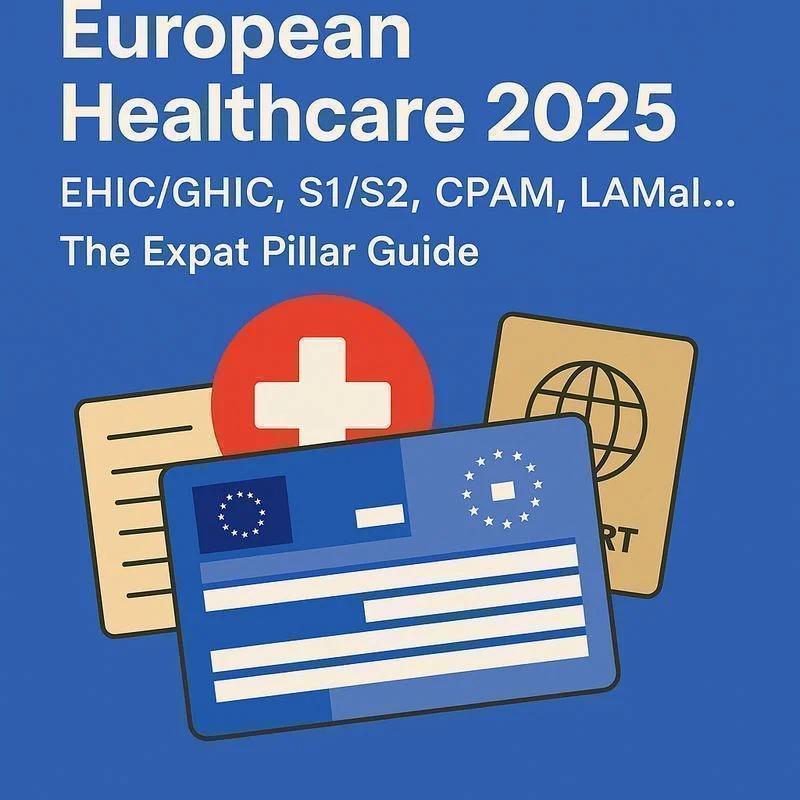
  4. Healthcare for European expats: EHIC, S1, local registration and private cover (2026 guide)
Healthcare for European expats: EHIC, S1, local registration and private cover (2026 guide)

Healthcare for European expats: EHIC, S1, local registration and private cover (2026 guide)

Published October 9, 2025

Health coverage in Europe is one of the few rights that does *not* automatically follow your passport — it follows your registered residence, your employment status, and how long you intend to stay. A British retiree in Spain, a Dutch freelancer in Berlin and a French employee on a 6-month assignment in Italy are governed by three different sets of EU regulations and three different reimbursement timelines. This guide walks through the four most common situations, the documents each one demands, and the order in which to do things so you are never uninsured between two systems. It is not exhaustive country-by-country (each national system has its own quirks) but it is the framework that applies under Regulation (EC) 883/2004 — the EU coordination of social-security regulation that every EU/EEA/Swiss country implements.

Decision tree: which route applies to you

Before any paperwork, identify which of four buckets you fall into. Most people will recognise their situation in one of the four:

• Stay under 12 months + insured at home → EHIC is usually sufficient for *necessary* care (sudden illness, injury, ongoing treatment of chronic conditions). Bring the EHIC and your home insurer's number to every appointment. Examples: a UK student doing one year of Erasmus in Lyon, a German consultant on a 9-month project in Madrid.

• Employee in the host country → register in the local public system ([Ameli](/en/blog/2026-04-26-cpam-ameli-registration-guide-expats-france) in France, Krankenkasse in Germany, Seguridad Social in Spain, INPS+SSN in Italy, ZUS+NFZ in Poland, etc.). Your employer files the initial enrolment within days of your start date; you complete the personal registration afterwards with your address and bank details. Until your insurance number is issued (4–12 weeks), keep your EHIC for emergencies.

• Pensioner / cross-border worker with S1 → the S1 portable document is requested *from your home insurer* before you move, and presented to the host-country health authority on arrival. The host system treats you as if you were locally insured; the home insurer reimburses the host state. A French retiree settling in Portugal, a Belgian frontalier working in Luxembourg — both use this route.

• Freelancer, remote worker, jobseeker, early retiree without S1 → this is the awkward middle. EU rules say you must be insured *somewhere*, but the host country may not enrol you immediately if you are not yet employed there. Two options: enrol voluntarily in the host system if it allows it (France's PUMa, Spain's Convenio Especial), or carry private international insurance until you qualify for public cover.

EHIC: what it covers and what it does not

The European Health Insurance Card is free, valid 1–10 years depending on issuing country, and proves you are insured in one EU/EEA state. It entitles you to medically *necessary* state-provided care during a temporary stay — at the same cost a local resident would pay. It does not cover: private healthcare, planned treatment in another country (that requires the S2 form), repatriation, lost or stolen property, or care once you have moved your residence.

The practical limit most travellers hit: many EU countries still charge a co-payment at the point of care (around 30 % of consultation fees in France, fixed prescription contributions in Germany, regional variations in Spain) — the EHIC reimburses what the *home* system reimburses, which may be less than the host charge. Always carry a credit card to cover the gap and keep all receipts for later claim. UK nationals: the GHIC (UK Global Health Insurance Card) replaces the EHIC post-Brexit and covers the EU/EEA but not Switzerland or Norway.

S1 portable document — the underused superpower

The S1 (formerly E121) is the single most useful piece of paper for any expat who keeps a legal link to their home country: pensioners drawing a state pension, cross-border workers commuting daily, posted workers on a fixed assignment, certain civil servants. The home country's insurer issues the S1; the document is registered with the host country's health authority; from then on you are treated locally exactly like a national of the host country, with the *bill* being passed back to the home country.

The S1 must be requested *before* you move — most insurers will not back-date it. Once registered, you do not keep your home country's GP — you must pick a new GP in the host country. Keep proof of registration (a paper or PDF confirmation from the host authority) in case of disputes.

Documents to bring to your registration appointment

Bring the originals and at least one photocopy of each. Most national health offices accept digital copies on a phone for the first appointment, but the original is required at some point. Standard set:

• National ID or passport — for non-EU spouses, a valid residence permit.

• Proof of address in the host country — utility bill, rental contract, attestation d'hébergement. See our first home abroad guide on getting documented proof of address.

• Employment contract OR S1 portable document OR proof of voluntary residency for self-employed/inactive applicants.

• Birth certificate (international or sworn-translated copy) — needed in France, Italy, Portugal for the initial file.

• Bank account details (IBAN/BIC) for reimbursements. See our European bank account guide for setting this up.

• Vaccination record for any children — most schools also require this separately.

• Marriage certificate if registering a non-working spouse as a dependant.

File size matters in some countries. France's Ameli accepts up to 4 MB per document; Germany's Krankenkassen vary by insurer. If the office rejects your file for an unstated reason, ask for the reason in writing — this triggers a formal review process.

Finding a GP and the first appointment

Each national system has an official directory. France: ameli.fr → annuaire santé. Germany: kbv.de → Arztsuche. Spain: ask your CAP centre. Italy: ASL website by region. Filter for doctors *accepting new patients* (médecin traitant accepts in FR, Hausarzt without Aufnahmestopp in DE). Expect a 4-12 week wait for a first appointment in most major cities.

For the first visit, bring: ID, your new health insurance card (or temporary attestation), any prior medical records you have, your previous prescriptions in *generic* names (drug brand names vary across the EU), and a list of any allergies. Ask the GP to register you officially in the system (declarer médecin traitant in France, einschreiben in Germany) — this is the step that activates higher reimbursement rates for future visits.

Pharmacy, prescriptions and equivalents

Many drugs sold under one brand name in one EU country are sold under a different brand name in another, even though the active molecule is identical. Always carry prescriptions in generic form (e.g. *paracetamol* instead of *Doliprane* in France or *ben-u-ron* in Germany). Pharmacists in any EU country can dispense an equivalent if the prescription is generic. For chronic medication, ask your GP for a 3-month prescription before each consultation to avoid running out between appointments.

Reimbursement varies wildly: France refunds 65 % of most prescription drugs at the counter via the carte vitale; Germany has fixed-amount contributions (zuzahlung) of 5–10 € per box; Spain refunds 60–90 % depending on income. Keep every receipt — even when you think the reimbursement is automatic — for the first 12 months of any new system.

Mental health, emergencies and telemedicine

Emergency number is 112 across the entire EU, EEA and Switzerland — this is the single number that always works for ambulance, fire and police. Mental-health-specific lines vary: SOS Amitié (FR) 09 72 39 40 50, Telefonseelsorge (DE) 0800 111 0 111, Teléfono de la Esperanza (ES) 717 003 717. Most national health systems offer low-cost or free counselling through municipal centres or universities; ask your GP for a referral letter (this is the gateway to reimbursed specialist sessions in most countries).

Telemedicine has expanded rapidly across the EU since 2020. France's Doctolib, Germany's TeleClinic, Spain's MIO Salud all offer video consultations with reimbursed GPs. For expats in a job that does not match local 9-to-5 hours (remote workers across time zones, healthcare workers, etc.), telemedicine is often the realistic way to access timely care.

Common pitfalls and a starter email script

Three mistakes recur often enough that they are worth flagging explicitly:

1. Letting EHIC become your default. EHIC was designed for temporary stays. Once your stay exceeds 3 months or you start work, you are expected to register locally. National authorities can — and do — demand retroactive contributions if they discover you have been using EHIC as a long-term substitute.

2. Not declaring a primary GP. Most systems halve the reimbursement rate for non-emergency visits to a GP you have not formally registered with. The declaration is usually a single form signed at your first appointment — there is no reason to skip it.

3. Forgetting the bank-details step. Even after registration is approved, reimbursements only flow once your IBAN is on file. Many expats discover this after 3–4 unreimbursed appointments.

Starter email to the local health office (adapt as needed):

*"Hello, I have just moved to [city] from [home country] as an [employee / freelancer / pensioner / cross-border worker]. Could you confirm which office I should register with, the documents you require, and the timeline for receiving my health number? I would also like to know whether I can use my EHIC / S1 / GHIC in the interim. Thank you, [name]."*

Frequently Asked Questions

Is EHIC enough for pregnancy or chronic care?

No. EHIC covers necessary care during *temporary* stays. Pregnancy, planned surgery, ongoing oncology and most chronic-condition management qualify as long-term care and require local registration. The one exception is acute episodes of an existing chronic condition during a short stay (a sudden asthma attack while on holiday, for example) — those are EHIC-covered.

Should I take private insurance or rely on the local system?

Use private for the *gap period* between arrival and active enrolment in the local public system (typically 1–6 months). Private is fast (cover begins within days) and covers private hospitals. Local public is the sustainable solution once you qualify — cheaper, broader and the route to long-term care. Most expats end up with both for a short period.

How long does it take to get a health insurance number after registration?

France: 4–12 weeks for the carte vitale, but a temporary attestation is usable from day one. Germany: 2–6 weeks for the Versichertenkarte. Spain: 4–8 weeks for the tarjeta sanitaria. Italy: 2–4 weeks for the tessera sanitaria. Plan to keep EHIC or private cover during this window.

Can my non-working spouse and children be covered under my registration?

Yes in nearly every EU/EEA country, via the *dependant* (ayant droit) status. The non-working spouse and minor children are added to your file with their birth/marriage certificates. The procedure is initiated at your local health office, not separately. Adult children studying may need their own student-status enrolment.

What if I work in country A but live in country B?

You are a cross-border worker — Regulation 883/2004 covers exactly this case. You are insured in the country where you *work* (country A) but receive care in the country where you *live* (country B) via the S1 portable document issued by A's insurer. See our <a href="/en/blog/2025-10-24-france-switzerland-cross-border-work">France-Switzerland cross-border worker guide</a> for the detailed mechanics of the most common cross-border case in Europe.

Stay updated

For more practical insights on this topic, explore our related articles:

  • CPAM & Ameli Registration in France: Step-by-Step Guide for Expats (Sécurité Sociale 2026)
  • LAMal vs CMU: How to Choose Health Insurance as a Cross-Border Worker in Switzerland
  • Your Health Insurance Stopped 6 Months Ago (You Just Don't Know It Yet)
  • The Peptide Craze Is Exploding in 2025 — What Expats in Europe Need to Know Before Crossing a Legal Line

Tool by AdminLanding

25+ French admin sites, explained in English

Guide: Démarches en France helps you fill Ameli, CAF, impots.gouv, France Travail, ANTS forms field-by-field. Procedure cards, chat support, bilingual EN/FR. Free Chrome extension; AI features use 5 free credits/month, top-up packs available.

Try Guide: Démarches en France

Conclusion: Health coverage in Europe is portable but rarely automatic. The three rules that save the most time and money: register locally as soon as employment or residence starts, declare a primary GP, and put your IBAN on file before you need a reimbursement. Once those three are in place, daily access to care looks the same as for a national of the host country — and you can stop carrying receipts around in your wallet.

Tool by AdminLanding

25+ French admin sites, explained in English

Guide: Démarches en France helps you fill Ameli, CAF, impots.gouv, France Travail, ANTS forms field-by-field. Procedure cards, chat support, bilingual EN/FR. Free Chrome extension; AI features use 5 free credits/month, top-up packs available.

Try Guide: Démarches en France→

Stay Updated

1 tip per week, no spam.

About the author:

Julien Maurice is the founder of AdminLanding and writes the editorial guides on ExpatAdminHub covering European expat life, France-Switzerland cross-border work, and French administrative procedures. Contact: [email protected]

Related posts

CPAM & Ameli Registration in France: Step-by-Step Guide for Expats (Sécurité Sociale 2026)
Healthcare•April 25, 2026

CPAM & Ameli Registration in France: Step-by-Step Guide for Expats (Sécurité Sociale 2026)

Any person stably and regularly residing in France for at least 3 months is entitled to French public health insurance under the Protection Universelle Maladie (PUMA), codified in Article L160-1 of the Code de la Sécurité Sociale. That sentence sounds simple — and yet, every single week, expats arriving in Paris, Lyon, Lille or Annemasse get stuck in the same loop: which CPAM should I apply to, which form opens my rights, what counts as a justificatif de domicile, why has my dossier been silent for ten weeks, when does the carte vitale actually arrive? PUMA replaced [CMU](/en/blog/2026-03-28-lamal-vs-cmu-health-insurance-cross-border-worker) in 2016, the student régime étudiant disappeared in 2019, the espace assuré on ameli.fr was redesigned in 2024, and not a single official page is written for someone whose first language isn't French. This guide walks through every stage of the CPAM registration in plain English: who qualifies and through which scheme, the exact list of supporting documents, how to fill form S1106, the carte vitale timeline, the médecin traitant declaration, and the five mistakes that delay coverage by months. By the end, you'll know exactly what to send, where, and what to expect back.

Read the article

LAMal vs CMU: How to Choose Health Insurance as a Cross-Border Worker in Switzerland
Healthcare•March 28, 2026

LAMal vs CMU: How to Choose Health Insurance as a Cross-Border Worker in Switzerland

If you live in France and work in Switzerland, you must choose between the Swiss LAMal system and the French CMU (now PUMa) within three months of starting work. This decision has long-term financial and practical consequences — here is what you need to know to make the right call.

Read the article
Your Health Insurance Stopped 6 Months Ago (You Just Don't Know It Yet)
Healthcare•January 8, 2026

Your Health Insurance Stopped 6 Months Ago (You Just Don't Know It Yet)

Your health coverage didn't end the day you moved. It ended quietly. Months ago. Everything looked fine. Your card was still in your wallet. No warnings arrived. Then came the doctor visit, the pharmacy bill, the reimbursement refusal. That's when you discovered the truth: you've been uninsured for months. This isn't negligence. It's how European health systems work. This article shows why coverage gaps hit thousands of expats, why no one warns you, and how you end up uninsured without ever deciding to be.

Read the article