
ExpatAdminHubEuropean expat guide
FR
Menu▾
HomePrivacyCookiesAboutContact
All guidesPreparationHousingFinanceHealthcareWorkFamily
ExpatAdminHubEuropean expat guide
HomePrivacyCookiesAboutContact
Categories
All guidesPreparation (checklists, visas, moving)Housing (rentals, utilities, neighborhoods)Finance (banking, taxes, budgeting)Healthcare (insurance, doctors, pharmacies)Work (jobs, contracts, work permits)Family (schools, childcare, family life)Culture (language, customs, integration)
FR

ExpatAdminHub

Practical guides for European expats navigating admin, housing, healthcare, and everyday life abroad.

Navigation

HomeAboutContactPrivacyTermsSitemap

Stay Updated

1 tip per week, no spam.

© 2026 ExpatAdminHub · European expat guide.
FR
  1. Home
  2. Blog
  3. Culture
  4. Europe's Most Affordable Hidden Cities for Expats in 2025
Europe's Most Affordable Hidden Cities for Expats in 2025

Europe's Most Affordable Hidden Cities for Expats in 2025

Published November 28, 2025

Europe remains a dream destination for expats, but major capitals have become unaffordable. With inflation, record-high rents and crowded labour markets, many foreigners now look for smaller, human-scale cities that remain affordable. This guide looks at the hidden cities that offer the ideal balance in 2025: quality of life, manageable costs, safety, strong infrastructure and a growing international community.

1) Why look beyond the big capitals in 2025

Major European metropolises such as Paris, Zurich, Amsterdam, Dublin and Berlin have become extremely expensive for newcomers. Rents have jumped, local labour markets are crowded and public support rarely compensates.

More and more expats are therefore looking for smaller, human-scale cities that still offer serious infrastructure. In practice, they want:

  • rent they can actually pay on a long-term basis (often around €700–€900 for a one- or small two-bedroom, sometimes less outside the centre);
  • reliable healthcare with clear rules for foreigners;
  • international or bilingual schools that do not absorb the entire family budget;
  • access to nature or at least pleasant public spaces and culture;
  • high-quality internet and coworking options for remote work;
  • tax rules they can understand and plan around.

This article focuses on five cities that, in 2025, offer a tangible balance between budget and quality of life. For a broader view of the current shocks around housing and healthcare, you can also read Expat housing shock in Europe 2025–2026 and Europe's health gap for expats.

2) Porto, Portugal – Lisbon's realistic alternative

Lisbon has turned into one of the most expensive cities on the continent. Porto, smaller and still more affordable, is increasingly the go-to choice for newcomers.

Why Porto:

  • usually around 30 to 45 per cent cheaper than Lisbon on rent;
  • mild Atlantic climate with short winters;
  • fibre broadband widely available, including in many older neighbourhoods;
  • Portugal's D7 and digital-nomad schemes remain attractive for eligible profiles;
  • a fast-growing but still accessible international community.

Typical monthly budget:

  • one-bedroom or small two-bedroom in the centre: roughly €900–€1,100;
  • similar flat outside the centre: about €700–€850;
  • lunch menu: around €10–€13;
  • public transport pass: roughly €30–€40 per month.

Best suited for:

  • remote workers and freelancers who can pick their European base;
  • active retirees who want a mild climate and manageable healthcare costs;
  • creatives who prefer a lively but less saturated city than Lisbon.

If you are considering a nomad or multi-country lifestyle with Porto as a base, combine this with Digital nomads 2025: new tax and visa rules.

3) Valencia, Spain – sun, safety and reasonable rents

Valencia has become one of Spain's most attractive cities for expats. It is cheaper than Barcelona, more manageable day-to-day than Madrid and still very international.

Key strengths:

  • wide network of international and bilingual schools;
  • fast access to the beach and large urban parks;
  • very solid safety perception;
  • cost of living still moderate compared with many Western European cities.

Indicative costs:

  • rent for a one- or small two-bedroom flat: about €750–€950 depending on area;
  • fibre internet subscription: around €30 per month;
  • strong public healthcare for residents, plus a dense private sector for those who want extra flexibility.

Valencia is particularly attractive for:

  • families with school-age children;
  • international students;
  • entrepreneurs and remote workers seeking sun, culture and airport connections.

For a country-level view of housing, healthcare and taxes in Spain, read Expats in Spain 2025: housing, healthcare, taxes.

4) Wrocław, Poland – Central Europe's rising tech hub

Wrocław is still less famous than Warsaw or Kraków, but it has quietly become one of Central Europe's most dynamic tech centres. It combines a beautiful historical core with a strong job market and a cost of living far below that of Western Europe.

What drives its growth:

  • a dense ecosystem of multinational companies and service centres;
  • a large community of developers, engineers and IT profiles;
  • rents still much lower than in Germany or the Netherlands for a comparable level of infrastructure;
  • a generally high feeling of safety for both families and young professionals.

Typical costs:

  • monthly rent for a one- or two-bedroom flat: roughly €600–€750 depending on location;
  • going out, food and services significantly cheaper than in Western capitals.

Wrocław is a strong option for:

  • engineers, developers and data professionals;
  • young professionals who want a lively city without capital-city prices;
  • remote workers employed by companies in other EU countries.

If you work across borders or for a foreign employer, you may also find Working remotely across borders in the EU useful.

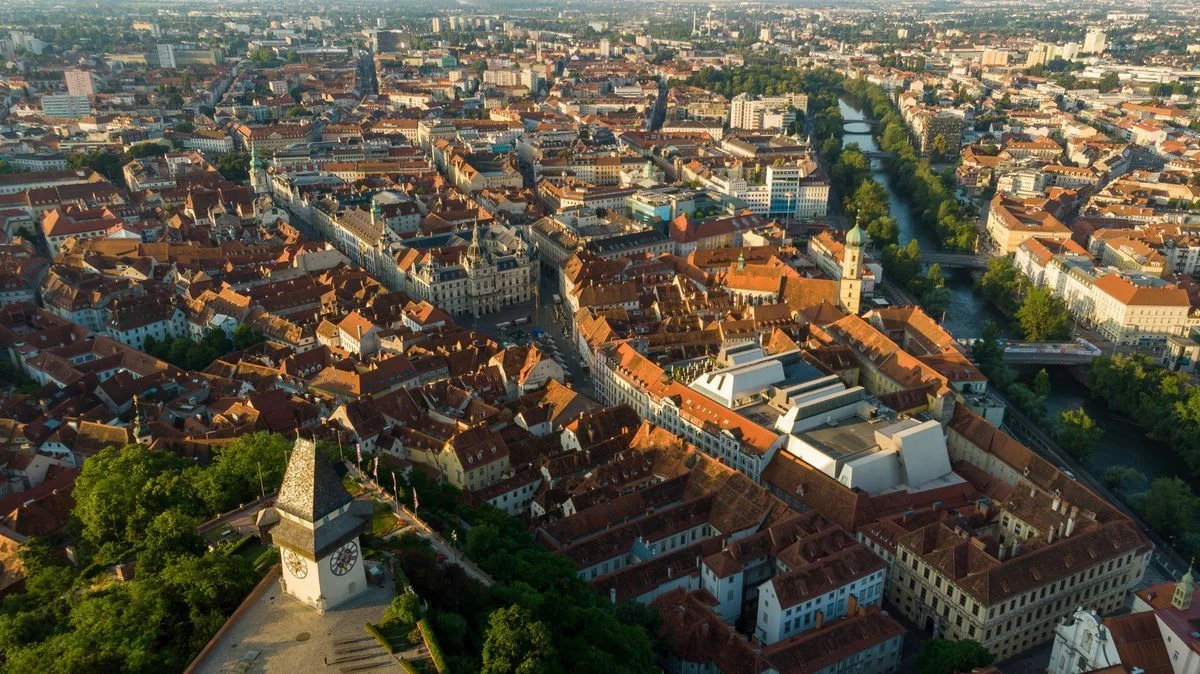
5) Graz, Austria – Vienna-level services without Vienna prices

Vienna regularly tops global quality-of-life rankings, but prices and housing pressure are rising. Graz, Austria's second city, offers a softer alternative while keeping most of the advantages: infrastructure, culture and safety.

Highlights:

  • one of Europe's strongest healthcare systems, accessible through Austrian health insurance;
  • a clean, very green city with plenty of parks and nearby nature;
  • reliable public transport and a walkable centre;
  • a strong presence of universities and international schools, which supports a stable expat and student community.

Indicative costs:

  • typical rent for a two-bedroom flat: around €850–€1,050 depending on area;
  • top-up health insurance for some profiles: often about €60–€80 per month.

Graz works particularly well for:

  • families looking for stability, schools and a safe environment;
  • active retirees who want a calm but urban lifestyle;
  • researchers and higher-education professionals.

To understand how health coverage and residence rules interact across the EU, you can pair this with European healthcare 2025 and EU residency changes 2025.

6) Cluj-Napoca, Romania – Europe's next Tallinn?

Cluj-Napoca has moved from a mostly local university city to a serious regional tech and startup hub. It offers a young, energetic atmosphere and very competitive prices.

Main advantages:

  • very fast fixed and mobile internet, including in residential areas;
  • low overall cost of living, especially for food and everyday services;
  • a booming startup and coworking scene;
  • a large student population and a generally warm welcome for foreigners.

Typical budget:

  • rent for a one- or two-bedroom flat: about €500–€650;
  • a restaurant meal: roughly €7–€10 for a simple menu.

Cluj is an excellent fit for:

  • developers and digital nomads on a tighter budget;
  • entrepreneurs who want to test projects with lower fixed costs;
  • young professionals who want a lively, youthful city.

For everyday working-life inspiration (even if focused on France), you can also look at Coworking for expats 2025.

7) Quick comparison of the five cities

As a snapshot, the table below summarises some of the key elements mentioned above. Figures are indicative only and will vary by neighbourhood and season.

City1–2 bedroom in centreInternetHealthcareInternational schoolsSafety
-----------------------------------------------------------------------------------
Porto€900–€1,100ExcellentVery goodMedium offerGood
Valencia€750–€950ExcellentExcellentLarge choiceVery good
Wrocław€600–€750Very goodGoodSome optionsVery good
Graz€850–€1,050ExcellentExcellentMany optionsExcellent
Cluj€500–€650ExcellentBasic to goodFew optionsGood

Use this as a starting point, then refine with your own criteria and on-the-ground research.

8) How to choose the right city for you

Instead of chasing whichever city is trending on social media, take time to map your real constraints and priorities:

  • Do you need international or bilingual schools immediately, or only later?
  • Is your job fully remote, hybrid, or anchored to a local employer?
  • What is your realistic monthly budget once you include housing, healthcare, transport and a buffer?
  • How important are the sea, mountains, airports, rail connections or a quieter medium-sized town?
  • Do you feel more at home in Latin, German-speaking or Central/Eastern European environments?

In short:

  • a flexible remote worker will often prioritise Porto or Valencia;
  • a tech engineer or developer may naturally gravitate towards Wrocław or Cluj;
  • a family with school-age children may find Graz or Valencia more straightforward.

For a broader first-year roadmap that covers budget, paperwork and belonging, see First year abroad: budget, paperwork, belonging.

9) 2026 trends: why timing matters

All available signals suggest that these opportunities will not stay unchanged for long:

  • Porto is likely to feel close to saturated by 2026 if demand keeps rising;
  • Valencia is already seeing rising rents and stronger competition for good flats;
  • Wrocław and Cluj are moving up fast on the radar of companies and remote workers;
  • Graz should remain stable but increasingly perceived as a premium, family-friendly city.

The best moment to secure a place in these ecosystems is often before the big wave, not after it. If you have a concrete project for the next 12 to 24 months, now is the time to refine your criteria, build a realistic budget, check your residency options and prepare housing and healthcare paperwork, using guides such as EU residency changes 2025 as a reference.

Frequently Asked Questions

Which city is cheapest in this list?

Cluj-Napoca is generally the most affordable, with one- or two-bedroom flats starting around €500 per month in some neighbourhoods.

Which city is best for families?

Graz and Valencia usually offer the best overall mix of schools, healthcare, safety and daily-life infrastructure, which makes them strong candidates for families.

Stay updated

For more practical insights on this topic, explore our related articles:

  • The Dark Side of ‘Expat Freedom’ in Europe — What Social Media Never Shows
  • Is Europe Becoming Harder for Expats in 2025? The Reality Behind the Headlines
  • AI vs European Bureaucracy: Who Will Win by 2026 — And What It Means for Expats
  • Why So Many Expats Leave Europe After 2–3 Years — And Why Others Stay for Life

Conclusion: Europe is changing, and its secondary cities are becoming the new expat capitals. More affordable, more human, but just as connected, they offer a realistic alternative for a balanced life. If you are planning a move in 2025, these cities are among your best bets.

Stay Updated

1 tip per week, no spam.

About the author:

Related posts

The Dark Side of ‘Expat Freedom’ in Europe — What Social Media Never Shows
Culture•December 23, 2025

The Dark Side of ‘Expat Freedom’ in Europe — What Social Media Never Shows

Scroll through social media and the image is irresistible: laptops on balconies, café workdays, slow mornings, spontaneous travel, and a life seemingly free from constraints. Europe is often portrayed as the ultimate playground for expat freedom — especially for remote workers, freelancers, and mobile professionals. Yet behind the curated images lies a reality few talk about openly. Freedom, in Europe, is conditional. And for many expats, the cost of that freedom only becomes visible months or years after arrival. This article explores the dark side of the ‘expat freedom’ narrative — not to discourage relocation, but to replace illusion with clarity.

Read the article


Is Europe Becoming Harder for Expats in 2025? The Reality Behind the Headlines
Culture•December 18, 2025

Is Europe Becoming Harder for Expats in 2025? The Reality Behind the Headlines

Scroll through expat forums, social media, or headlines in late 2024 and one narrative dominates: Europe is becoming harder for expats. Visas are stricter. Taxes are higher. Bureaucracy is heavier. Benefits are harder to access. Many newcomers arrive already convinced that Europe has closed in on itself. Yet at the same time, millions of expats continue to settle, integrate, and build long-term lives across the continent. So which version is true? In 2025, is Europe genuinely becoming more hostile to expats — or is something more subtle happening beneath the surface?

Read the article
AI vs European Bureaucracy: Who Will Win by 2026 — And What It Means for Expats
Culture•December 17, 2025

AI vs European Bureaucracy: Who Will Win by 2026 — And What It Means for Expats

European bureaucracy has survived wars, currency changes, digital revolutions, and decades of reform attempts. It is slow, resilient, and deeply embedded in legal culture. Artificial intelligence, on the other hand, moves fast, adapts instantly, and thrives on complexity. As Europe accelerates its digital transformation, a quiet confrontation is taking place: not AI replacing administrations, but AI reshaping how people survive them. By 2026, this shift will profoundly change the expat experience. The question is no longer whether AI will interact with bureaucracy — but who will control the interaction.

Read the article